
The most popular advice about PRP injections is to try them when ordinary treatment hasn't worked. That's too broad. Failure of another treatment doesn't establish that PRP will help, and using your own blood doesn't make an uncertain procedure good value.
Are PRP injections worth it? Sometimes, for a specific diagnosis and a defensible treatment protocol. The useful question isn't whether PRP is regenerative. It's whether the proposed injection offers enough additional, patient-noticeable improvement to justify its cost, inconvenience, and uncertainty compared with your next best option.
Table of Contents
- Are PRP Injections Worth It by Diagnosis
- Knee Osteoarthritis Numbers That Change the Bet
- PRP Versus Steroid, Hyaluronic Acid, and Rehab
- Real Cases Where the Spend Does or Does Not Pay
- Self-Pay Cost and the Break-Even Test
- Patient Selection and the Evaluation Before You Pay
Are PRP Injections Worth It by Diagnosis
Selected knee osteoarthritis is a more defensible elective use than Achilles tendinopathy. Between those conditions sit several possibilities where the decision requires closer attention to the diagnosis, completed rehabilitation, and treatment goals.
A condition-specific review of PRP describes potential clinically meaningful benefit for selected mild-to-moderate knee and hip osteoarthritis, plantar fasciitis, degenerative rotator-cuff disease, and trochanteric tendinopathy, with improvement sometimes emerging around 8–16 weeks, rather than immediately. That's a broad observation about the reviewed conditions, not a reliable onset promise for every row below.
PRP worth-it snapshot by diagnosis
| Condition | Evidence lean | Typical onset | Reasonable when |
|---|---|---|---|
| Mild to moderate knee osteoarthritis | Favorable in some pooled comparisons; less convincing against rigorous placebo controls | Delayed improvement, if effective | Pain persists after strengthening, appropriate weight management, and activity change |
| Hip osteoarthritis | Promising, but limited by trial size and preparation differences | A dependable condition-specific onset isn't established | Conventional care hasn't provided enough relief and expectations stay modest |
| Plantar fasciitis | Potentially meaningful benefit in condition-specific reviews | Gradual rather than immediate | Loading, footwear changes, and calf work haven't been enough |
| Degenerative rotator-cuff disease | Potential benefit for selected degenerative tendon disease | Gradual rather than immediate | The tendon is the pain source and surgery isn't the indicated next step |
| Trochanteric tendinopathy | Potential benefit for gluteal tendon pain | Gradual rather than immediate | Lateral hip pain persists after an appropriate strengthening program |
| Tennis elbow | Mixed | No dependable onset established | A loading program is complete and the remaining uncertainty is acceptable |
| Achilles tendinopathy | Trials don't establish meaningful superiority to placebo | No reliable benefit demonstrated | Generally not a defensible routine self-pay choice |
Define success before choosing an injection
For a spending decision, worth it should mean a noticeable improvement that lasts long enough to matter, alongside continued strengthening. For knee arthritis, a validated measure such as WOMAC or KOOS can help distinguish improvement from a vague impression that something changed.
Choose a daily task too: walking the dog, climbing stairs, or sleeping without repeated shoulder discomfort. A score is more useful when it corresponds to something you want to do.
Three mismatches should stop a purchase:
- Advanced arthritis sold as regeneration: A promise of rebuilding a severely worn joint goes beyond a symptom-management decision.
- Tendon pain without a loading plan: An injection shouldn't become a shortcut around determining what exercise the tendon can tolerate.
- A series before a diagnosis: A package isn't a clinical explanation of which tissue hurts or why injecting it makes sense.
Identify your condition in the table first. If no row fits, the immediate purchase should be an evaluation, not an injection.
Knee Osteoarthritis Numbers That Change the Bet
The clearest positive pooled evidence concerns knee osteoarthritis, but its headline figures need careful translation.
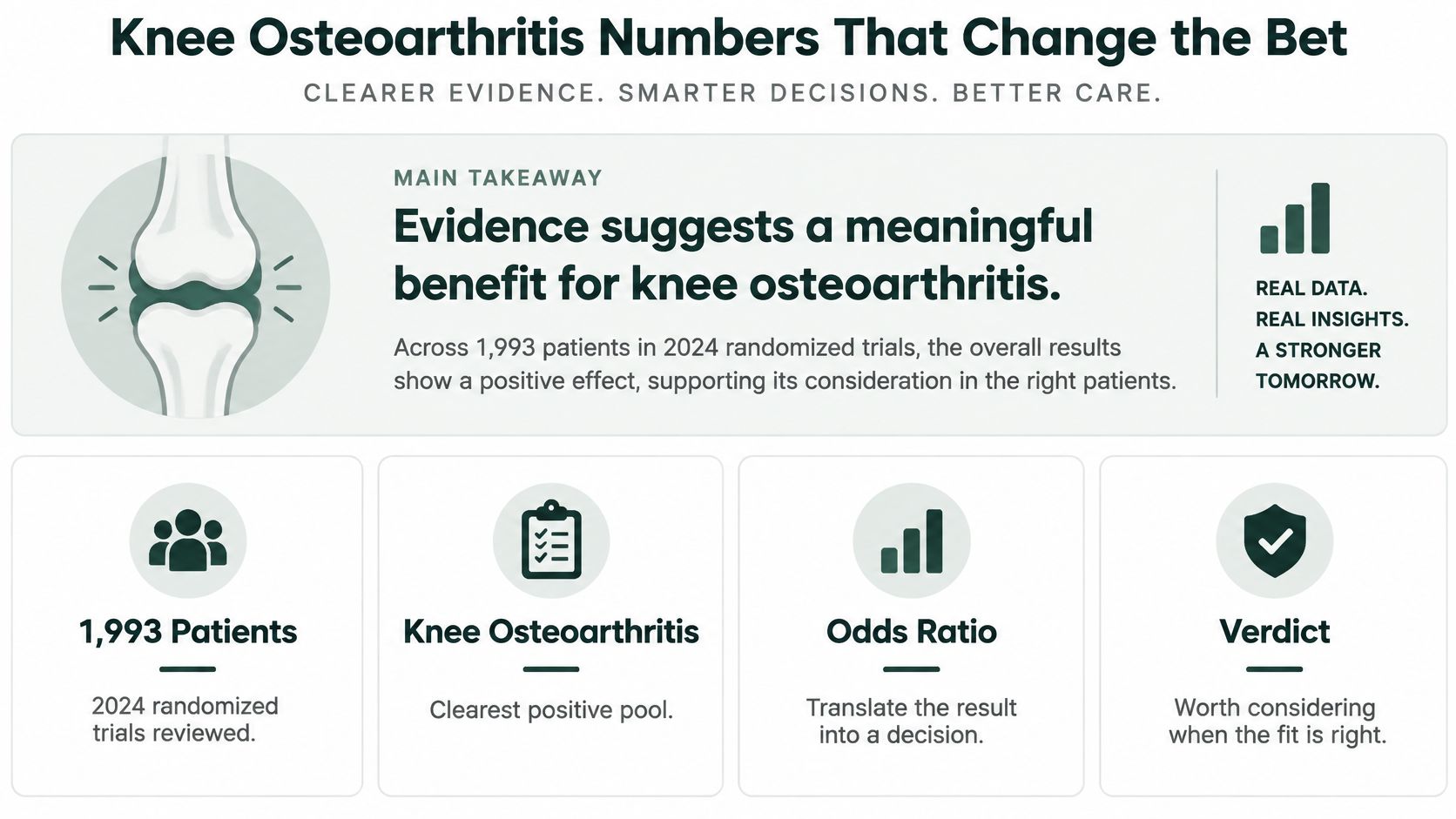
A 2024 systematic review and meta-analysis of randomized trials, including 1,993 patients with a mean age of 58.0 years, reported the following pooled odds ratios and confidence intervals.
Knee osteoarthritis odds ratios from the 2024 meta-analysis
| Outcome | Comparison | OR | 95% CI |
|---|---|---|---|
| Successful clinical outcome | PRP vs hyaluronic acid | 2.19 | 1.33–3.62 |
| Patient-reported symptom relief | PRP vs hyaluronic acid | 1.55 | 1.07–2.24 |
| Avoiding reintervention | PRP vs hyaluronic acid | 2.17 | 1.33–3.53 |
| Minimal clinically important pain difference | PRP vs other nonoperative care | 6.19 | 1.63–23.42 |
These are associations within pooled treatment groups, not personal success probabilities. The comparisons also differ: the largest estimate concerns other nonoperative care, not specifically hyaluronic acid.
What the odds mean for your purchase
An odds ratio compares the odds of a defined outcome between groups. It doesn't tell you how much your pain will fall, how far you'll walk, or how long your improvement will last.
You also need the comparator group's underlying success rate to translate an odds ratio into an absolute probability. Without that baseline, a clinic can't responsibly turn the table into your likelihood of success.
The minimal clinically important difference is particularly relevant because it asks whether improvement crosses a meaningful threshold, rather than merely whether scores change. However, the broad confidence interval around that estimate shows substantial uncertainty about the size of the advantage.
Practical rule: A favorable odds ratio can justify considering treatment. It cannot justify a guaranteed outcome or an automatic injection series.
Why the pooled result isn't a protocol
The review's authors described the conclusions of individual randomized trials as having only slight statistical strength. Pooling positive results doesn't erase weaknesses in the trials that produced them.
Nor does a pooled result describe every product sold under the PRP label. Arthritis severity, preparation, platelet concentration, injection count, rehabilitation, and comparator treatment can all affect how applicable a trial is to your plan.
For the spending decision, ask for the platelet target and proposed injection count in writing. Ask which outcome the clinic expects to improve and why its protocol resembles the evidence relevant to your arthritis.
A clinic that cites favorable pooled odds but can't describe its own preparation has supplied a marketing argument, not enough information to evaluate the purchase.
PRP Versus Steroid, Hyaluronic Acid, and Rehab
Your actual choice usually isn't PRP versus doing nothing. It's PRP versus another injection, a better rehabilitation program, symptom management while you remain active, or an assessment for a different treatment pathway.
Compare each option against the same goal. Relief for an upcoming obligation, sustained walking tolerance, and avoiding unnecessary procedures are different objectives.
PRP against the usual alternatives
| Option | Best fit | Onset | Hard limit |
|---|---|---|---|
| Corticosteroid injection | Discussing short-term management of an inflammatory flare | Establish the expected response window for the target condition | Symptom relief isn't evidence of tissue restoration |
| Hyaluronic acid | Knee osteoarthritis symptom care | Ask for a condition-specific assessment window | It isn't a cure, and comparison with PRP doesn't establish either as universally preferable |
| Prolotherapy | Selected ligament or attachment-site problems considered for a dextrose-based approach | Judge against the proposed course and rehabilitation plan | Don't assume evidence for PRP transfers to another injection |
| Rehab, weight, and activity change | Foundational osteoarthritis and tendon care | Assess progression across a completed program | A poorly matched or unfinished program isn't an adequate test |
| PRP | Selected osteoarthritis and some non-Achilles tendon conditions | Allow for a delayed response | Protocol-dependent, with uncertain additional benefit |
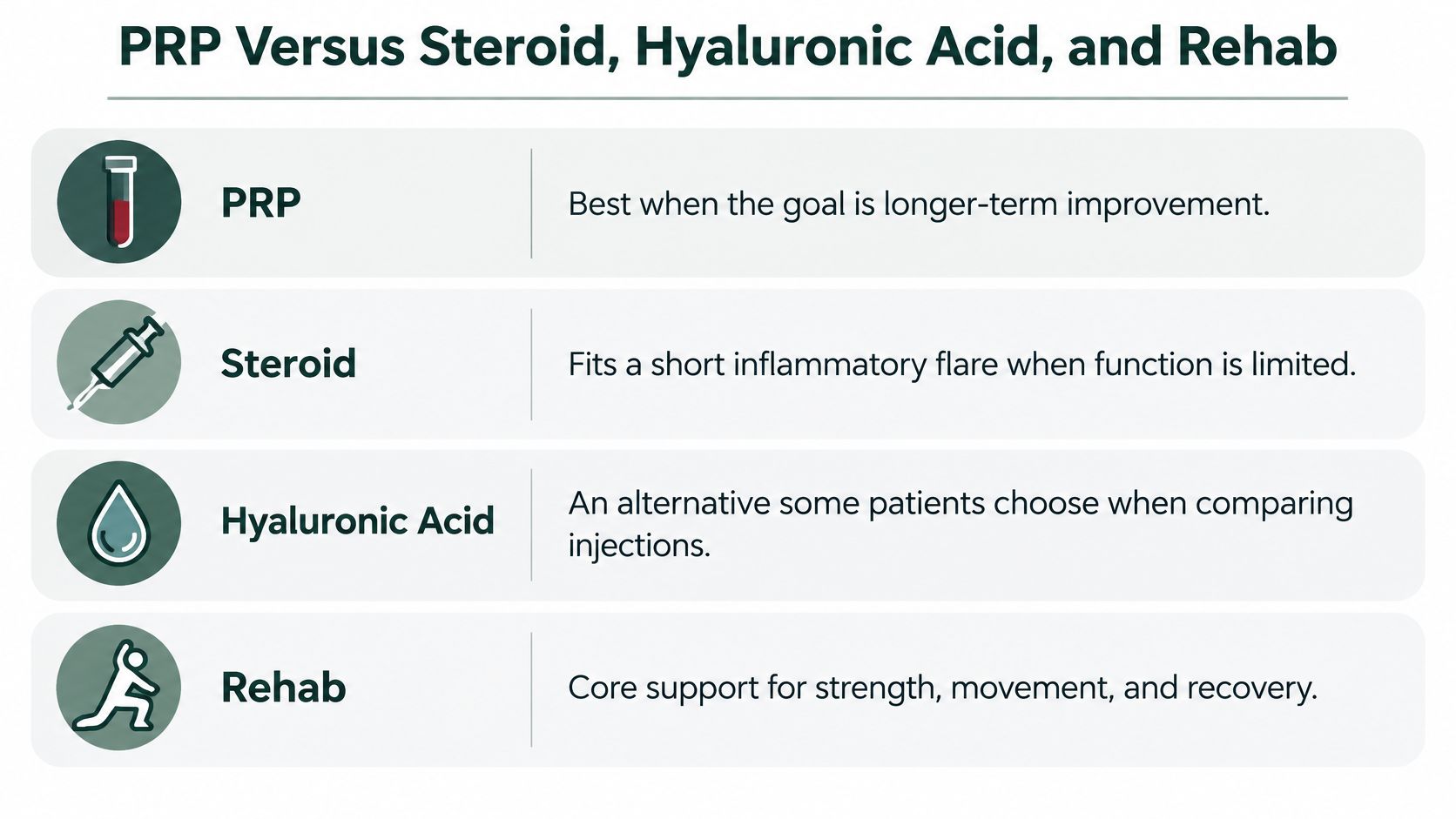
The comparison graphic summarizes the intended roles, not guaranteed treatment outcomes.
The placebo comparison changes the conclusion
The British Orthopaedic Association's update on injectables for osteoarthritis describes an earlier review in which one or two PRP injections improved six-month pain versus placebo, with mean differences of −2.45 and −2.07 points, respectively, on the review's pain scale. The same update contrasts that finding with RESTORE, which found no advantage over saline for symptoms or cartilage volume at 12 months, and notes that analyses emphasizing large, low-risk-of-bias trials generally find only small effects.
That tension matters more than a simple tally of positive studies. A pooled advantage over an active comparator and failure to outperform placebo in a rigorous trial can coexist because the studies ask different questions and use different methods.
A statistically significant result isn't necessarily large enough, durable enough, or predictable enough to justify your bill.
Choose by time horizon and opportunity cost
If you need prompt symptom control, a treatment with a delayed and uncertain response may not meet your immediate need. If you want sustained function, compare the expected additional benefit with what an improved exercise plan could accomplish without an injection.
For ligament complaints, our guide to supporting ligament healing offers practical context for the recovery discussion. The first decision remains whether the ligament is responsible for the symptoms.
Don't interpret persistent pain as proof that all rehabilitation has failed. Review what exercises were prescribed, how loading progressed, whether pain prevented participation, and whether the original diagnosis still fits.
The strongest comparison is between complete care plans, not between syringes. Include the exercise program, activity adjustments, monitoring, and next step if symptoms persist in every option you consider.
Real Cases Where the Spend Does or Does Not Pay
Consider these hypothetical patients. Their willingness to pay might be identical, but the evidence doesn't support giving them the same recommendation.

The walker with persistent knee arthritis
A recreational walker has mild-to-moderate knee osteoarthritis and has completed a progressive strengthening program. Appropriate weight work and route changes helped, but knee symptoms still limit outings.
PRP could be an optional symptom-management purchase, provided the walker can afford an unsuccessful result. The useful goal is improved walking tolerance, not an imaging promise.
The question to bring to the appointment is concrete: Which score and walking task will we track, what improvement would count, and how will strengthening continue? If the answer focuses only on what's inside the syringe, the plan is incomplete.
The runner with Achilles pain
A runner has persistent mid-portion Achilles tendinopathy and wants an injection before returning to training. Here, wanting a different treatment doesn't make PRP a good bet.
A 2024 meta-analysis of Achilles tendinopathy trials involving 422 participants found no meaningful improvement in pain or function versus placebo at three months or one year; injection-site discomfort at two weeks was reported by 80% of PRP recipients versus 61% of sham-treated participants.
The conclusion isn't that every treated runner will fail to improve. It's that improvement after the procedure wouldn't establish that PRP caused it, and the controlled evidence doesn't justify a reliable added-benefit claim.
For this runner, the better question is: What needs to change in the loading and return-to-running plan? Paying for an uncertain procedure shouldn't postpone that assessment.
The desk worker with tennis elbow
A desk worker also plays recreational racket sports and has persistent lateral elbow pain. If rehabilitation consisted only of occasional stretching, the case for an elective injection is premature.
After a completed strengthening program, PRP remains a shared decision because the evidence is mixed. The person should identify a meaningful task, such as gripping a pan or completing a work session, and ask which validated measure will capture progress.
The patient with shoulder or lateral hip tendon pain
A patient has either degenerative rotator-cuff symptoms or persistent gluteal tendon pain. PRP is more defensible when the examination supports that tendon as the pain source and the treatment plan addresses the loads provoking symptoms.
An acute traumatic tear, marked weakness, or another suspected pain source calls for diagnostic reassessment rather than assuming the same injection pathway applies. Ask what finding would change the recommendation or prompt a surgical opinion.
For any patient proceeding, review what to expect after a PRP injection before arranging work, caregiving, or exercise commitments. Recovery instructions should fit the treated tissue, not just the procedure's name.
Self-Pay Cost and the Break-Even Test
The available cost summary places PRP at approximately $500–$2,500 per treatment, while a 2025 U.S. payer policy on orthopedic PRP classifies the orthopedic treatment as investigational because of mixed trial results and insufficient evidence of improved net health outcomes. That distinction matters: a treatment can be available for purchase without having established enough benefit for routine coverage.
The following table is a budgeting checklist, not a clinic quote. Items in the extra-cost column are charges or practical costs to clarify, not fees every practice necessarily bills separately.
What a PRP plan can cost before it helps
| Situation | Typical cash | Often extra | Value test |
|---|---|---|---|
| Single PRP session | Per-treatment estimate above | Consultation, guidance, blood-draw supplies, follow-up | A named diagnosis and an agreed outcome check |
| Pre-planned series | Multiply the written session price by the planned injection count | Repeat visits, rehabilitation, activity restrictions | Justification for the whole course before starting |
| Commercial insurance | Commonly self-pay | Consultation may bill separately; investigational denial is possible | Obtain written benefit information and a self-pay quote |
| Medicare for joints | Don't budget routine coverage | Separate evaluation and procedure charges | Don't confuse wound-related coverage with orthopedic injections |
| Delaying established care | No fixed cash estimate | Lost activity, delayed rehabilitation, postponed referral | The injection must not displace indicated care |
Calculate the whole purchase
A low advertised injection price isn't necessarily a low-cost plan. Include evaluation, imaging if indicated, preparation supplies, guidance, follow-up, rehabilitation, travel, and time away from work or training.
Ask whether a series is a fixed recommendation or a conditional option. If additional injections are proposed, the plan should explain what finding triggers them and what finding stops treatment.
A biologically plausible treatment can still be poor value. That's especially true when the expected added benefit is uncertain and the patient bears the full financial downside.
Use a personal break-even threshold
Start with the improvement that would make the expenditure worthwhile to you. Being able to resume a valued activity may justify a cost that a barely detectable score change wouldn't.
Then consider the unsuccessful outcome. If paying would prevent you from completing rehabilitation or obtaining an indicated specialist assessment, the financial threshold should be higher, not lower.
You don't need a pretend-precise return-on-investment calculation. You need:
- A complete price: What's included, excluded, and potentially repeated.
- A meaningful target: The functional improvement you'd value.
- A credible alternative: What you'd do with the same time and money instead.
- A stopping rule: What happens if the agreed outcome doesn't improve.
Request an itemized written quote showing the injection count, included visits, and excluded services before blood is drawn. Don't treat the price of an initial session as the price of the entire decision.
Patient Selection and the Evaluation Before You Pay
Book an evaluation that can produce a no, not an appointment that assumes an injection. Regenerative injection therapy requires a patient-specific assessment to determine whether it's appropriate.
At our practice, the evaluation comes before that decision. The purpose is to establish whether the suspected joint, tendon, or ligament problem fits the proposed treatment, not whether pain is present.
Confirm the target and the unfinished work
Bring a description of what hurts, which activities provoke it, and what you've already tried. Include the actual exercise program when possible: the movements, resistance, progression, and reason you stopped.
A completed rehabilitation block and an abandoned one aren't interchangeable. If pain prevented participation, the clinician needs to address that barrier rather than count it as proof that exercise cannot help.
Use this screening checklist:
- Proceed to a fuller discussion: The target tissue is reasonably established, conventional care has been adequately tried, and the expected benefit matches your priorities.
- Pause the purchase: The diagnosis remains uncertain, rehabilitation wasn't tolerable, or you need relief sooner than the proposed treatment can reasonably be assessed.
- Decline the sales premise: The recommendation depends on guaranteed cartilage regrowth or a universal success claim.
- Resolve safety concerns first: Report active infection, bleeding problems, medication changes, and relevant medical conditions before any procedure.
Don't stop prescribed medication on your own to prepare for PRP. Medication review belongs with the treating clinician and, when necessary, the prescriber.
Use hip evidence as a certainty check
A 2024 review of randomized trials for hip osteoarthritis found five eligible trials, each enrolling 43–111 patients; all reported improvements in pain and function, and no major adverse events were reported. The small evidence base and differences in preparation methods, including open versus closed processing, limit how confidently those results apply to another patient or protocol.
The favorable safety findings are reassuring within the studied populations. They don't establish that the procedure is risk-free or that someone with different health conditions will have the same experience.
Transient soreness should be part of the consent discussion. Also establish whom to contact if symptoms are more severe or persistent than expected, rather than assuming every post-procedure problem is an ordinary response.
Before paying: Ask whether the recommendation rests on evidence for your diagnosis and the proposed preparation, or simply on evidence that PRP sometimes helps somewhere.
Treat platelet dose as a quality question
A possible dose-response relationship is a reason to ask better protocol questions, not a reason to buy the highest advertised concentration. A dose finding doesn't by itself identify an optimal treatment for an individual patient.
Ask how the preparation is characterized. Platelet concentration, injected volume, and total delivered platelets are related but different quantities, so a concentration claim alone doesn't describe the full treatment.
Other useful questions include:
- Preparation: What formulation is planned, and why is it appropriate for this tissue?
- Placement: Is image guidance planned, and what determines that choice?
- Course: Why is this injection count proposed rather than a different course?
- Duration: How long is meaningful benefit reasonably expected to persist?
- Failure plan: What changes if the outcome measure doesn't improve?
A clinic doesn't need to pretend these questions have universally settled answers. It should explain which decisions are evidence-supported, which remain uncertain, and how that uncertainty affects your recommendation.
Prepare records and establish the follow-up decision
Before a first visit with us, provide relevant medical records, imaging reports, X-rays, MRIs, laboratory results, and medication information. Existing records can clarify prior diagnoses and prevent the conversation from starting with an incomplete account of what's already been evaluated.
Our PRP preparation guide can help organize the practical discussion. Preparation instructions should follow the individualized assessment, not substitute for it.
Write down the baseline outcome before treatment. Choose a validated score appropriate to the condition and pair it with a repeatable task, using comparable conditions when you reassess.
Also settle the financial boundary. Insurance may cover the consultation portion of prolotherapy when we're contracted with your plan, but regenerative injections themselves aren't covered. Consultation coverage shouldn't be interpreted as approval or payment for the procedure.
Finally, agree on what happens if improvement is absent, partial, or short-lived. An uncertain response should trigger reassessment, not an automatic assumption that more injections are necessary.
The strongest candidate isn't just someone willing to pay. It's someone with a sufficiently clear diagnosis, a defensible protocol, realistic goals, and enough financial room to accept that the treatment may not provide worthwhile additional benefit.
Restore Osteopathic Medicine offers physician-led evaluation and regenerative injection therapy, including PRP and prolotherapy, in Aurora, Colorado. Visit Restore Osteopathic Medicine to request an evaluation, bring your records and rehabilitation history, and determine whether an injection or a different next step fits your condition and budget.