
You're in the parking lot, bandage on, treated knee or tendon already aching more than it did this morning, and you're wondering if you made a mistake. That doubt is normal. What to expect after PRP injection isn't instant relief, it's a staged curve shaped by the tissue treated, how hard you load it, and your medical history.
Table of Contents
- The First 72 Hours After Your PRP Injection
- Why Pain Can Worsen Before It Improves
- Getting Back to Work and Daily Activity
- Warning Signs That Need a Call to the Clinic
- Rehab, Loading, and What Actually Drives Results
- The 12-Week Outlook and Follow-Up Schedule
The First 72 Hours After Your PRP Injection
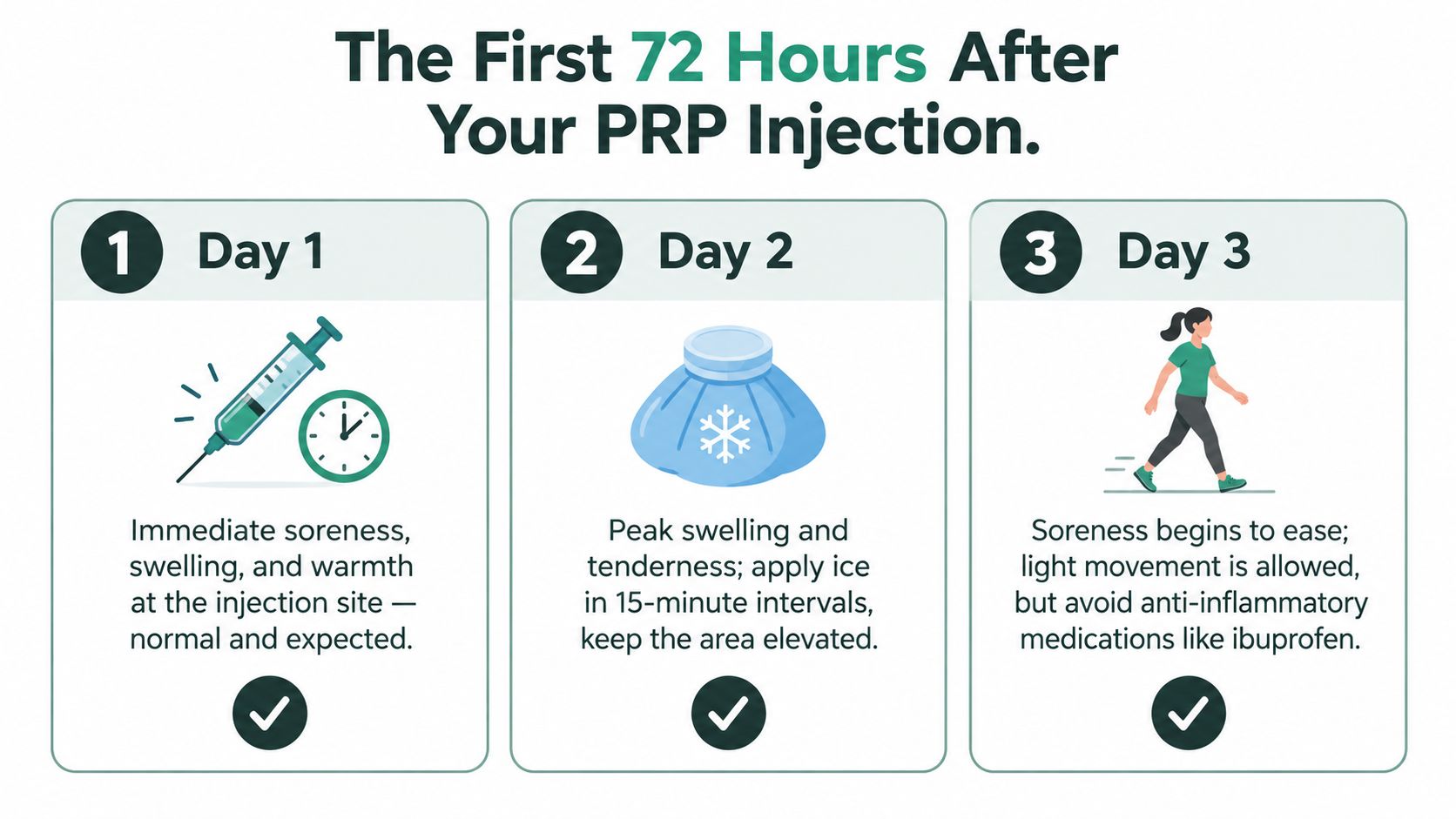
Most patients leave feeling deceptively okay, then notice soreness, swelling, and warmth building over the next several hours. A superficial tendon may feel tight and tender to touch. A deeper joint often feels fuller and stiffer, especially when you try to bend it after sitting. Neither pattern automatically means something's wrong.
A neutral academic medical-center protocol describes discomfort for 3 to 7 days, possible worsening during the first few days, and improvement often beginning after 1 to 2 weeks, as outlined in UTHealth Houston PRP patient guidance. Useful context comes from a 2025 randomized comparison in 200 patients, where injection site pain occurred in 12% of PRP recipients and mild swelling in 4%, with reported events resolving within 48 to 72 hours in that same summary.
What Normal Feels Like Day by Day
On day 1, expect a dull ache, local tenderness, and reduced range of motion. Driving may be uncomfortable after a knee, hip, ankle, or foot injection, so don't plan to test yourself in traffic if pressing a pedal hurts. Sleep is often broken the first night because you can't find a position that unloads the area.
Day 2 is frequently the peak for swelling. Relative rest helps more than complete immobilization unless your clinician braced or booted you. Keep the limb moving gently within comfort, raise it when you can, and don't chase stiffness with aggressive stretching.
By day 3, uncomplicated soreness should start plateauing or easing, even if it hasn't disappeared. You're looking for direction, not perfection. If each morning feels slightly less angry than the last, you're on the expected track.
If you judge PRP on the first 72 hours, you'll judge the inflammatory response, not the treatment result.
Ice, Medication, and Work Decisions
- Ice and elevation: Use them for comfort if your clinician allows it, in short intervals rather than leaving cold on continuously.
- Medication choices: Don't self-prescribe anti-inflammatory drugs or restart stopped medicines without asking. Protocols differ, and your clinician needs to weigh pain control against bleeding risk and the intended healing response.
- Work and errands: Desk work may be tolerable once you can position the limb comfortably, but prolonged standing, lifting, or repetitive use of the treated area usually isn't wise this early.
Keep the injection site clean and follow your clinic's bathing instructions. The goal for these three days is simple, protect the area, monitor the trend, and don't provoke a flare you then mistake for failure.
Why Pain Can Worsen Before It Improves
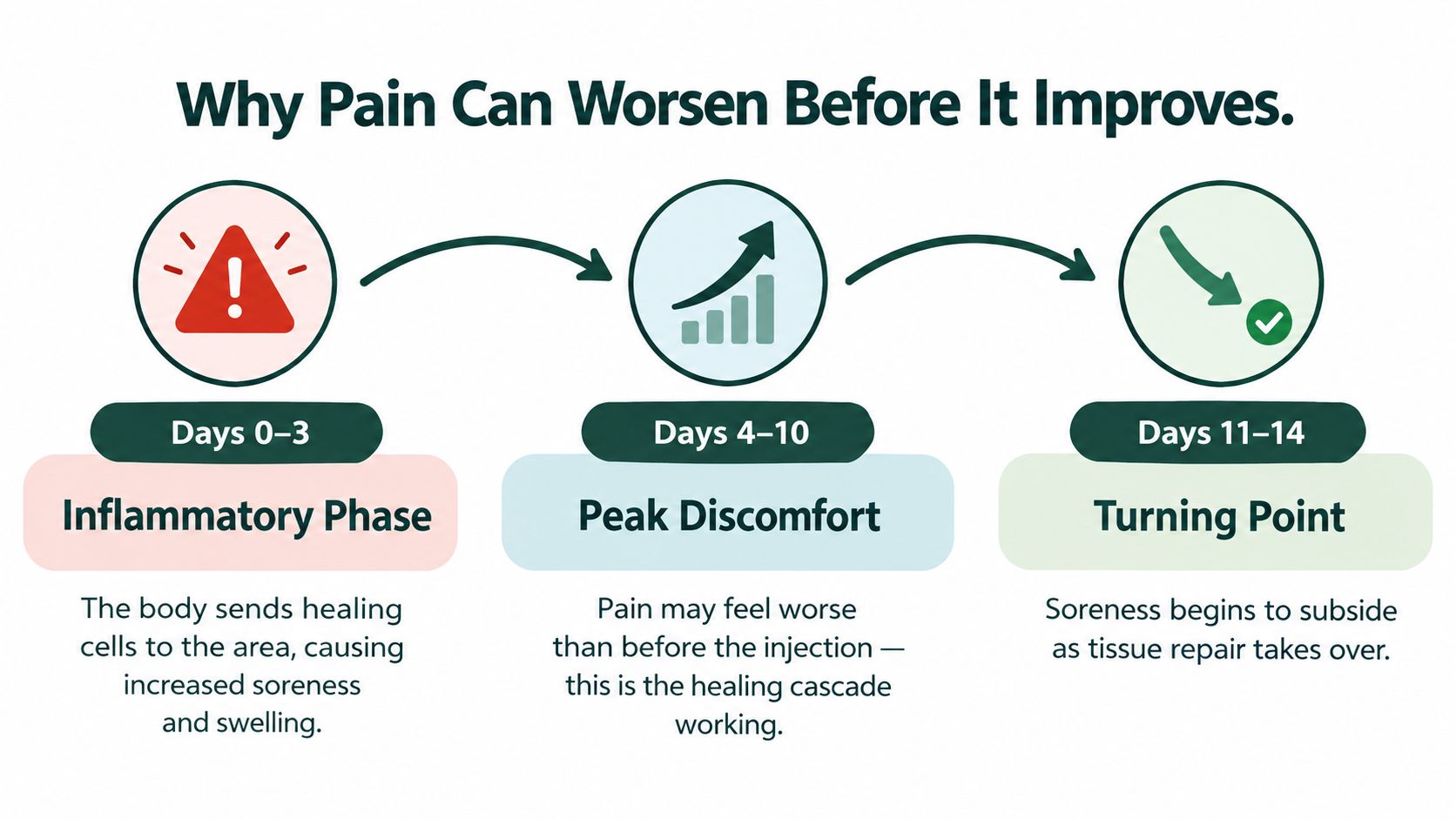
PRP doesn't numb tissue. It concentrates platelets from your own blood and places them where healing has stalled, which triggers a localized inflammatory cascade meant to recruit repair cells. That process hurts before it helps, and patients who aren't warned often assume the injection damaged something.
The American Academy of Orthopaedic Surgeons states that pain at the injection site may worsen during the first 1 to 2 weeks and a beneficial effect may take several weeks to appear, according to AAOS OrthoInfo guidance on platelet-rich plasma. NHS patient guidance similarly reports injection related pain, inflammation, swelling, or redness lasting approximately 5 to 7 days in that same source summary. Those windows overlap because tissue type matters.
How the Curve Changes by Tissue
A superficial tendon, like the elbow or patellar tendon, often feels sore to press and sore to load early. The ache is localized, and you can usually point to it. For some tendon treatments, soreness is expected to settle within about 1 week, with prescribed rehabilitation often beginning after roughly 48 hours once pain has eased, as noted in the AAOS linked guidance above.
An intra-articular joint injection, such as inside the knee, behaves differently. Swelling and stiffness may dominate over sharp tenderness, and the joint can feel worse with prolonged sitting or first steps in the morning. Deeper structures are harder to assess by touch, so function becomes your better signal, can you bend, straighten, and bear weight a little more easily over time.
Why Corticosteroid Is the Wrong Benchmark
Don't compare PRP to a corticosteroid shot you had years ago. NHS radiology guidance explains PRP benefits may take several weeks to months because the intended effect is medium to long term, unlike the faster short term effect often associated with corticosteroids, a contrast also described in the AAOS linked summary. Fast relief isn't the same as tissue repair, and slow onset isn't failure.
Practical rule: Expect a short sore period, then judge progress by pain trend, range of motion, strength, and activity tolerance over weeks.
What you want is a curve that peaks, turns, and gradually descends. A flat, unchanging severe pain or a second sharp escalation after initial improvement doesn't fit that shape and deserves a call, which is covered in detail further down.
Getting Back to Work and Daily Activity
There's no single return date that fits a desk worker with an elbow tendon injection and a warehouse worker treated for a heavily loaded knee. Work demands, lifting requirements, and tissue involvement set the pace. Guessing from a calendar is how patients flare a healing tendon on a Tuesday and lose the next two weeks.
One NHS hospital protocol reports most patients are comfortable between 2 and 6 weeks after PRP, with suggested restrictions of approximately 2 to 3 weeks for light work without lifting, 3 to 6 weeks for medium work involving light lifting, and 6 to 12 weeks for heavy work or activity above shoulder level, as set out in Sherwood Forest Hospitals NHS PRP patient information. That same guidance notes people with low impact jobs may return the next day once short term discomfort settles, while physically demanding jobs need longer.
Locating Yourself in the Right Band
Light desk work mainly tests positioning. If you can raise a leg, avoid typing through a treated elbow flare, and take movement breaks, early return is often realistic. Your risk isn't the desk, it's commuting, carrying bags, and sitting locked in one posture.
Medium manual work adds repetition and light lifting. That's where patients underestimate cumulative load. One lift feels fine. Fifty lifts across a shift irritate tissue that hasn't regained capacity yet.
Heavy or overhead work demands the longest runway because load is high and mistakes are costly. A shoulder that's fine for reaching a shelf at home isn't ready for overhead work all day.
| Activity Level | Typical Return Window | Key Considerations |
|---|---|---|
| Light work without lifting | Next day to 2 to 3 weeks of restriction | Positioning, commute, ability to modify tasks |
| Medium work with light lifting | 3 to 6 weeks | Repetitive load, shift length, lifting frequency |
| Heavy or above shoulder activity | 6 to 12 weeks | Strength, overhead tolerance, safety risk if pain spikes |
Use the table as a starting framework, not clearance. A small joint or superficial tendon may permit earlier daily activity than a heavily loaded tendon, ligament, or joint, a distinction also made in the NHS linked protocol. Avoid aggravating activity, and don't start clinician directed exercises before you're instructed to.
If your employer needs a date, ask your treating clinician for staged restrictions in writing. Modified duties protect your result better than an all or nothing return.
Warning Signs That Need a Call to the Clinic
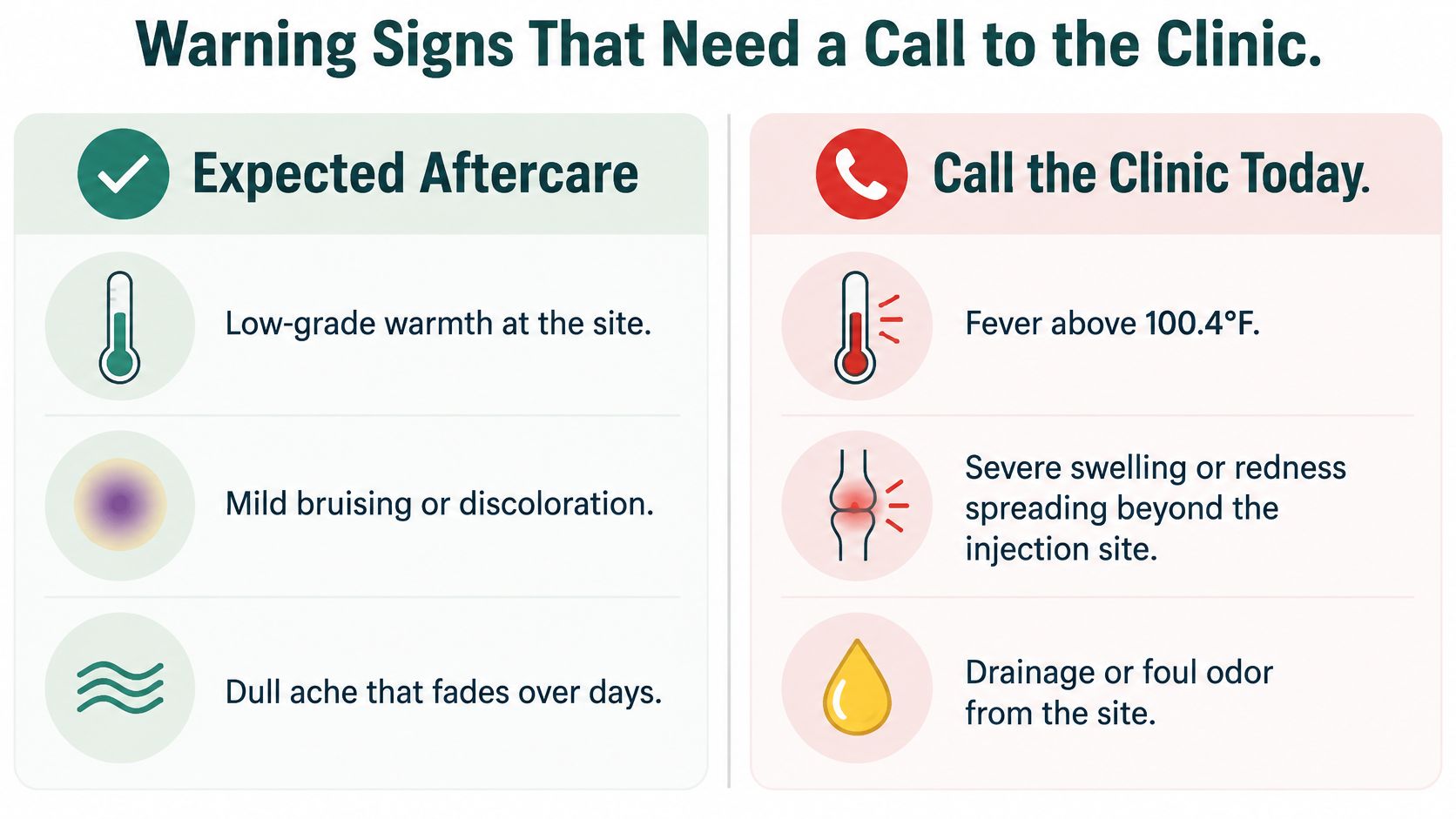
Routine soreness is dull, localized, and gradually improving. A complication usually breaks that pattern in direction, intensity, or spread. Learning the difference is the most important safety skill after PRP, because automatic reassurance is as unhelpful as panic.
Published safety data keeps this in perspective. In a systematic review of PRP for lateral epicondylitis, injection site pain occurred in 13.09% of PRP treated patients (39 of 298), reported pain resolved within study periods, and no serious complications were reported, according to a systematic review of PRP safety in lateral epicondylitis. For intra-articular knee PRP, a separate meta-analysis reported adverse events in 18.7% of cases, with mild knee pain and swelling accounting for 10.6%, generally transient and requiring no intervention in that same review.
Call the Same Day for These Changes
- Escalating pain: Pain that intensifies rather than eases, or persistent severe pain that doesn't behave like routine soreness.
- Spreading local signs: Increasing redness, swelling that worsens or spreads, marked warmth, or drainage from the site.
- Systemic symptoms: Fever or feeling unwell alongside a worsening injection site, which can indicate infection.
- Neurologic or allergic signs: Marked weakness, numbness, or an allergic type reaction.
Don't wait for every sign to appear together. One rapidly worsening finding is enough to seek review. Published safety reviews describe infection and other serious events as uncommon but real, so systemic symptoms or rapidly worsening local findings warrant prompt assessment, as noted in the review linked above.
Medical History Changes the Threshold
Call earlier and follow individualized restrictions if you're pregnant, take anticoagulants, have diabetes, or have other conditions that affect healing or infection risk. These factors don't automatically rule out PRP, but they change monitoring, medication decisions, and how cautiously activity should progress.
NSAID decisions belong in that same individualized category. Don't copy another patient's protocol from a forum. Your physician has to account for bleeding risk, pain control, other medicines, and whether blunting inflammation fits your specific plan.
Soreness that trends down is expected. Pain, redness, or swelling that trends up after it should be settling is a clinical question, not a willpower test.
When you call, report when symptoms changed, whether you have fever, what the site looks like, and what medications you've taken. That timeline helps the clinic triage you quickly.
Rehab, Loading, and What Actually Drives Results
PRP without rehabilitation is an incomplete plan for most tendon and joint problems. The injection may change the biological environment, but progressive loading teaches tissue to tolerate real life again. Skipping rehab, then returning to full activity because pain dipped, is a common route to relapse.
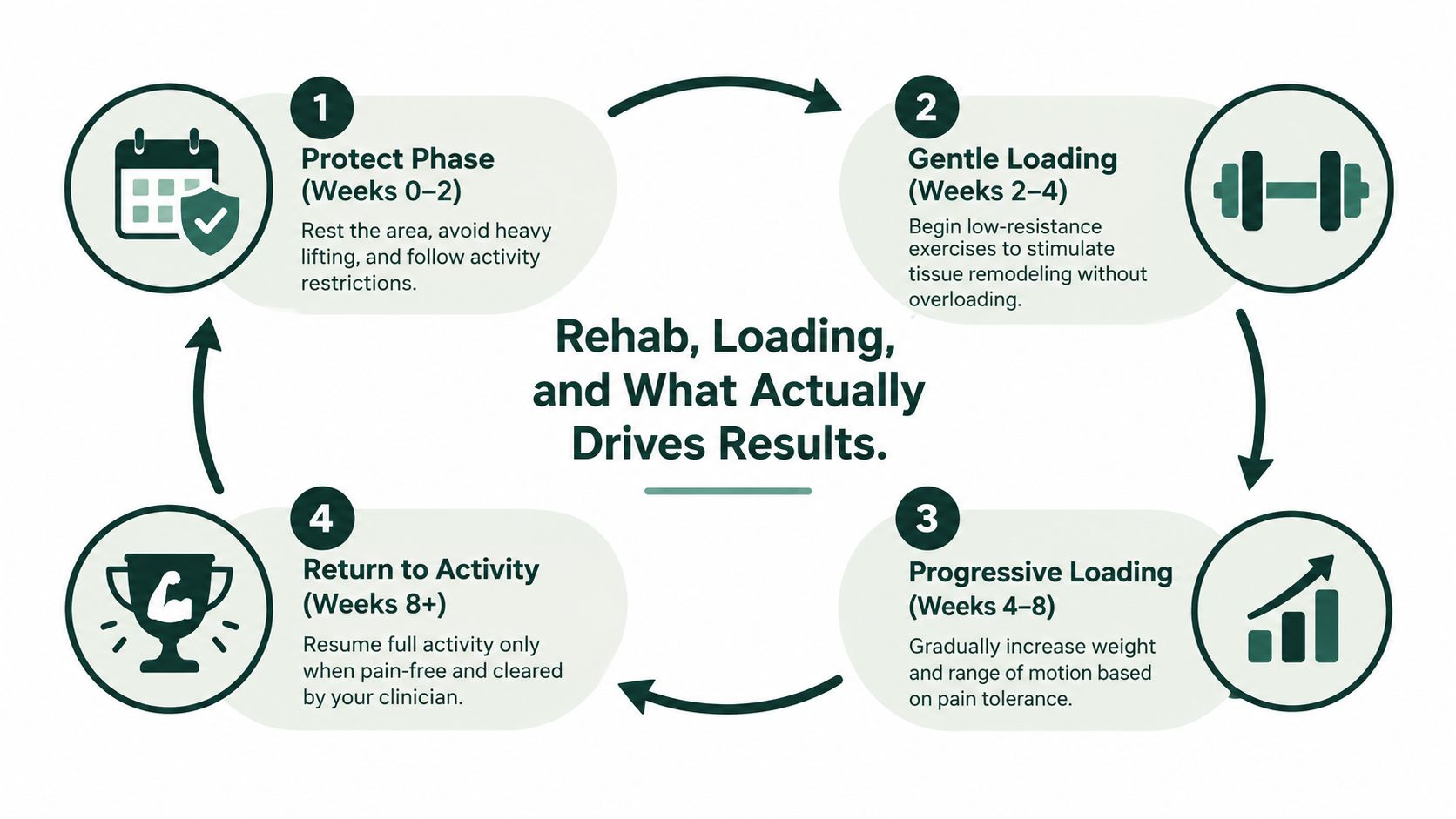
For tendon procedures, a practical protocol is relative rest immediately afterward, followed by gentle range of motion work and clinician directed rehabilitation, with an expert consensus review supporting beginning tendon rehabilitation approximately 5 to 10 days after injection, as described in an expert consensus review on PRP tendon rehabilitation. Early loading should remain sub-painful, with isometric exercise generally kept at no more than 3 out of 10 pain during exercise and for the following 24 hours in that same review.
A Progression That Respects Biology
- Protect and move gently: Relative rest first, then range of motion that doesn't provoke a lasting flare.
- Load isometrically: Low pain holds build tolerance without large movement stress.
- Add resistance gradually: Progress only when pain, swelling, strength, and function are improving.
- Restore specific demands: Sport, lifting, or overhead tasks come last, after basic capacity returns.
Some patients also benefit from addressing whole body movement patterns alongside local loading, which is where osteopathic manipulative treatment as a whole body approach to movement and function can fit into a broader plan when your physician recommends it. Restore Osteopathic Medicine offers that type of physician led osteopathic care in Aurora alongside regenerative services, presented here as one option to discuss rather than a requirement for every PRP patient.
Why One Result Cannot Predict Another
Protocols vary substantially by tissue, injection depth, platelet concentration, leukocyte content, activation method, dose, and rehabilitation plan, so outcomes from one joint or tendon can't be generalized to another, a limitation emphasized in the consensus review linked above. Evidence is condition specific too. In a randomized trial of 230 patients with acute Achilles tendon rupture, PRP didn't improve muscle tendon function, pain, quality of life, or recovery speed at 24 weeks compared with placebo in that same source.
That candor matters. More injections or faster activity won't necessarily improve results, and a diagnosis that doesn't fit PRP won't be rescued by enthusiasm. You need a diagnosis specific loading plan and scheduled reassessment, with load adjusted to your response rather than your impatience.
Track next day reaction, not just pain during exercise. If a session leaves you worse the following morning, the dose was too high, even if it felt easy at the time.
The 12-Week Outlook and Follow-Up Schedule
By the end of the sore phase, the question shifts from, is this normal, to, is this working. Answer it with function. Can you walk farther, lift with less guarding, sleep on that side, or complete rehab loads that previously flared you? Those changes often appear before pain fully resolves.
Follow-up should reassess pain, range of motion, strength, and activity tolerance, not just ask for a pain score in isolation. Your clinician compares those measures with your baseline, reviews rehab adherence, and checks whether activity progressed too fast or too cautiously. Bring notes on what aggravates symptoms, what eases them, and any medications you've used.
Decisions Your Clinician May Make
- Continue conservative care: Appropriate when function is trending upward, even slowly, and loading can still progress.
- Discuss repeat injection: Considered only after reassessment of diagnosis, response, tissue, and overall plan, not automatically because a date arrived.
- Pursue imaging or further evaluation: More likely when pain persists without functional gain, weakness or mechanical symptoms stand out, or the clinical picture changes.
PRP fits within regenerative injection therapy rather than replacing diagnosis, rehabilitation, sleep, nutrition, and management of health conditions that affect healing. For some patients, osteopathic care, functional medicine, and lifestyle support are relevant adjuncts. For others, the right next step is a different orthopedic or rehabilitation pathway, and a good follow-up visit says so plainly.
A Checklist to Save
- Track the trend weekly: Record pain, swelling, motion, strength work, and activity tolerance in brief notes.
- Progress one variable at a time: Don't increase load, duration, and intensity in the same week.
- Keep follow-up even if you feel better: Clearance for heavy or sport specific activity should be deliberate.
- Report a plateau: No functional change despite adherence is useful information, not a personal failure.
Give the process weeks, protect the early response, load progressively, and use follow-up to make decisions with data from your own recovery. That's how you know What to Expect After PRP Injection in practice, not just in theory.
If you're weighing PRP or you're unsure whether your current soreness, work restrictions, and rehab pace fit your diagnosis, Restore Osteopathic Medicine provides physician led evaluation, regenerative injection therapy, osteopathic manipulative medicine, and follow-up planning in Aurora, Colorado. Schedule a consultation to review your tissue specific recovery timeline, activity demands, and medical history before you guess at the next step.