
Search for ear acupuncture for addiction and you'll meet the same pitch from clinic after clinic: five tiny needles in each ear, and the body clears itself of toxins. That promise is everywhere, and it's part of why so many people finish a course of sessions unsure whether anything happened. Nobody told them what "working" was supposed to look like.
The NADA protocol doesn't remove anything from your body. Its own parameters make that plain. Five fixed points, both ears, fine needles, a seated group, roughly 45 minutes, several visits a week. What those parameters describe is a standardized, low-cost way to help a room full of people sit still, settle, and keep showing up for the care that does the harder work. That's a modest claim. It's also the claim the published evidence can carry.
Table of Contents
- The NADA Protocol at a Glance
- Where the NADA Protocol Came From
- How a NADA Session Runs Step by Step
- What NADA Is Used For and How Strong the Evidence Is
- Safety Screening and Contraindications Before Treatment
- Deciding Whether NADA Fits Your Integrative Care Plan
The NADA Protocol at a Glance
A clinic can call almost any ear treatment "detox." The protocol you can verify is narrower than that pitch: five points, both ears, the same order every time.
Those points are Shen Men, Sympathetic, Kidney, Liver and Lung. Fine needles go in bilaterally. There is no electrical stimulation. Selection does not change with your diagnosis, your pulse, or which substance you use. A review of NADA delivery in clinical settings describes the format most often studied: people seated for about 45 minutes, often in groups of up to 20, treated several times weekly.
| Element | Standard NADA format | Notes from studies |
|---|---|---|
| Points | Five bilateral auricular points, Shen Men, Sympathetic, Kidney, Liver, Lung | Same points every session, no individualized selection |
| Stimulation | Fine needles, no electrical stimulation | Non-electrostimulated by design |
| Session length | About 45 minutes, seated | Common group format in substance-use research |
| Group size | Up to 20 people | Designed for group delivery |
| Frequency | Several times weekly | Repeated across the week in substance-use research, not offered as a single visit |
| Pain-study dosing | Shorter daily sessions over a limited course | Used in some chronic-pain research, outside the usual substance-use schedule |
| Who delivers it | Trained behavioral-health personnel | Not limited to physicians |
The fixed points work like a printed bus route. Same stops, same order, whoever is driving. What published trials change is the timetable: how long people sit, and how the visits are spaced. A shorter session or a looser weekly schedule is not automatically a different treatment. A different set of points is.
Use the left column as the test. Ask which five points, how long the needles stay in, and whether everyone in the room gets the same placement. If the answer is a custom map built around your diagnosis, or a claim that the needles clear toxins, that offer is not standard NADA. What the parameters standardize is a low-cost group format aimed at helping people settle and keep coming back.
That role is a layer, not a whole plan. It fits beside integrative primary care services for whole body health that pair hands-on care with lifestyle and medical follow-up, rather than treating one needle session as the result.
Where the NADA Protocol Came From
Auricular acupuncture for withdrawal symptoms was observed in Hong Kong during the 1970s. Clinical use followed at Lincoln Hospital in the Bronx, New York, where treatment began in 1975. Michael Smith and colleagues formalized the standardized five-point ear protocol and founded the National Acupuncture Detoxification Association in 1985, as documented in the historical review of the protocol's development.
A 1988 report by Smith and Khan is an early record of how that model grew at Lincoln Hospital. The caseload it described was modest by later research standards. The setting still explains the design: a busy public hospital serving people in crisis, where a treatment had to be fast, inexpensive, and the same every time.
Traditional acupuncture works like a chef. The practitioner reads one patient's presentation and chooses the points. NADA works like a written recipe: five points, same order, so a trained behavioral-health worker can run the same session in another room. People sat together. Staff watched the group. Nobody wrote a new point prescription for each chair.
That choice is why the protocol traveled. Group delivery by trained behavioral-health personnel carried it out of physician-only acupuncture rooms into detoxification programs, mental-health services, disaster-response work, and community clinics through the late 1980s and 1990s.
The association's name marks the programs that first adopted it. What the protocol standardized is narrower: five fixed ear points and a group format that any trained worker could repeat. Wide adoption and clinical proof are separate achievements. NADA got very good at the first.
How a NADA Session Runs Step by Step
People often arrive expecting a custom detox ritual. A session that follows the protocol is narrower than that. Five fixed ear points, a quiet rest, often with other people in the room, and a written note of how you felt afterward. Those parameters are the treatment. "Detox" is a marketing word, and it is not a step.
A well-run session is boring in the best sense. The order stays the same every visit so the needles stay safe and so you leave with a number, not a vague impression, about whether it helped.
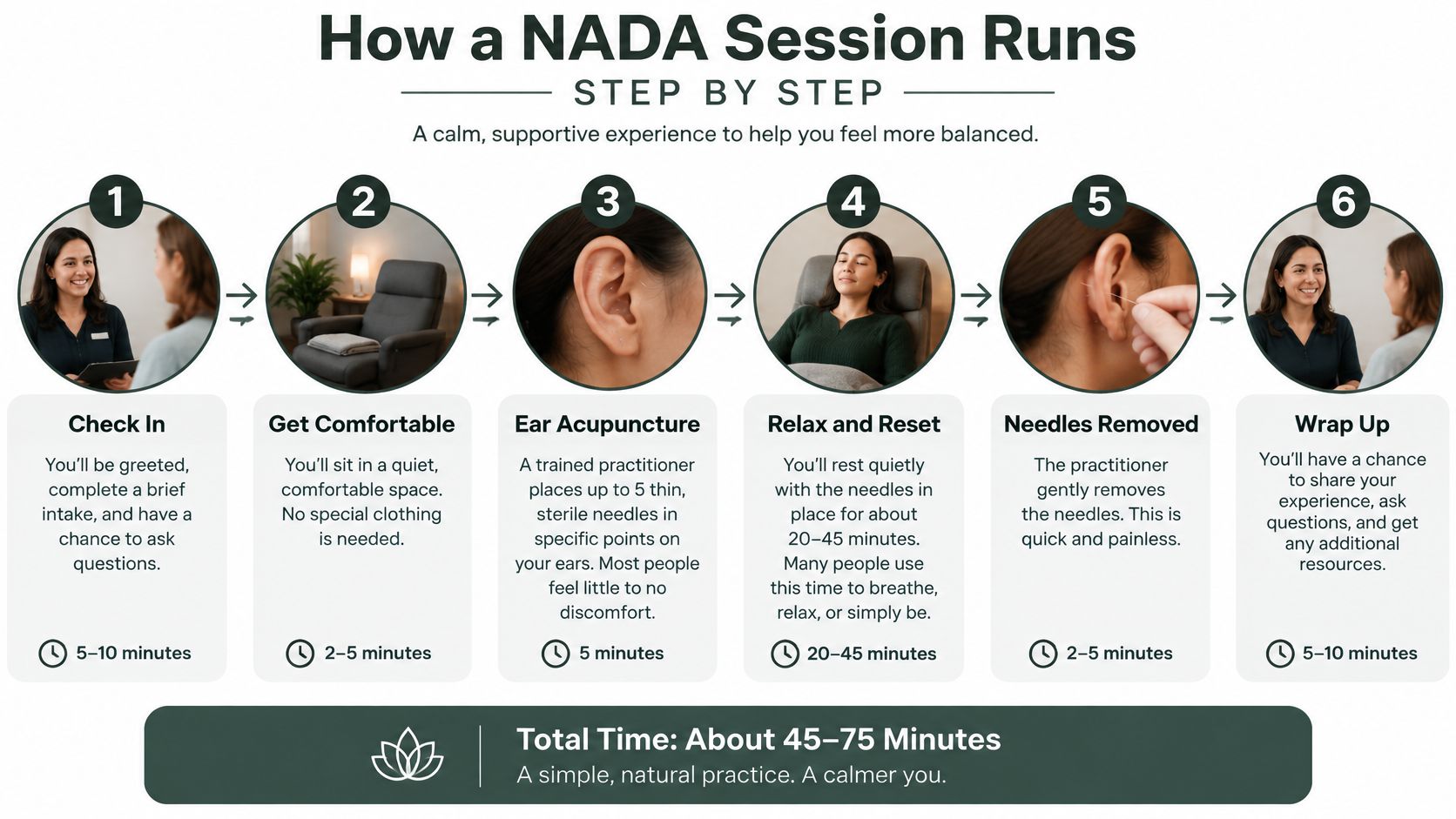
The session works like a preflight checklist on a small plane. The crew does not invent new items because a passenger had a hard week. They run the same list so nothing safety-related gets skipped.
Intake and screening. The clinician confirms why you are there, records your medical history, and checks two things specifically: bleeding risk and any history of fainting during needling. Both change how the session is run. Neither is a formality.
Informed consent. You should hear the five points named, what the needles feel like (usually a quick pinch, sometimes nothing), and a plain statement that this sits alongside other care rather than standing in for it. If the word "detox" shows up, ask which of these steps is supposed to remove a toxin. None of them is. The standardized job is the five points and the rest period, offered as relaxation support.
Preparation. Hands washed, both ears cleaned, and sterile single-use needles opened in front of you. Watch for that last part. Reusable needles have no place in ear acupuncture.
Placement. The clinician works in a consistent order, typically Sympathetic first because it sits folded behind the helix and is placed by feel, then Shen Men on the surface, then Kidney, Liver and Lung. Short needles (half-cun or one-cun) are standard because longer ones are heavy enough to work loose from a seated patient's ear. Each needle should be firmly rooted, with no wobble. A smile or a sentence can otherwise shift one.
Rest period. You sit still for about 45 minutes, often in a shared room. Staff stay nearby and watch for dizziness or fainting. Keep the jaw quiet. Movement at the jaw tugs the ear, and a needle that felt firm a minute ago can loosen. That stillness is part of how the session is built, not an empty wait before a later "real" treatment.
Removal and documentation. Needles come out, the ears are checked for irritation or small bleeds, and your response is recorded next to patient-reported scores for anxiety, sleep, craving or pain. Numbers beat impressions here.
Follow-up. The next session is scheduled at the program's frequency, and the outcome measures are reviewed at set intervals so somebody can tell whether the course is worth continuing.
The stop rule: any dizziness, clamminess or nausea during the rest period means needles out, legs raised, and the patient observed until fully recovered. No exceptions, and no push to finish the 45 minutes.
A clean session matches every step above. Ask how the clinic runs them before you book.
What NADA Is Used For and How Strong the Evidence Is
The five-point NADA protocol standardizes where needles are placed and is commonly delivered in a quiet group setting. Those parameters describe a supportive format, not proof of “detox.” The Defense Technical Information Center review of NADA evidence notes limitations across the research, including small trials, varied controls, and difficulty separating the effects of needling from the surrounding care.
Relaxation and stress
The proposed explanation is that stimulating the five ear points together may support autonomic regulation. That remains a hypothesis, not a confirmed mechanism. A careful description is that NADA may support relaxation and symptom management alongside other care.
Trauma support
NADA has been used in disaster-response and community settings, where the quiet, structured group format may be appealing. The reviewed evidence does not establish trauma treatment as a specific indication. For people considering PTSD and substance use treatment options, NADA should be understood as a possible adjunct, not a replacement for established care.
The detox question
Claims about “detox” go beyond what the protocol's parameters or research establish. The review of NADA in pain and substance-use settings describes evidence for reducing acute opioid craving or withdrawal as inconclusive. It discusses possible adjunctive roles in retention or medication requirements, but those findings remain tentative because of methodological limitations.
The table separates proposed uses from the strength of the available evidence.
| Use | What studies found | Evidence strength |
|---|---|---|
| Chronic low-back pain in older adults | Pain scores fell significantly by two weeks; one 20-minute treatment daily for 10 sessions; open-label, single center | Preliminary, no causal inference |
| Substance-use programs: quality of life, mood, abstinence | Randomized study of 100 participants with twice-weekly 45-minute group sessions; systematic reviews report mixed results | Mixed, methodological weaknesses |
| Acute opioid craving or withdrawal | A review found NADA may not reliably reduce craving or withdrawal | Inconclusive |
| Retention in methadone or established care | May support retention or reduce medication requirements when added to established treatment | Tentative |
| Stress in parents of NICU infants | 2025 pilot, 41 parents, 3 to 16 NADA sessions each | Preliminary |
| Stress and relaxation | Proposed autonomic regulation, not confirmed as a specific effect | Plausible, not confirmed |
| Trauma support | No reviewed source establishes trauma as an indication | Not established |
| Standalone detoxification | No evidence that NADA removes toxins | Not supported |
A prospective comparative study of older adults with chronic nonspecific low-back pain reported lower pain scores after the NADA group received one 20-minute treatment daily for 10 sessions. The study was open-label and single-center, so the results cannot establish that needling caused the improvement.
A randomized prospective study of 100 participants measured quality of life, depression, anxiety, and abstinence-related outcomes during twice-weekly, 45-minute group sessions. Its findings sit within a wider body of research with mixed results and methodological weaknesses. The evidence is best read as a reason to study NADA further, not as proof that it treats substance use or removes toxins.
A pilot study in a neonatal intensive-care unit followed parents receiving NADA interventions, with each participant receiving between 3 and 16 sessions, as reported in Frontiers in Global Women's Health. This offers preliminary information about stress in parents, not evidence for a specific treatment effect.
One unresolved question is how much of any benefit comes from needling versus the setting around it: quiet time, repeated visits, familiar staff, and peer contact. That distinction matters when judging the research. The standardized points and group format can describe what NADA offers; they cannot, by themselves, substantiate claims of detoxification.
Safety Screening and Contraindications Before Treatment
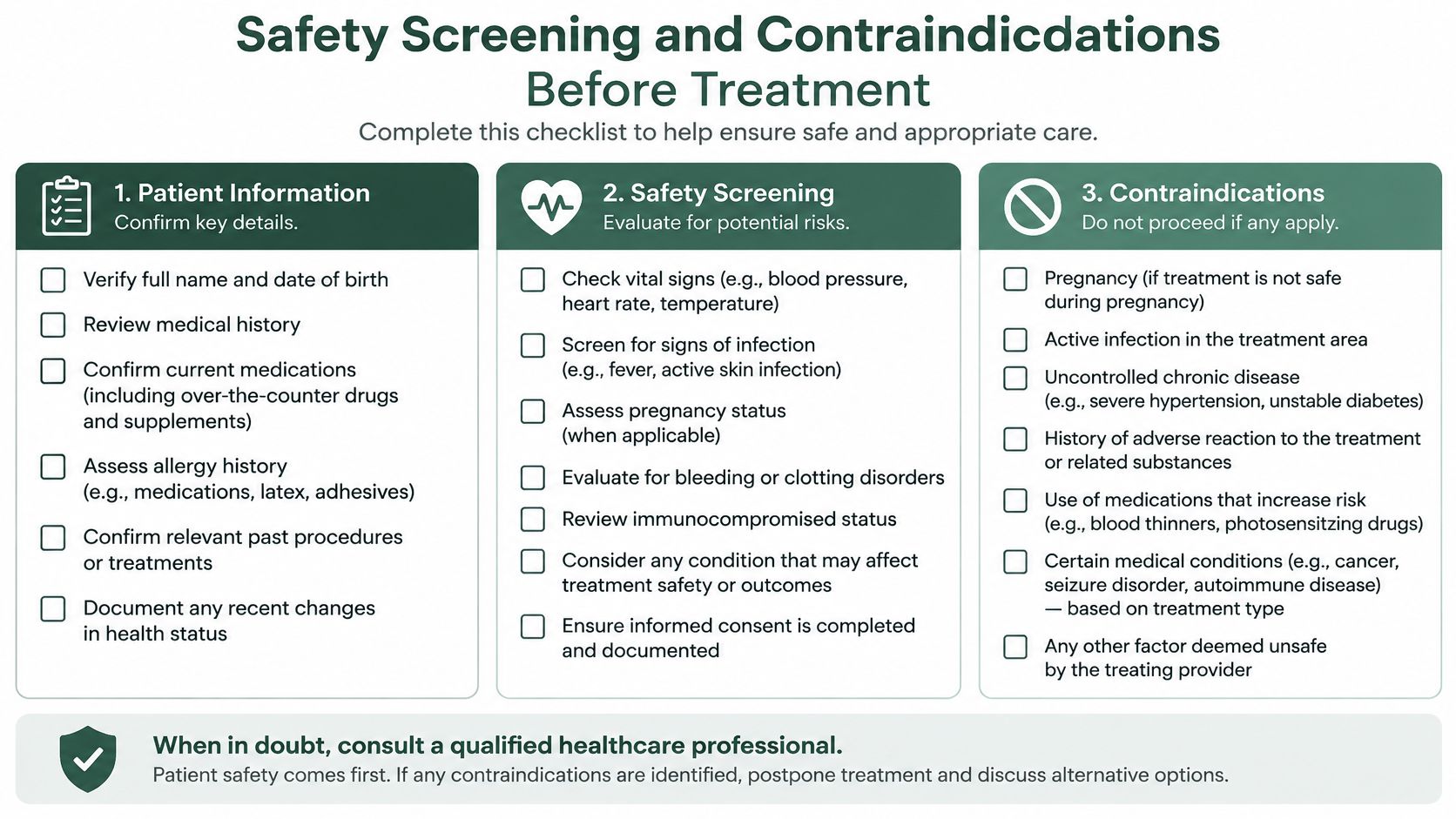
Most NADA sessions pass without incident. The safety work happens before the first needle, in the screening conversation and in the judgement to defer when something doesn't fit. The baseline the evidence supports is straightforward: informed consent, sterile single-use needles, screening for bleeding risk and vasovagal reactions, and observation during treatment.
Situations that change the plan
Active withdrawal, overdose risk or emergency symptoms. These come first and they come before any elective ear acupuncture. Refer to medically supervised withdrawal or emergency care. NADA is not a substitute for either, and no protocol parameter changes that.
A bleeding disorder or blood-thinning medication. The ears bleed easily even in healthy patients. The clinician should consult the prescriber and document the risk before treatment, and keep gauze on hand during placement and removal.
A history of fainting during needling. Plan for observation during the session and stay with the patient until they've fully recovered. Seated treatment makes a faint more hazardous than it needs to be, so position matters as much as watching.
Pregnancy or postpartum. Clinician review first, then confirmation that the treatment fits the wider care plan. If you're already juggling infusion appointments, osteopathic visits and postpartum follow-up, the clinic's notes on IV vitamin therapy benefits can help you see how adjunct appointments get layered without stacking too much into one week.
Methadone or buprenorphine. Continue prescribed treatment unchanged. NADA is an add-on only, and skipping a dose to "let the acupuncture work" is the single most dangerous misunderstanding in this whole area.
Broken skin, a cut or an infection at the ear. Defer treatment at that site until it heals. There's no benefit worth the infection risk.
Documentation is the safety net. Vital signs where indicated, patient-reported scores, and a written note of any adverse reaction. If a clinic can't show you what it records, it isn't tracking much.
What you should expect afterward is equally plain: a short observation, a check of both ears, and a clear instruction on what to report if something feels wrong at home.
Deciding Whether NADA Fits Your Integrative Care Plan
A protocol only belongs in a plan when the job matches the tool. NADA was built as five fixed ear points, a quiet group sitting, and support for relaxation. Marketing that promises a toxin flush is describing a different service. The goals you can judge are narrower: easier relaxation, calmer sleep, and a little more stamina for counseling.
Use three checks.
The goal is relaxation and steadier engagement with the care you already have. Calmer nights and an easier time staying in a counseling hour are changes you can notice across a few weeks. A promise to flush toxins asks the five-point session to do work its design never included.
The format stays the standard five points, both ears, for a set length of time. In the usual arrangement, people sit together in a quiet room. Points do not get swapped from visit to visit. Anxiety, sleep, craving, or pain is written down the same way each time, so a change is visible instead of guessed. A program that changes the points and records nothing is offering an experience.
It is added to medication, counseling, osteopathic treatment, and lifestyle work. Prescribed treatment stays in place. If someone says the needles can stand in for that treatment, that is a reason to decline.
Primary care and mental health most often come apart over whether an add-on joins the plan or tries to replace it. connecting primary care and mental health is a useful primer on why the two work better as one plan. When the main complaint is musculoskeletal, the ear sessions can run beside osteopathic neuromusculoskeletal medicine, which addresses the structural side while the ear protocol handles the settling-down side.
At Restore Osteopathic Medicine in Aurora, Acudetox is that kind of adjunct: a specialized form of acupuncture that uses fine needles placed at specific points on the ear, in the five-point protocol format. A single Acudetox treatment is $50. A 6-treatment package is $250. One sitting is too short to judge an effect, so the package is the fair cost comparison. The clinic is at 10555 E Dartmouth Ave, Unit 200, Aurora, CO 80014, open Tuesday, Wednesday and Friday from 8am to 5pm and Thursday from 8am to 1pm, closed Monday, Saturday and Sunday.
Fit is also a calendar problem. If an ear session, an osteopathic visit, and counseling all fall in the same week, leave recovery space between them so one day is not doing three jobs.
If you want a straight answer about what ear acupuncture can and cannot do for you, Restore Osteopathic Medicine offers Acudetox in the standard NADA five-point format as relaxation support alongside your existing medical and behavioral care. Book a visit at Restore Osteopathic Medicine and ask whether it fits your plan, and what a 6-treatment package involves.