
The popular advice to choose an IV drip for more energy or stronger immunity skips the most important question: what medical problem needs treatment? Getting nutrients into the bloodstream quickly isn't the same as improving health. Before booking an infusion, separate treatment of a confirmed deficiency or fluid loss from wellness claims that haven't been convincingly demonstrated.
Table of Contents
- Which IV Vitamin Therapy Benefits Have Evidence
- Why Higher Blood Levels Do Not Guarantee Better Results
- Common IV Vitamin Formulations Compared
- Who Needs Screening Before Any Infusion
- What Happens During an IV Vitamin Infusion
- When IV Vitamin Therapy Is Medically Justified
Which IV Vitamin Therapy Benefits Have Evidence
A higher nutrient dose does not establish a health benefit. Evidence varies by the condition being treated and the outcome measured.
| Claimed benefit | What the evidence shows | Strength of support |
|---|---|---|
| Fibromyalgia tenderness and pain | A controlled Myers' cocktail study reported reduced tenderness and pain after treatment, but the evidence base is small | Limited |
| Energy and general wellness | The NIH Office of Dietary Supplements review finds insufficient evidence that routine IV vitamin therapy benefits people without a diagnosed need | Insufficient |
| Immunity | No controlled trial establishes routine benefit for people with adequate nutrition | Insufficient |
| Detoxification | Clinical trials do not support this claim | Insufficient |
| Cancer treatment side effects with IV vitamin C | Small studies report improved quality of life or fewer symptoms in some patients; the FDA has not approved this use | Limited, not approved |
| Documented vitamin deficiency or malabsorption | Targeted replacement can be appropriate when oral intake or absorption is inadequate | Established clinical use for appropriate indications |
Overall, evidence supports selected, condition-specific uses, not a general wellness benefit. The Health overview of IV vitamin therapy describes the controlled fibromyalgia study, the limited evidence for broader wellness claims, and small studies of IV vitamin C for cancer-treatment side effects.
What the positive findings actually mean
The fibromyalgia result is worth distinguishing from proof of a dependable treatment effect. Reduced tenderness and pain after treatment do not show how much improvement came from the ingredients rather than other influences. A convincing claim depends on whether treatment performs better than an appropriate comparison, not just whether patients improve from where they started.
Energy, immunity, and detoxification are not established benefits of routine infusions in well-nourished adults. A nutrient's role in normal physiology does not show that extra amounts improve that function.
Cancer-related findings also need careful interpretation. Improved quality of life or fewer treatment symptoms are different outcomes from treating cancer, and IV vitamin C should not replace oncology care.
Treating a deficiency is a separate indication
When a deficiency or malabsorption is documented, replacement addresses a specific clinical problem. The Cleveland Clinic explanation of IV vitamin therapy discusses the distinction between limited wellness evidence and circumstances in which replacement may be appropriate.
Before booking: Ask what condition or measurable treatment goal the infusion is intended to address. A menu description is not a diagnosis.
For help weighing convenience against medical value, read whether IV infusions are worth it. The case for treatment depends on a clear indication and a benefit relevant to that problem.
Why Higher Blood Levels Do Not Guarantee Better Results
Pouring water into a glass faster doesn't help if the glass is already full. The analogy isn't a complete description of vitamin metabolism, but it captures the mistake behind many infusion claims: more delivered doesn't automatically mean more benefit.
IV delivery bypasses gastrointestinal absorption and can produce blood concentrations that oral supplements rarely achieve. That's a real pharmacological difference. It tells us how a substance enters the body, not whether the patient feels better, functions better, or recovers sooner.
What a controlled trial measured
In a randomized trial published in JAMA, 167 patients with sepsis-associated acute respiratory distress syndrome received vitamin C at 50 mg/kg every 6 hours for 96 hours; plasma vitamin C concentrations rose substantially, but the treatment didn't significantly improve the modified Sequential Organ Failure Assessment score or inflammatory and vascular-injury biomarkers compared with placebo.
Those were critically ill patients, not healthy adults visiting a wellness clinic. The trial therefore doesn't settle every question about elective infusions. It does demonstrate why reaching a higher blood concentration cannot serve as proof that treatment works.
The relevant question is whether the infusion improves the outcome it was intended to change.
A laboratory value can show that a vitamin reached the bloodstream without showing that the patient benefited.
Read results in clinical context
A result needs interpretation alongside symptoms, medical history, and the timing of supplementation. If you're preparing to discuss B12 testing, Vital iQ Health's B12 results guide can serve as a discussion aid, rather than a reason to choose treatment from a laboratory number alone.
A credible infusion plan specifies the indication, dose, monitoring, and patient-centered outcome. More energy, stronger immunity, faster recovery, and longer life each require their own evidence. None follows automatically from an increase in circulating vitamins.
Common IV Vitamin Formulations Compared
Common IV vitamin formulations and what they contain
| Formulation | Typical contents | Documented use | Main caution |
|---|---|---|---|
| Myers' cocktail | Magnesium, calcium, and vitamins C and B; exact doses aren't specified here | Studied in fibromyalgia in a small controlled trial | Magnesium-containing formulations require attention to electrolyte levels and cardiac risk |
| High-dose vitamin C | Ascorbic acid; research protocols use indication-specific doses, not a standard wellness dose | Investigated in sepsis and cancer; no established routine wellness benefit | Kidney failure risk in kidney disease; hemolysis in G6PD deficiency |
| Saline-based hydration with electrolytes | Sodium chloride solution, sometimes with added electrolytes; exact dose must be prescribed | Hydration support for clinically assessed dehydration or fluid loss | Fluid overload, particularly with heart or kidney disease |
| B-vitamin or B-complex infusion | Selected B vitamins; exact ingredients and doses must be confirmed | Targeted replacement when indicated; limited evidence for routine wellness use | Allergic reactions; dose-related risks can't be assessed without the actual formulation |
A formulation is defined by what's in it and how much, not by its menu name. Terms such as recovery or vitality don't identify the active ingredients, fluid volume, infusion rate, or reason the mixture suits a particular patient.
High-dose vitamin C illustrates why research formulas shouldn't become casual wellness recipes. A Mayo Clinic Press review of benefits and risks discusses a prostate cancer trial using 1 gram per kilogram of IV vitamin C alongside chemotherapy, without improvement in the measured clinical outcomes.
Match the formulation to the problem
The useful question is not which drip sounds most thorough. It's why each ingredient belongs in this patient's treatment.
For example, someone who needs fluid replacement doesn't automatically need a vitamin mixture. Someone with a confirmed nutrient deficiency needs a plan for that nutrient, not necessarily every ingredient in a combination infusion.
Before accepting a formulation, get clear answers to these questions:
- Contents: What are the exact ingredients, doses, and total fluid volume?
- Rationale: Why is each component necessary for this indication?
- Success: What change will demonstrate that the treatment worked?
If oral supplementation is an option, reviewing nutraceutical considerations can help frame the alternative. Oral products still require appropriate selection and dosing; avoiding an IV doesn't make every supplement suitable.
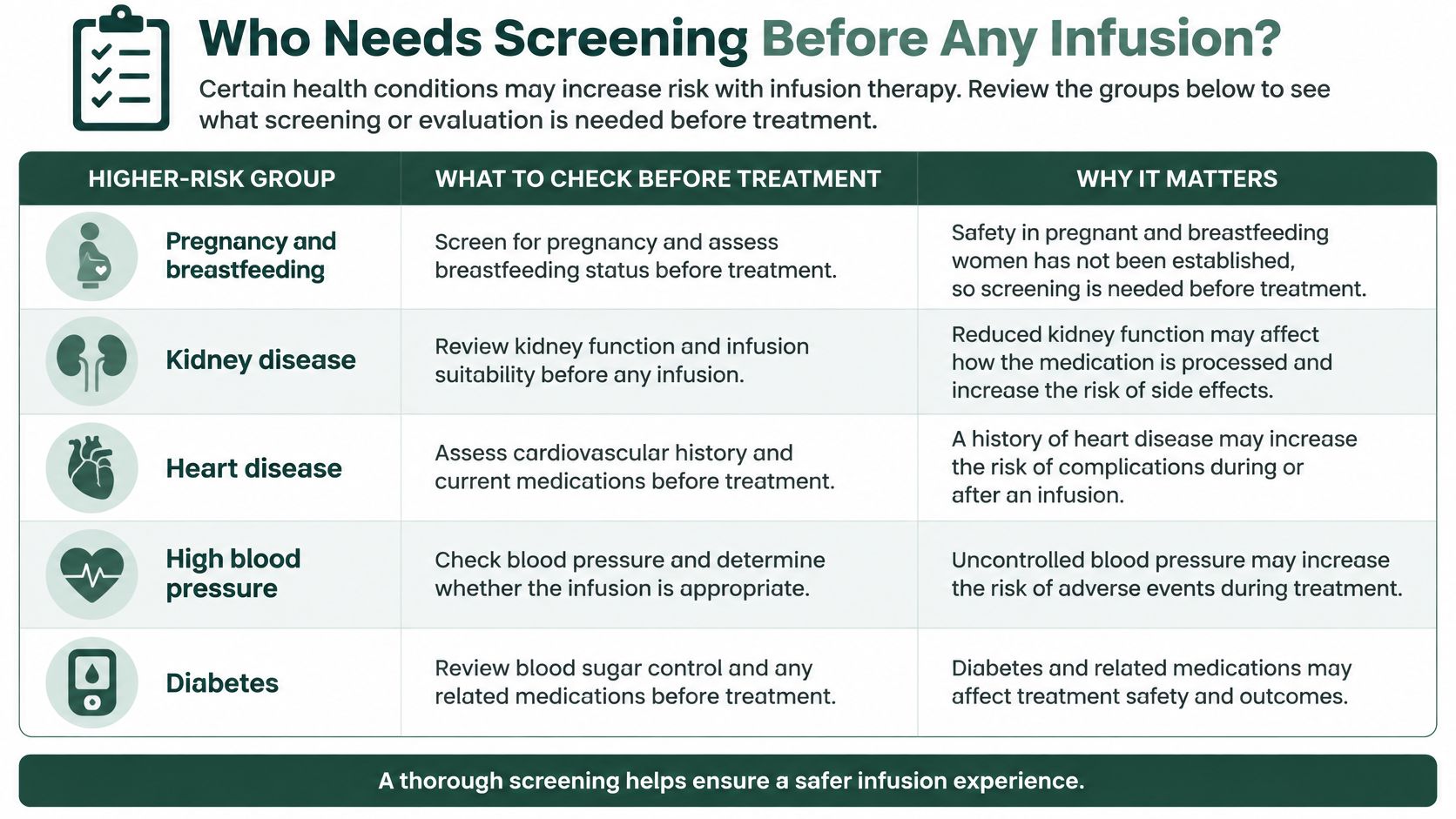
Who Needs Screening Before Any Infusion
Screening required before IV vitamin therapy, by condition
| Condition or situation | Why it matters | Required check or action |
|---|---|---|
| Pregnancy or breastfeeding | Safety hasn't been studied | Coordinate with the obstetric clinician; avoid empiric high-dose formulations |
| Kidney disease | High-dose vitamin C can cause kidney failure in susceptible patients | Review kidney function and obtain appropriate testing before treatment |
| G6PD deficiency | High-dose vitamin C can cause hemolysis, the breakdown of red blood cells | Establish G6PD status with appropriate enzyme or genetic testing before high-dose treatment |
| Hemochromatosis | Increased iron absorption is a concern | Review iron-related risk and the proposed formulation |
| Heart disease or abnormal electrolytes | Potential arrhythmias, blood-pressure changes, and muscle weakness | Cardiac review and relevant electrolyte testing |
| Interacting medications or supplements | Ingredients may interact with existing treatment | Review all prescriptions, nonprescription medicines, and supplements |
The MSD Manual's review of intravenous vitamin therapy states that safety in pregnant and breastfeeding women hasn't been studied. It also describes electrolyte-related risks, medication interactions, and procedural complications, making screening particularly important during pregnancy and postpartum recovery.
Bring specific questions to the appointment
Natural doesn't mean risk-free. An infusion combines nutrient exposure with a procedure that enters a vein, so ingredient safety and clinical technique both matter.
Use this checklist before consenting:
- Personal history: Have I disclosed pregnancy, breastfeeding, kidney or heart disease, blood-pressure problems, diabetes, and previous infusion reactions?
- Medication review: Has the clinician reviewed my prescriptions, over-the-counter products, and supplement labels?
- Laboratory review: Are my relevant results current enough to guide this particular treatment?
- Written formulation: Can I see every ingredient and dose before administration?
- Clinical supervision: Who prescribes the infusion, who administers it, and what are their credentials?
- Sterile preparation: Where and how is the mixture prepared?
- Emergency readiness: What happens if I develop an allergic reaction or become unwell?
- Follow-up: Who should I contact after leaving, and which symptoms require urgent care?
Concerns raised in FDA-related reporting about some med-spa settings include inadequate sterilization, unlicensed personnel, and unapproved ingredients. A comfortable treatment room isn't evidence that these safeguards are in place.
Keep the whole medical picture in view
A discussion about integrative primary care and whole-body health should include the treatments you already receive, not just the infusion you're considering. Don't stop a prescription or add supplements to prepare for an infusion unless the prescribing clinician directs you to.
Nutraceuticals and dietary supplements aren't appropriate for every person or every medical condition, and they can interact with medications. The same caution applies when familiar nutrients are delivered through an unfamiliar route.
What Happens During an IV Vitamin Infusion
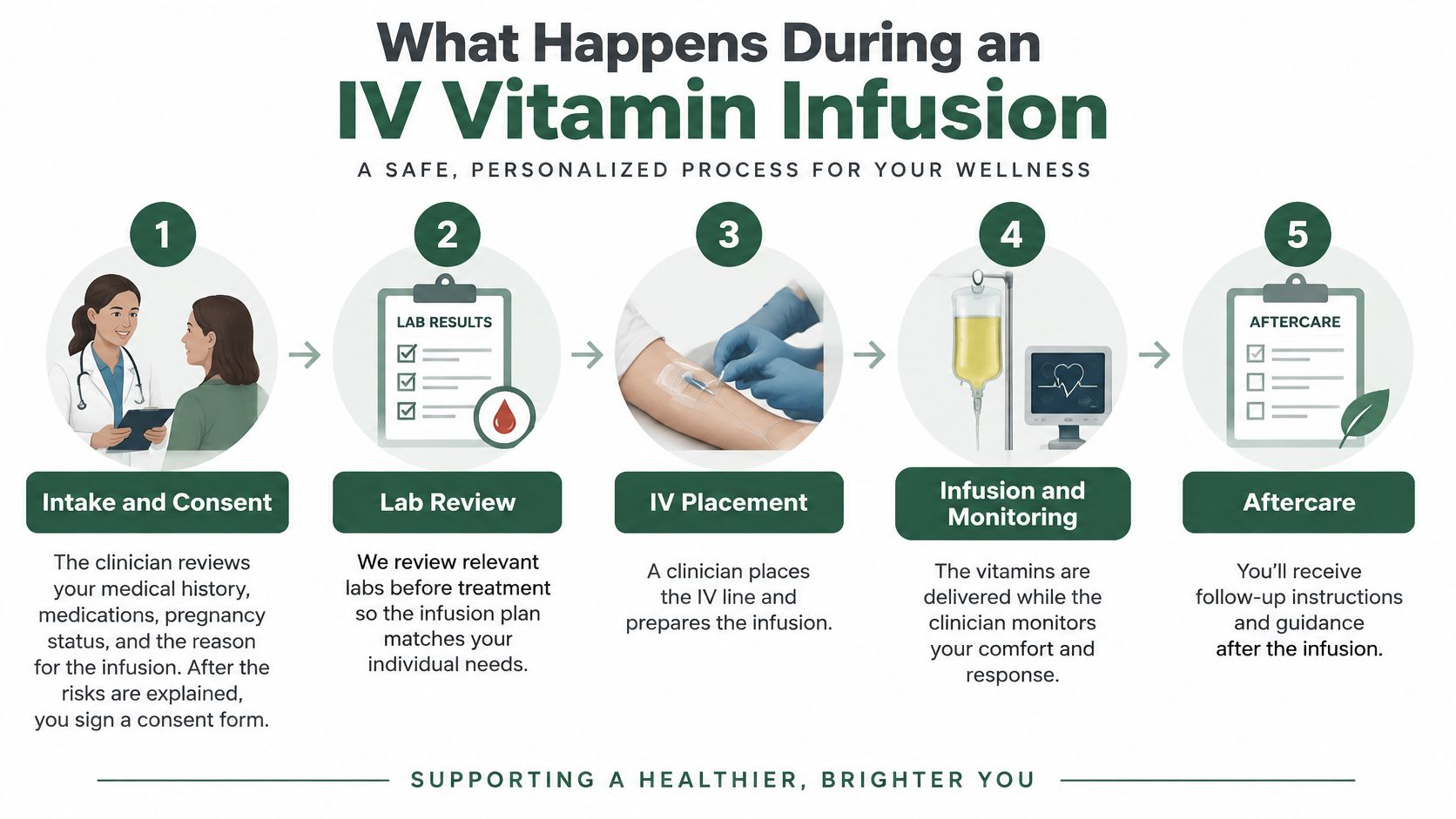
A medically supervised visit should involve more than choosing a bag and finding a vein. Expect a conversation about the treatment goal, the proposed formulation, and the reasons the clinician considers it appropriate.
The clinical sequence
Intake and consent. The clinician reviews your medical history, medications, pregnancy or breastfeeding status, and reason for treatment. You should understand the expected benefit, alternatives, and risks before signing consent.
Relevant laboratory review. Kidney function, electrolytes, or nutrient results are considered when the indication and formulation require them. Testing should answer a clinical question, rather than accompany every infusion package.
Ingredient and dose confirmation. The clinician confirms the formulation in writing, including fluid volume and individual doses. This gives you an opportunity to identify an ingredient allergy or clarify why a component is included.
IV placement. A credentialed staff member places a catheter using sterile technique. Careful preparation and line handling help reduce avoidable procedural risks.
Controlled administration. The clinician selects the infusion rate for the formulation and patient. Don't request a faster infusion to shorten the appointment, because the administration rate is part of the prescription.
Monitoring during treatment. Staff monitor your response and check vital signs as appropriate. Report rash, chest tightness, dizziness, or pain and swelling at the IV site immediately rather than assuming discomfort is expected.
Observation and follow-up. Before discharge, the clinic confirms that you're stable and explains aftercare, warning signs, and any planned testing. Follow-up should establish whether the original treatment goal was achieved.
Patient safety: Speak up when symptoms begin. Don't wait until the bag is empty to mention a reaction.
Allow time for assessment
The appointment length is determined by the formulation, prescribed rate, and monitoring needs. There isn't a universal session time that establishes safe or effective care.
If you feel unwell after leaving, follow the discharge instructions and seek urgent care for severe symptoms such as breathing difficulty, chest pain, or fainting. A follow-up appointment isn't a substitute for emergency assessment.
When IV Vitamin Therapy Is Medically Justified
IV delivery may be appropriate when oral intake or absorption cannot meet a medical need, or when a clinician determines that rapid correction is necessary. A peer-reviewed review of IV vitamin therapy supports targeted use for appropriate deficiency, malabsorption, or hydration indications, while finding limited evidence for routine wellness use in otherwise healthy people.
An indication explains both what needs treatment and why IV delivery is appropriate. The route should follow the clinical need.
Indications and the check that confirms each
| Indication or situation | Confirming check or action |
|---|---|
| Documented malabsorption, including a relevant history of bowel surgery or inflammatory bowel disease | Confirm the absorption problem and assess the nutrient level; the diagnosis alone doesn't establish an IV requirement |
| Severe deficiency | Laboratory confirmation and assessment of severity, symptoms, and suitable replacement route |
| Dehydration with significant fluid or electrolyte loss | Clinical assessment and relevant electrolyte testing |
| Hospital-supervised treatment for a specific condition | A documented treatment goal within the treating clinician's plan |
| Elective infusion in well-nourished adults | No demonstrated routine gain sufficient to assume the added procedural risk is worthwhile |
Build a plan that can be evaluated
Fatigue alone doesn't establish a nutrient deficiency. For a postpartum parent or someone experiencing menopausal symptoms, an infusion shouldn't replace assessment of the underlying problem.
A useful plan records the indication, baseline findings, treatment goal, and reassessment point. It also defines when treatment won't be repeated. Without an outcome to track, an open-ended schedule makes it difficult to tell whether care is helping.
For example, a patient with confirmed malabsorption and a low nutrient level may have a documented reason oral replacement is inadequate. A clinician can prescribe targeted treatment and check whether the deficiency improves. That plan differs from offering the same mixture to someone whose only stated goal is more energy.
Answer these questions before deciding
- What specific problem is the infusion meant to treat? The answer should identify a clinical need, not repeat the drip's marketing name.
- How will improvement be measured? Agree on the relevant symptom, functional change, laboratory result, or hydration assessment.
- Could a safer or less costly option meet the same goal? Consider diet correction, oral supplementation, or treatment of the cause of fatigue when appropriate.
For people comparing broader approaches to ongoing care, OneTwenty's information on personalized care for long-term health can help frame questions about continuity and reassessment. It isn't evidence that an infusion is necessary.
Make the next step specific
Restore Osteopathic Medicine's IV Infusion Therapy uses targeted IV therapies to deliver hydration and nutrients directly to the body. Whether this service fits your needs depends on an individualized assessment of your indication.
If there's a documented indication, request a written plan listing ingredients, doses, baseline tests, follow-up tests, and your individual risks. Bring the screening checklist to the visit.
Clarify costs as well. Insurance coverage varies by plan and service, and some treatments, medications, laboratory testing, supplements, prescriptions, regenerative injections, and other services may not be included. Office visit prices cover the visit or consultation; laboratory testing, prescriptions, medications, supplements, peptides, supplies, or procedures may be additional.
Restore Osteopathic Medicine provides osteopathic and integrative care in Aurora, including individualized evaluation and infusion services. Visit Restore Osteopathic Medicine to arrange a consultation, bring your medication list and relevant laboratory results, and discuss whether targeted replacement or another approach best addresses your symptoms.