
Of 3,550 people evaluated for sciatica, 26 had pain attributed to the piriformis muscle, about 0.7%, according to a review of piriformis syndrome diagnosis and management. That estimate comes from one cohort using strict criteria; other studies report higher shares, reflecting differences in populations and diagnostic definitions.
A search query such as “piriformis syndrome vs sciatica” can make the conditions sound like equal alternatives. They are not equivalent labels: sciatica describes pain traveling along the sciatic nerve, while piriformis syndrome is one possible cause of that pain. The distinction matters because the likely source can shape decisions about examination, imaging, injections, and surgery.
The useful question is which structure is irritated and what evidence would change that conclusion.
Table of Contents
- Piriformis Syndrome and Sciatica at a Glance
- What Each Condition Is
- Overlapping Symptoms and the Ones That Separate Them
- Red Flags That Need Urgent Medical Care
- Diagnostic Tests and What They Can and Cannot Prove
- Treatment Options Compared by Cause
- Confirm the Right Path Before You Treat
Piriformis Syndrome and Sciatica at a Glance
Sciatica describes a pattern of radiating pain; piriformis syndrome proposes one possible source. The distinction matters because the symptoms overlap, and neither a pain pattern nor a single test reliably identifies the cause.
| Feature | Sciatica | Piriformis syndrome |
|---|---|---|
| What the label describes | Pain radiating along the sciatic nerve pathway | A possible source of sciatic nerve irritation near the piriformis muscle |
| Where the problem may sit | Often the lumbar spine, including a nerve root | The buttock, near the piriformis or other deep gluteal structures |
| Typical pain pattern | Pain may travel from the low back or buttock down the leg | Buttock pain may worsen with prolonged sitting or hip movement |
| Neurologic findings | Numbness, weakness, or reflex changes can occur | Often absent; their presence may point toward another cause |
| How it is assessed | Clinical examination, with imaging when a spinal cause is suspected | Diagnosis of exclusion, using examination findings and sometimes an injection |
| Usual initial approach | Activity adjustment, medication, or physical therapy | Activity adjustment, stretching, or strengthening; injection may be considered in selected cases |
The table is a guide, not a diagnostic scorecard. Symptoms can overlap, and a spinal problem can coexist with buttock muscle irritation. A lumbar MRI finding alone does not establish that the finding is causing the pain.
Pain beginning in the low back and traveling down the leg raises concern for a spinal source. Buttock pain aggravated by sitting or hip movement can raise the possibility of deep gluteal involvement, but it does not confirm piriformis syndrome. Diagnosis depends on how the history, examination, and any imaging fit together.
What Each Condition Is
Sciatica describes a symptom pattern
Sciatica refers to pain, numbness, or weakness that radiates along the sciatic nerve pathway from the low back or buttock into the leg. In about 85% to 90% of cases, it is associated with lumbar disc-related compression or inflammation of a nerve root, according to a review of sciatica definitions and mechanisms. The term describes symptoms, not a single cause.
Piriformis syndrome describes a possible source
Piriformis syndrome refers to irritation or compression of the sciatic nerve in the buttock near the piriformis muscle. Its estimated contribution to low-back or sciatica presentations ranges from 0.3% to 6%, but the estimates vary with how researchers define and identify the condition.
One clinical study found piriformis syndrome in 27 of 110 patients evaluated for sciatica, or 24.5%. The study used muscle tenderness and substantial pain relief after a local injection as diagnostic criteria. The difference between that result and lower estimates reflects how each study defines the condition: broader criteria can include more cases, while stricter criteria identify fewer.
There is no universally accepted test for piriformis syndrome. Clinicians make the diagnosis from the overall pattern and by considering more common spinal causes. A 2025 systematic review of 97 case-report articles covering 212 patients found that 50.5% received a clinical diagnosis of piriformis syndrome before treatment, according to the published systematic review. That figure describes diagnoses in the reviewed case reports, not the condition's prevalence in the general population.
Sciatica is a symptom pattern with multiple possible causes; piriformis syndrome is one less common explanation that may be considered after spinal causes have been assessed. Terms such as radiculopathy, entrapment, and nerve root can help clarify discussions of nerve pain; the regenerative medicine glossary defines related terminology. When a disc is identified as the source, osteopathic treatment for herniated disc radiculopathy addresses the spinal cause rather than assuming the buttock is the origin.
Overlapping Symptoms and the Ones That Separate Them
A deep ache in the buttock with pain or tingling down the back of the thigh can fit either a spinal nerve-root problem or irritation along the sciatic nerve in the buttock. The pattern matters, but no single symptom settles the diagnosis.

Clues that lean toward the buttock
- Focal tenderness near the sciatic notch: pressing one deep spot reproduces familiar pain, rather than tenderness spreading across the low back.
- Sitting intolerance: pain builds on a hard chair or when a wallet presses against the affected buttock. This can suggest local pressure or irritation.
- Pain with hip movement: internal rotation, crossing the affected leg, or climbing stairs aggravates symptoms more than lumbar flexion does.
- No clear neurologic deficit: strength, sensation, and reflexes remain symmetrical. This makes a nerve-root problem less evident, but does not rule it out.
Clues that lean toward the spine
- Back pain dominates: the low back is the main source of pain, with buttock symptoms alongside it.
- Numbness or weakness follows a defined pattern: symptoms fit a nerve-root distribution, such as L5 or S1, rather than a general ache down the leg.
- Reflexes differ between sides: a reduced ankle or knee reflex can support a spinal nerve-root cause.
- Straight-leg raise reproduces pain below the knee: coughing, sneezing, or straining may also worsen radiating symptoms.
- Back symptoms began after lifting or alongside known disc disease: this history raises suspicion of a spinal source, though it cannot confirm one.
A useful discriminator: measurable weakness, sensory loss, or reflex change gives more weight to a spinal source. Buttock pain without those findings keeps a deep gluteal cause in consideration.
A fall onto the buttock may precede symptoms, but its absence does not rule out deep gluteal irritation. Likewise, a palpable mass or gluteal wasting is not a routine requirement for the diagnosis. These findings can inform an assessment, but they do not form a reliable checklist.
Compare two patterns. A cyclist develops a deep buttock ache after long rides, worse on the saddle and eased by standing, with no back pain and normal strength and reflexes. A crate-lifter develops a sore back, painful lumbar extension, and numbness along the outside of the calf. The first pattern points more toward a deep gluteal source; the second raises more concern for a nerve-root problem.
The broader term deep gluteal syndrome covers sciatic nerve irritation from structures beyond the piriformis, including fibrous bands, muscle, tendons, or anatomical variants, as described in the clinical overview of deep gluteal syndrome. This helps explain why buttock pain plus leg pain alone cannot establish piriformis syndrome. A patient who self-diagnoses piriformis syndrome may instead have a disc-related nerve-root problem, so the examination should assess both the back and hip. An evaluation of hip pain with numbness into the leg can help assess those overlapping contributors.
Red Flags That Need Urgent Medical Care
Some findings override the entire piriformis-versus-spine question. When these appear, the diagnostic puzzle waits and the safety question comes first.
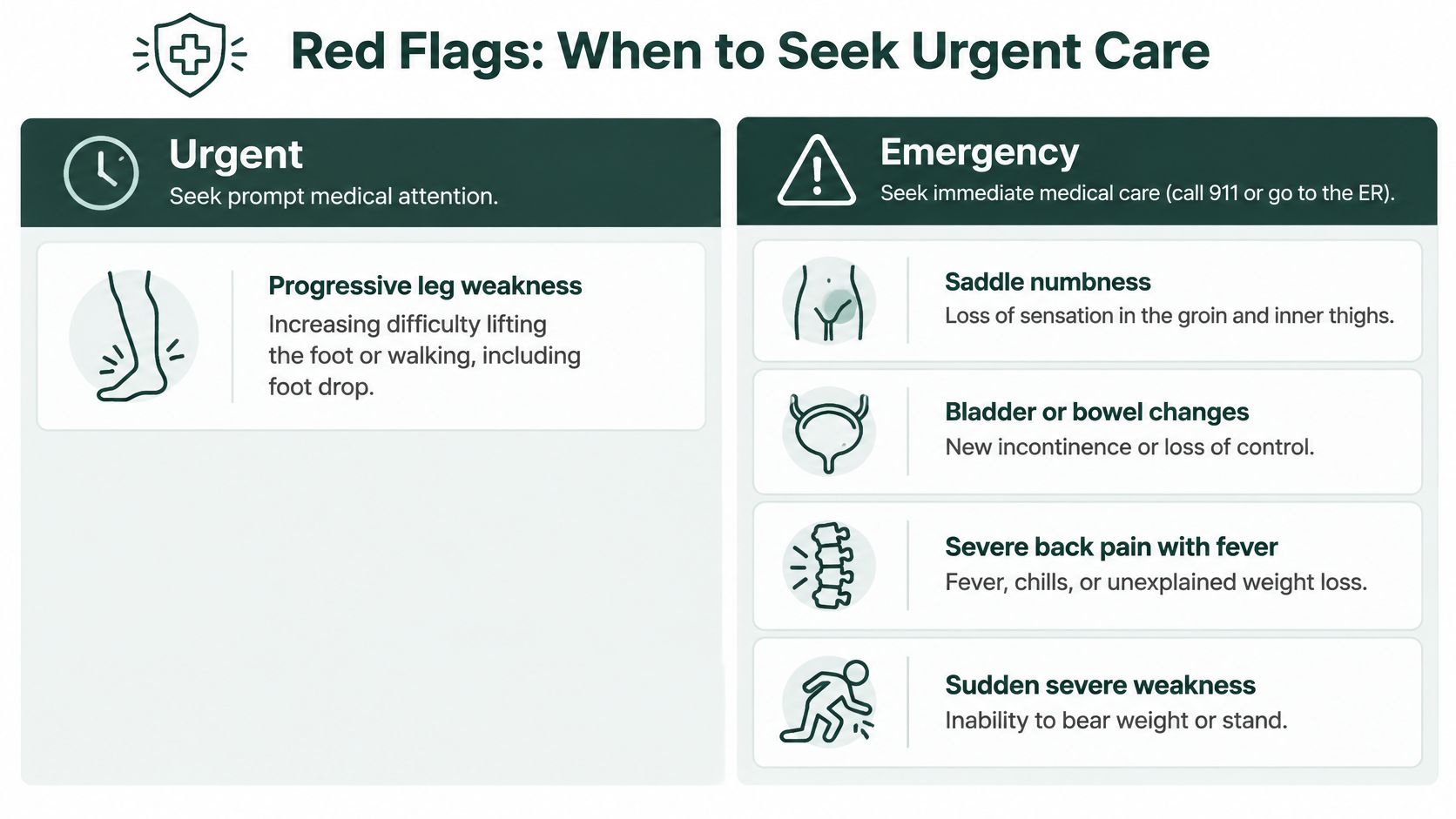
Emergency findings that need same-day assessment
- Saddle numbness: loss of sensation in the groin and inner thighs, which can signal compression of the cauda equina nerve bundle.
- New bladder or bowel dysfunction: difficulty starting urination, incontinence, or loss of bowel control.
- Bilateral leg symptoms: weakness or numbness affecting both legs rather than one.
- Sudden severe weakness: inability to bear weight or stand.
Cauda equina compression is a surgical emergency, and the window for preserving function is measured in hours, not weeks. Anyone with saddle numbness or new incontinence goes to emergency care the same day, regardless of what the buttock feels like.
Urgent findings that need prompt evaluation
- Progressive leg weakness, including increasing difficulty lifting the foot or walking, and foot drop.
- Fever or chills with back pain, which raises concern for infection.
- Unexplained weight loss or a history of cancer, both of which change the pretest probability of a spinal lesion.
- Significant trauma or a fall, especially in anyone with osteoporosis or on long-term steroids.
A patient who notices new foot weakness shouldn't spend three weeks on piriformis stretching hoping it settles. The weakness moves the problem onto a spinal pathway.
Decision rule: if any red flag is present, seek urgent care first and sort out the piriformis-versus-spine question afterwards.
Persistent pain with stable neurologic findings is a different situation. That pattern can usually wait for a scheduled assessment with a proper examination. The line that matters is change: new weakness, new numbness, or rapidly worsening symptoms get evaluated now, while a stable ache that has lasted months gets evaluated properly.
Diagnostic Tests and What They Can and Cannot Prove
Clinical tests for piriformis syndrome can shift the diagnosis toward or away from it, but their accuracy varies with the test and the study population.
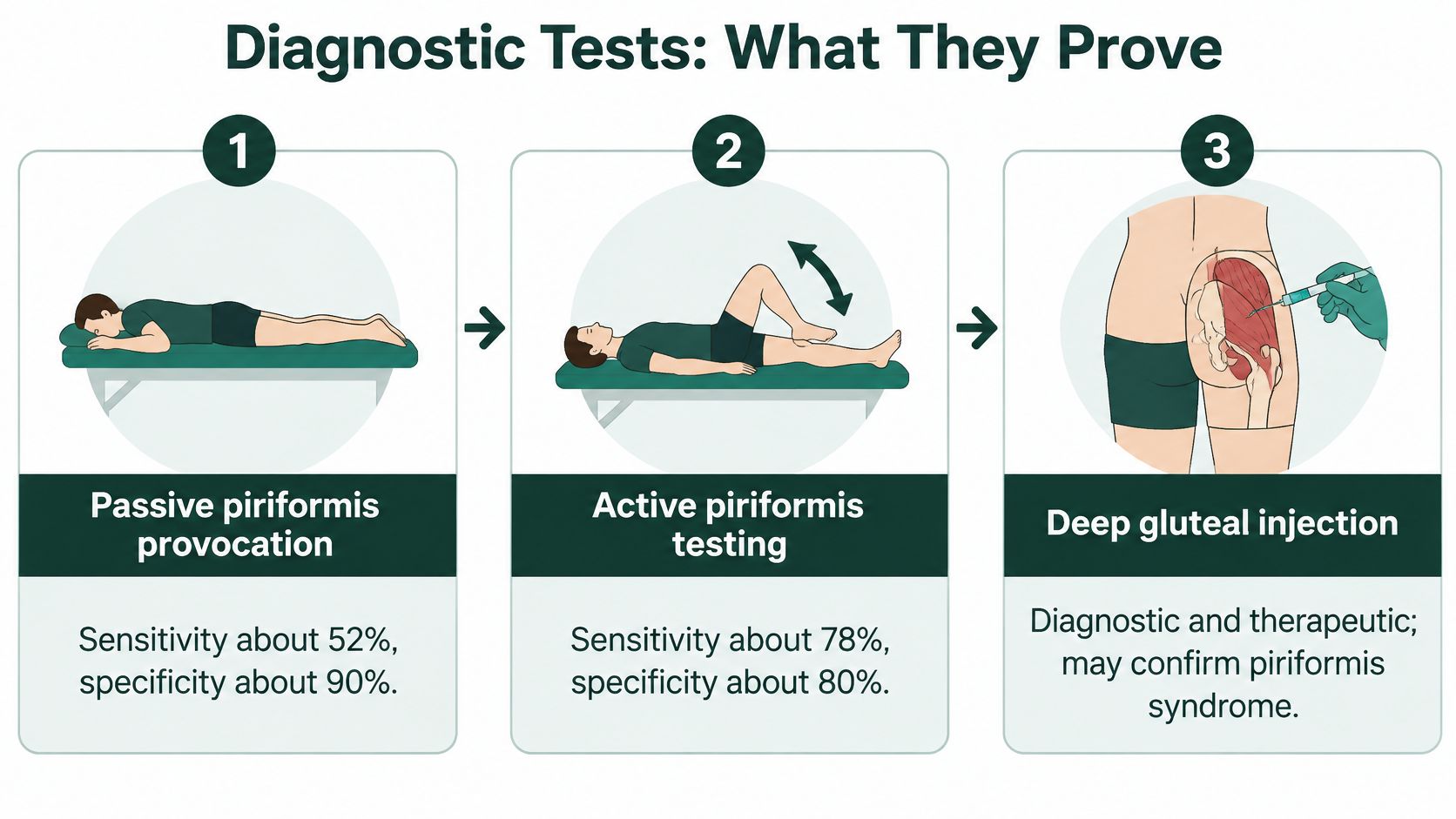
| Test | Sensitivity | Specificity or positivity | Caveat |
|---|---|---|---|
| Passive piriformis provocation | About 52% | About 90% specificity | Varies by study definition |
| Active piriformis test | About 78% | About 80% specificity | Varies by study definition |
| Active piriformis test, deep gluteal dataset | Not reported separately | 89% symptomatic-side positivity | Positivity, not paired accuracy |
| HCLK maneuver | Not reported separately | 84% symptomatic-side positivity | Positivity, not paired accuracy |
| FAIR test | Not reported separately | 74% symptomatic-side positivity | Positivity, not paired accuracy |
| FAIR-position H-reflex criterion | About 88.1% | About 83.2% | Operational definition, not universally validated |
The deep gluteal positivity figures and FAIR-position H-reflex estimates are summarized in the clinical reference on piriformis syndrome testing. A positive result may strengthen suspicion, while a negative result cannot reliably exclude the condition when sensitivity is limited.
Why the percentages don't transfer cleanly
Spectrum bias arises when studies enroll patients who already resemble people with the condition. Results may then overstate how well a test performs in a general clinic, where many cases of leg pain have a spinal cause. Verification bias occurs when studies use different reference standards, such as response to injection, clinical assessment, or imaging not designed to answer the same diagnostic question.
Overlap adds another limit. Some study participants have both lumbar radiculopathy and deep gluteal tenderness, so a positive piriformis test does not establish which structure is producing the symptoms.
A practical examination sequence
- Take the history first. Record where pain begins, how long sitting is tolerated, and whether coughing or hip rotation provokes it. These details shape how later findings are interpreted.
- Palpate the sciatic notch. Localized tenderness can add context, though tenderness alone does not identify the pain source.
- Test resisted hip abduction and external rotation. Note whether these movements reproduce the familiar pain.
- Complete a neurologic screen. Assess strength, sensation, and reflexes to help determine whether a spinal cause remains plausible.
- Image the lumbar spine when radiculopathy is plausible. Imaging addresses possible spinal causes; it does not directly establish a gluteal diagnosis.
- Consider diagnostic injection after assessing alternatives. Relief after local anesthetic may support a suspected source, but it must be interpreted alongside the history and examination.
Piriformis syndrome remains a diagnosis of exclusion: no single maneuver or scan settles the question, and overlapping spinal and gluteal findings can make an either-or answer misleading.
Treatment Options Compared by Cause
Treatment should match the suspected source of pain. A plan aimed at the deep gluteal muscles may not address a compressed lumbar nerve root, and the reverse is also true.
| Treatment | Best suited to | Key consideration |
|---|---|---|
| Activity change and over-the-counter pain relief | Early or mild symptoms in either condition | Discuss medication choice with a clinician |
| Physical therapy (stretching, strengthening, nerve mobility) | Piriformis-pattern pain and disc-related sciatica | Usually runs for several weeks before it is judged |
| Osteopathic manipulative treatment | Musculoskeletal pain and mobility limits | Requires assessment for urgent spinal causes |
| Local injection (corticosteroid or local anesthetic) | Selected piriformis-pattern cases after alternatives fail | May also serve as a diagnostic check, so timing matters |
| Epidural steroid injection | Persistent radicular pain from a lumbar nerve root | Targets the nerve root in the spine, not the buttock |
| Regenerative injection (prolotherapy) | Selected musculoskeletal pain | Suitability for sciatica-related symptoms requires individual assessment |
| Surgery (piriformis release or lumbar discectomy) | Persistent, severe or deficit-causing cases | Considered when conservative care has not helped |
For piriformis-pattern pain, conservative care may focus on stretching that combines hip flexion, adduction, and internal rotation, strengthening the hip abductors and external rotators, and reducing prolonged sitting. Disc-related pain may call for lumbar stabilization, nerve mobilization, and avoiding end-range flexion or straining. A buttock-focused stretching program can delay treatment of a herniated disc for weeks. Osteopathic treatment for sciatica pain relief may be considered within a plan for musculoskeletal pain and restricted mobility.
Osteopathic manipulative treatment also belongs among conservative options when an examination supports a musculoskeletal cause and urgent spinal causes have been ruled out. Evidence for manual treatment in these specific conditions remains limited, so it is best viewed as a possible way to relieve symptoms, not a cure.
What an injection response tells you
A local injection of corticosteroid or anesthetic into the deep gluteal space may both treat symptoms and test whether that area is contributing to pain. In the cohort described earlier, 40.9% met the study's diagnostic response criterion after local injection. A response can inform the assessment, but it does not prove the diagnosis: injectate may spread, needling itself may affect symptoms, and expectations can influence pain reporting.
Regenerative injection therapy is a separate category. Prolotherapy involves injecting a solution, commonly containing a dextrose-based proliferant, into targeted musculoskeletal tissues. At Restore Osteopathic Medicine, a single Prolotherapy treatment costs $255, and a 5-treatment package costs $870. Regenerative injection therapy may be evaluated for joint pain in the knees, shoulders, or hips, ligament and tendon injuries, chronic back or neck pain, arthritis, and joint instability. Evidence for its use in piriformis syndrome or disc-related sciatica remains limited, and an evaluation is required to determine whether it is appropriate for an individual patient.
Surgery addresses different targets depending on the diagnosis: piriformis release may be considered for persistent deep gluteal entrapment, while discectomy or decompression addresses a nerve root that remains compressed despite conservative care.
Confirm the Right Path Before You Treat
Start by drawing the pain before the appointment. Mark where it begins, where it travels, and whether it extends below the knee. Note what aggravates it, such as sitting, bending, coughing, or rotating the hip. A simple diagram can help you describe the pattern clearly.
- Check for the emergency and urgent findings listed above.
- Choose a clinician who examines both regions. A primary care physician, physiatrist, spine specialist, or sports medicine physician can assess the neurologic system and perform relevant provocative tests. An examination focused on only the spine or only the hip may leave the other possible source unexplored.
- Agree on a defined treatment trial and track your response. Over four to six weeks, record sitting tolerance, activity levels, and medication use. Ask for reassessment if symptoms remain unchanged or worsen rather than extending the same plan.
- Request imaging only when the examination points to a spinal cause.
Bring the pain diagram, a sitting and activity log for a typical week, and a list of current medications, including over-the-counter products. How symptoms respond to conservative care over four to six weeks can help guide reassessment and changes to the treatment plan.
A clinic offering osteopathic and integrative care may assess both spinal and deep gluteal contributors. At Restore Osteopathic Medicine, regenerative injection therapy requires an evaluation to determine whether it is appropriate for a particular patient, so discuss it after the examination rather than treating it as a default option.
For people in the Aurora or Denver area, Restore Osteopathic Medicine offers physician-led care that includes osteopathic manipulative medicine and regenerative therapies. Prolotherapy may be considered for selected musculoskeletal concerns as part of an individualized plan. Learn about Restore Osteopathic Medicine.