
You're getting out of the car and your hip aches, but it's the numb patch down your outer thigh or across the top of your foot that stops you. The hip is where it hurts most, so it feels logical to assume the hip is the problem. That assumption is exactly where hip pain and numbness in leg symptoms mislead people.
Pain location and nerve territory aren't the same thing. A nerve irritated in your lower spine can send pain into the buttock and hip while the numbness shows up much farther down. Sorting out which pattern you have, and whether any warning signs need same-day care, helps you book the right examination instead of treating the wrong place. This guide supports that decision. It doesn't replace an in-person assessment.
Table of Contents
- Match Your Pain Pattern to the Likely Source
- Red Flags That Need Urgent Care
- Why Leg Numbness Usually Starts in the Spine
- Hip Joint and Nerve Causes Beyond the Spine
- Bedside Clues That Point to a Specific Nerve Level
- First Steps for the Next Two Weeks
- Book the Right Evaluation for Your Leg Symptoms
- Compare Options Before You Commit
Match Your Pain Pattern to the Likely Source
Use this table as a starting map, not a diagnosis. Match where the pain sits and where the numbness runs, then use the next step column to plan your appointment.
| Pattern | Likely source | What it suggests | Next step |
|---|---|---|---|
| Shooting pain and numbness from buttock down back or outer leg | Lumbar nerve root, often L5 or S1 | Radiculopathy or sciatica | Spine-focused exam and neurologic check |
| Numbness over front or outer thigh, no back pain | Lateral femoral cutaneous nerve near the hip | Meralgia paresthetica | Clinical exam; hip imaging is often normal |
| Deep groin pain worse with weight bearing or rotation, little numbness | Hip joint, such as osteoarthritis or labral tear | Hip joint pathology | Hip-focused exam and imaging |
| One-sided buttock or low back pain, tender over sacroiliac joint | Sacroiliac joint | SI joint dysfunction | Provocation tests and exam |
| Numbness around genitals or anus, bladder or bowel change | Cauda equina compression | Possible emergency | Same-day emergency assessment |
A shooting line from buttock to calf points away from the hip joint and toward a lumbar nerve root. Numbness confined to the front or outer thigh, without back pain, points to a small sensory nerve trapped near the hip. Deep groin pain that worsens when you bear weight or rotate the hip, with little numbness, fits the joint itself.
Buttock pain with tenderness over the back of the pelvis fits the sacroiliac joint more than the hip socket. The last row is different in kind, not just degree. It needs emergency care, not watchful waiting.
Three Questions to Answer Before Your Appointment
- Where does numbness begin: Note the first spot, not just where it ends.
- Does it follow one path: A narrow strip down the leg suggests one nerve territory.
- What changes it: Record whether sitting, walking, or coughing makes it better or worse.
Find the row closest to your pattern. If it's the last row, read the red flags next and act today. If it's the first row, the spine sections will matter most. If it's the second or third, focus on the hip and peripheral nerve causes.
Red Flags That Need Urgent Care
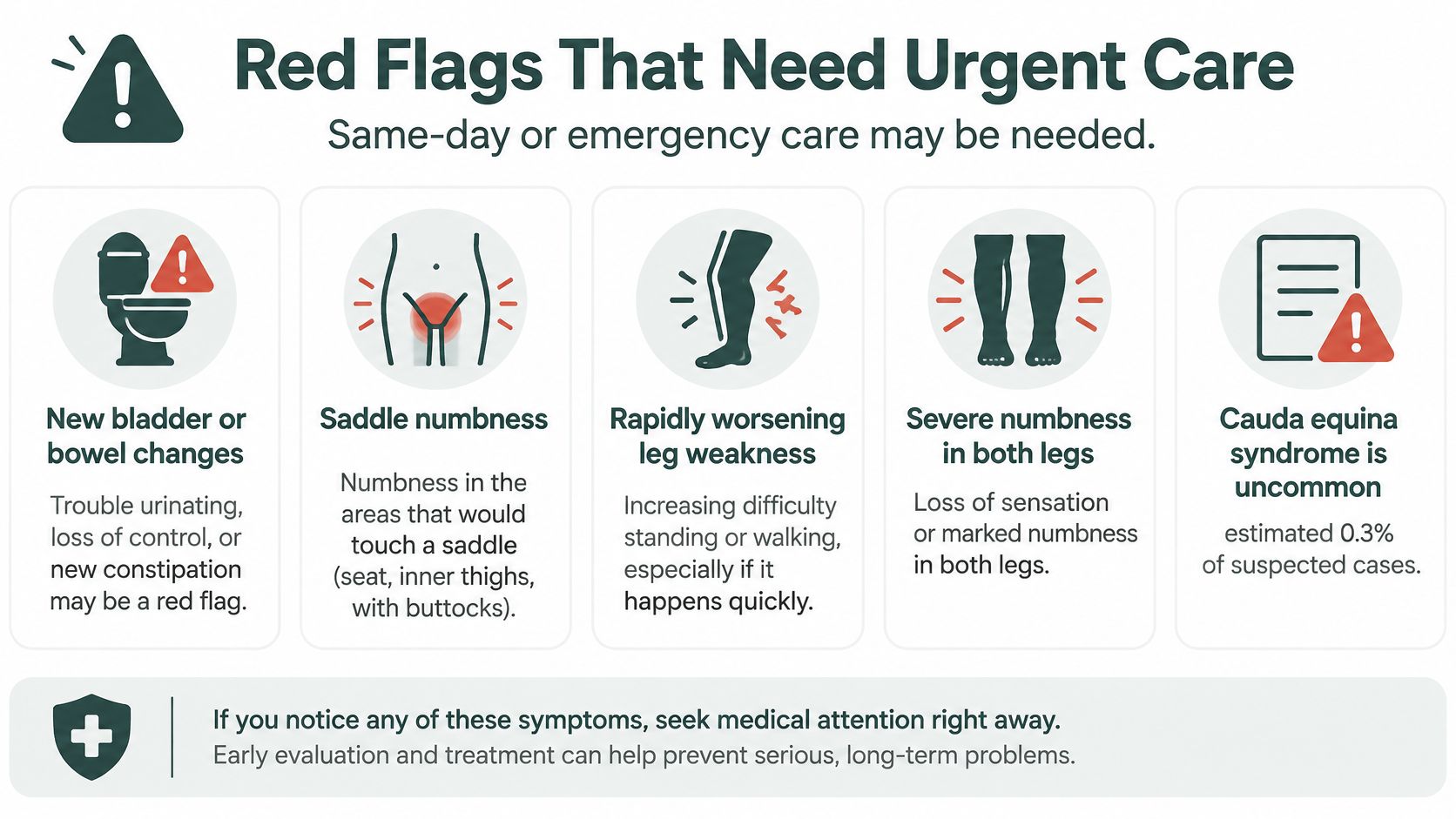
If leg numbness comes with new bladder or bowel trouble, numbness around the genitals or anus, symptoms in both legs, or rapidly worsening weakness, get same-day or emergency care rather than booking a routine visit.
The Checklist
- Saddle numbness: Reduced feeling around the genitals, buttocks, or anus, the area that would touch a saddle.
- Bladder or bowel change: Trouble starting urine, poor stream, loss of sensation, incontinence, or new bowel dysfunction.
- Both legs involved: Numbness, pain, or weakness spreading to the second leg.
- Progressive weakness: Foot drop, tripping, a knee that buckles, or strength that's clearly worse than yesterday.
- Other warning context: Fever with back pain, recent significant trauma, or unexplained weight loss.
If you can't pass urine at all, seek emergency care at once. Don't wait to see if it resolves overnight.
These signs matter because of cauda equina syndrome, compression of the bundle of nerves below the spinal cord. It's uncommon. A recent guideline review on cauda equina syndrome estimates that approximately 0.3% of patients presenting with low back pain have cauda equina syndrome. Most leg numbness isn't this, and the checklist is a filter, not a reason for panic.
When it does occur with acute disc prolapse, the same review reports severe back pain in 96% of patients and sciatica in 93%. Urinary retention was reported in 41%, other bladder symptoms in approximately 40%, bowel dysfunction in 39%, and reduced saddle sensation in 67%.
A separate analysis of 256 patients found severe or progressive bilateral neurologic deficits in 50.78%, urinary or fecal incontinence in 35.16%, and leg weakness or anesthesia in 24.22%. Those numbers explain why clinicians treat bilateral symptoms and bladder change as urgent even though the condition itself is rare.
If none of these apply, you don't need an emergency department today. You still need a timely evaluation, because persistent numbness means a nerve isn't signaling normally and someone should find out why.
Why Leg Numbness Usually Starts in the Spine
Think of a garden hose kinked near the tap. The kink is in one place, but the weak flow shows up at the far end. A nerve root works in a similar way. Pressure or inflammation where the root leaves your spine can produce pain in the buttock and hip, with numbness in the thigh, calf, or foot.
That pattern is called lumbar radiculopathy, often described to patients as sciatica when pain travels down the leg. A clinical article on lumbar radiculopathy epidemiology and symptoms reports that lumbar radiculopathy affects approximately 3-5% of adults, while sciatica-like symptoms occur in roughly 13-40% of people at some point during life. Radiculopathy also represents about 5-10% of low-back-pain cases.

Each root supplies a strip of skin called a dermatome. That's why location matters so much. Numbness on top of the foot points to a different root than numbness along the inner foot. You're not just reporting that it feels odd. You're giving the clinician a map coordinate.
In clinical descriptions, paresthesia such as pins-and-needles is reported in approximately 63-72% of patients with lumbar radiculopathy. About 27% report numbness and approximately 35% experience pain radiating into the lower limb. So numbness without dramatic pain still fits a nerve root problem. Pain intensity alone doesn't rule it in or out.
The L5 nerve root is the most frequently affected lumbar root. Its territory helps explain symptoms that run through the buttock, outer thigh, leg, or foot, which is why many people first call it hip pain. Lower down, an explanation of S1 bulging disc symptoms shows how a neighboring level can send symptoms toward the calf and outer foot instead.
These figures describe groups. They don't diagnose you. Peripheral nerve entrapment, spinal stenosis, sacroiliac region disorders, and less commonly vascular or systemic conditions can mimic the same complaint.
Hip Joint and Nerve Causes Beyond the Spine
Not every case starts at a nerve root. Some start in the joint, and some start where a smaller nerve passes the hip.
When the Joint Is the Generator
Hip osteoarthritis and labral tears usually produce deep groin or front-of-hip pain. It's worse with weight bearing, stiff after rest, and limited when the clinician rotates the hip inward. Numbness is usually minor or absent, because a worn joint generates pain without interrupting nerve signals. If you're cupping the side of your hip to show where it hurts and stairs provoke it, the joint moves up the list.
Alignment can load that joint unevenly over time. The relationship described in scoliosis and hip problems is one example of posture and pelvic mechanics changing how the hip bears weight.
When a Peripheral Nerve Is Trapped
Meralgia paresthetica compresses the lateral femoral cutaneous nerve near the inguinal ligament at the front of the pelvis. It causes burning, tingling, or numbness over the front and outer thigh only. It doesn't weaken the leg, because this nerve carries sensation, not motor signals. Tight belts or clothing, weight gain, pregnancy, and diabetes are common contributors.
Sciatic nerve entrapment deeper in the buttock, near the piriformis and other deep hip structures, is less common. It typically causes buttock pain radiating down the back of the leg and can be hard to separate from a spinal source on symptoms alone.
If numbness spreads in a stocking pattern, affects both feet, or comes with a longer history of sensory change, a broader nerve condition may also need consideration. Readers exploring that wider picture can explore peripheral neuropathy care options from Sunridge Medical as background before discussing testing with their own clinician.
Normal hip imaging does not rule out a meaningful nerve problem. An X-ray can look fine while a nerve root or peripheral nerve is clearly irritated.
A review on distinguishing hip and spine pain sources notes that diagnostic hip injection may help determine whether the hip joint is the primary pain generator, with reported accuracy above 90% in the cited review. That figure reflects that specific review's conditions, not a guarantee for every clinic or patient. The logic is simple. If numbing the joint removes the pain, the joint was likely generating it. If numbness in the leg remains unchanged, look elsewhere.
Bring one question to your appointment. After the hip has been checked, does the nerve territory examination still match where your numbness runs? That question prevents a hip-only workup from ending the search.
Bedside Clues That Point to a Specific Nerve Level
A good examination tests sensation, strength, and reflexes level by level. That tells the clinician more than a pain score, because each root has a predictable job.
| Nerve level | Sensation to check | Strength to test | Reflex to check |
|---|---|---|---|
| L4 | Medial malleolus and medial foot | Knee extension | Patellar (knee) reflex |
| L5 | Dorsum of the foot | Hip abduction, ankle dorsiflexion, great-toe extension | No single standard reflex |
| S1 | Lateral foot | Plantarflexion and heel raise | Achilles (ankle) reflex |
The NCBI clinical reference on lumbosacral radiculopathy describes L4 involvement reducing sensation near the medial malleolus or medial foot and affecting knee extension or the patellar reflex. L5 involvement may cause numbness over the dorsum of the foot and weakness of hip abduction, ankle dorsiflexion, or great-toe extension. S1 involvement may affect the lateral foot and Achilles reflex.
Notice the practical consequences. L5 weakness can make your toes catch on the ground. L4 weakness can make the knee feel unreliable on stairs. S1 weakness shows up when you try to push off or stand on your toes.
Provocation Tests and Gait
During a straight-leg raise, the clinician lifts your straight leg while you lie on your back. Radiating symptoms reproduced between approximately 30 and 60 degrees support lower-lumbar nerve-root irritation. A tight hamstring ache alone doesn't count. The test is positive when it reproduces your traveling symptoms.
The femoral nerve stretch test, done face down with the knee bent, is more relevant to upper-lumbar L2-L4 disease that sends symptoms into the front of the thigh. Clinicians also watch you walk on your heels and toes. Heel walking stresses ankle dorsiflexion, toe walking stresses push-off strength, and both expose weakness you might not notice sitting down.
Toe drag, knee buckling, persistent objective deficits, or progressive weakness warrant prompt assessment. At that point MRI or electrodiagnostic testing may be justified to define the involved level and confirm whether the problem sits at the root or farther along the nerve.
Start a Symptom Diary
- Location: Shade or describe the exact numb area.
- Timing: Note time of day and how long episodes last.
- Triggers and relievers: Sitting, walking, bending, lying down.
- Weakness events: Tripping, foot slapping, trouble with stairs.
Two weeks of that record is more useful than trying to reconstruct it from memory in the exam room.
First Steps for the Next Two Weeks
This routine is for people without red flags who are waiting for an appointment. It's a bridge to evaluation, not a substitute for it.
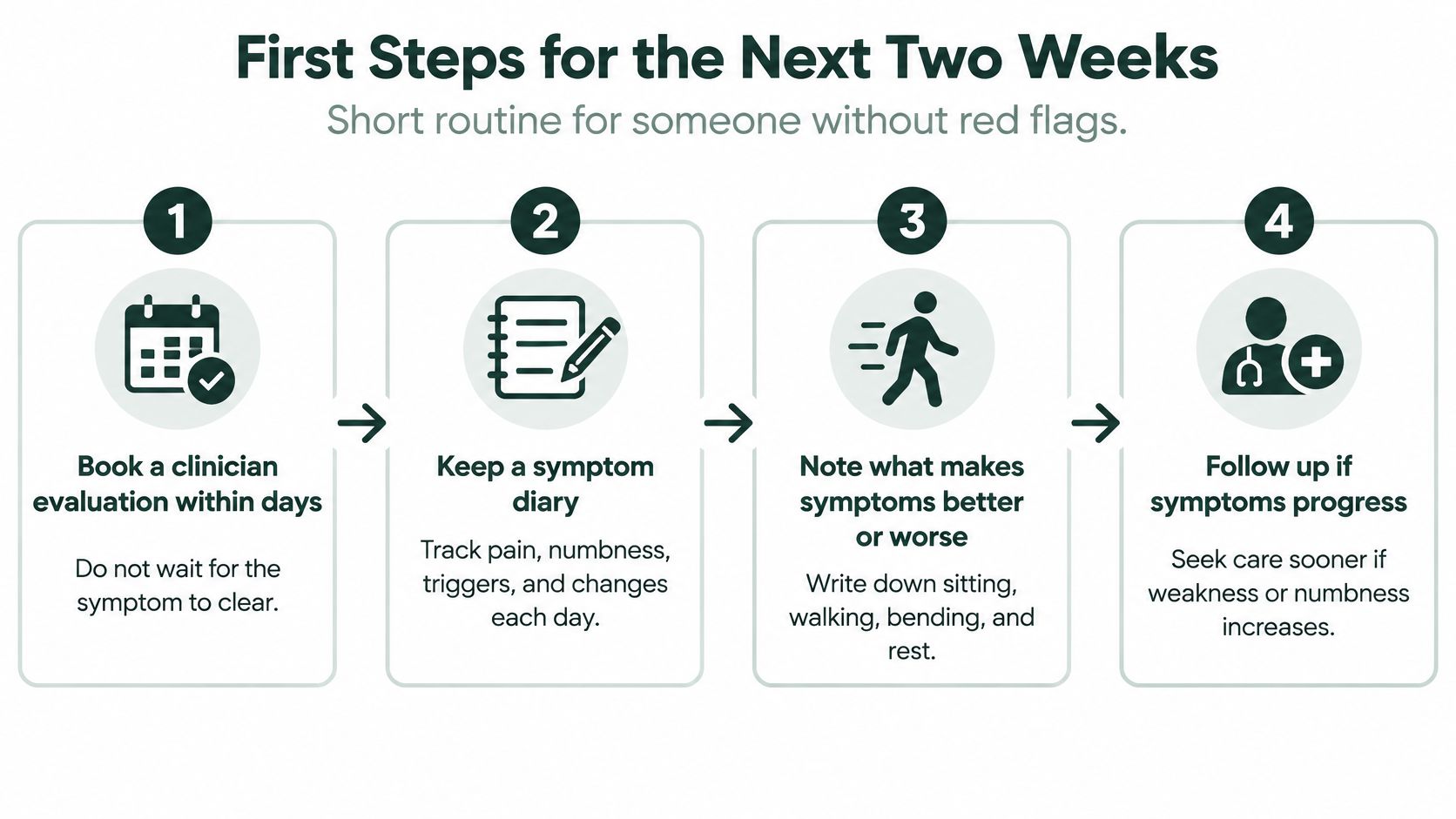
- Book a clinician evaluation within days. Don't wait for numbness to clear before calling. Early documentation of strength and sensation gives later visits a baseline to compare against.
- Keep a daily symptom diary. Record location, timing, triggers, relievers, and any weakness. This helps the clinician localize the level faster and spot progression you'd otherwise miss.
- Keep moving within comfort. Use short, frequent walks and regular position changes instead of long bed rest. Prolonged stillness stiffens joints and can slow recovery, while gentle movement maintains circulation and function.
- Adjust sitting and driving. Use a small lumbar support, keep both feet supported, and take a break every 30 to 45 minutes to stand or walk. Sustained flexed sitting commonly aggravates nerve root symptoms.
- Ask before medicating. Check with a pharmacist or clinician about which over-the-counter pain relief suits your medical history, other medications, and kidney, stomach, or blood pressure concerns. Don't guess if you take anticoagulants or have chronic conditions.
- Avoid heavy lifting and repeated twisting. Skip loaded bending and twisting until the affected level is confirmed. You're reducing mechanical stress on a structure nobody has identified yet.
- Review on day 7 and day 14. Write down whether numbness is stable, improving, or worsening compared with day one. Worsening numbness or new weakness means you return promptly, not at the next routine slot.
If your diary points toward the back of the pelvis rather than a nerve strip, practical background on how to treat sacroiliac joint pain can help you describe that pattern accurately at your visit.
Will It Settle on Its Own
Stable, mild symptoms without red flags may be monitored while your evaluation is pending, and some nerve irritation does calm down. That doesn't make waiting a treatment plan. Your clinician sets the timeline for further waiting, imaging, or referral after examining you.
Reassuring progress looks like stable or shrinking numbness and less pain doing the same activity. Escalate if the numb area expands, weakness appears, both legs become involved, or bladder or bowel function changes.
Book the Right Evaluation for Your Leg Symptoms
Start with primary care, or a spine or hip specialist if you already have access, and ask for an assessment that includes both a neurologic examination and a hip examination. One without the other leaves half the differential untested. For nonurgent cases, physiotherapy or osteopathic evaluation of neuromusculoskeletal function can also document strength, gait, mobility, and symptom behavior.
If any red flag is present, skip that sequence and go to emergency care at once. Routine referral pathways aren't built for progressive weakness or bladder retention.
What to Bring
- Your symptom diary: Location, timing, triggers, and weakness events.
- A medication list: Names, doses, and anything you've tried for this pain.
- Key dates: When symptoms began and when they changed.
- Existing reports: Any hip or spine imaging already on file.
- Provoking activities: The specific movements or positions that worsen symptoms, so the clinician can test them.
One local option to compare is Restore Osteopathic Medicine, a physician-led clinic in Aurora, Colorado, where Dr. Benjamin Keaton, DO, practices osteopathic neuromusculoskeletal medicine. Patients are assessed before any treatment is discussed, and the clinician, not this article, decides whether the source is nerve, joint, or spine. Where joint pain is part of the picture, regenerative injection therapy may be evaluated for joint pain in the knees, shoulders, or hips, ligament and tendon injuries, chronic back or neck pain, arthritis, and joint instability.
Treat that as one option among others, judged by the same standard. Does the evaluation test both the hip and the nerve levels your pattern suggests?
Do three things this week. Write the diary, check yourself against the red flag list, and book the evaluation.
Compare Options Before You Commit
Different first appointments answer different questions, and choosing well saves you a second round of referrals. Compare what each route examines before you commit time and money.
What Each Route Does Best
Primary care is the right entry point when you're unsure of the source. Your clinician can run the neurologic screen, examine the hip, review medications and medical history, and decide whether imaging or referral comes first. It's also the fastest route to urgent escalation if the examination finds weakness.
A hip specialist answers a narrower question well. Expect detailed joint testing, imaging review, and possibly a diagnostic injection discussion when groin pain and restricted rotation dominate. If your main complaint is a numb strip down the leg, ask upfront whether nerve levels will also be assessed.
A spine-focused evaluation fits shooting leg pain, dermatomal numbness, or a positive straight-leg raise pattern. Expect level-by-level strength, reflex, and sensation testing, plus a clear threshold for when MRI becomes worthwhile rather than automatic.
Physiotherapy or osteopathic neuromusculoskeletal evaluation suits nonurgent cases where function is the immediate problem. You'll get gait and movement assessment, a graded activity plan, and monitoring over visits. Confirm how the clinician will flag deterioration and refer back if numbness spreads or strength drops.
Decision rule: Choose the clinician who will examine both where it hurts and where the numbness runs. If only one gets tested, the other source stays unexamined.
Questions That Reveal Quality
- Which nerve levels will you test: A specific answer beats a general one.
- What would change your plan: Look for named triggers, such as progressive weakness or persistent deficit.
- When do we recheck: Stable symptoms still need a review date.
- What happens if imaging is normal: The answer should include the clinical examination, not dismissal.
Cost and convenience matter, but they come after fit. A nearby appointment that examines the wrong structure isn't a shortcut. It's a delay with a receipt.
Bring your table row, your diary, and these questions. You'll leave with a named working diagnosis, a level to monitor, and a clear point at which the plan escalates. That's what a good first evaluation for hip pain and numbness in leg symptoms should deliver.
If you're in the Aurora or Denver area and your symptoms match the patterns above, Restore Osteopathic Medicine offers physician-led osteopathic neuromusculoskeletal evaluation that examines the hip, spine, and nerve function together before any treatment is discussed. Bring your symptom diary, note where the numbness runs, and get a clear answer on which structure needs attention. Visit Restore Osteopathic Medicine to book your assessment.