
You're fine sitting down. Then you stand up, take those first steps to the kitchen, and your ankle complains. Or it starts softly and builds halfway through a walk until you're shortening your stride, turning your foot out, and wondering whether you should keep going.
That pattern is useful information. Ankle pain when walking isn't one problem with one fix. Where it sits, when it appears in your step, and how long it's lingered point toward different tissues and different next steps. Learning to read those clues helps you decide what to load, what to protect, and when waiting stops being sensible.
Table of Contents
- Common Causes of Ankle Pain When Walking
- How to Find Where Your Ankle Pain Starts
- Pain That Starts Elsewhere in the Walking Chain
- When a Sprain Is Not Healing as It Should
- Loading Tendon Pain Without Making It Worse
- Treatment Options Matched to Each Cause
- Red Flags and When to See a Clinician
Common Causes of Ankle Pain When Walking
Say your first steps after getting up are stiff and sore, then things loosen. On another day, you're comfortable at the start of a long walk and aching by the end. Those are different stories, and they rarely mean the same tissue is irritated.
Many people assume arthritis explains most cases, especially after age 50. The picture is broader. In the Clinical Assessment Study of the Foot, a community based investigation of 5,109 adults aged 50 years and older in four United Kingdom general practices, the weighted prevalence of ankle pain was 11.7%, while symptomatic radiographic ankle osteoarthritis was present in 3.4% of participants. That gap matters. Pain during weight bearing can come from a previous injury, a tendon or ligament problem, altered mechanics, inflammation, or a nearby structure, even when an X-ray doesn't meet criteria for osteoarthritis.
Why Location Beats Intensity
A pain score tells a clinician how much it hurts. It doesn't tell them what's loaded when it hurts. Pain at push-off stresses the calf, Achilles tendon, and forefoot. Pain as your heel lands loads different structures. Pain only on uneven ground often reflects control and stability, not just tissue damage. Two people can both report pain at a six out of ten and need opposite advice.
That's why a starting map based on location and trigger is more helpful than a generic label. Use it to narrow possibilities, not to settle a diagnosis.
| Cause | Where pain sits | When it hurts while walking | Other clues |
|---|---|---|---|
| Lateral ligament sprain | Outer ankle | Push-off and uneven ground | Swelling, giving way, lingering after a twist |
| Achilles tendinopathy | 2 to 6 cm above the heel bone | Hills, stairs and toe-off | Morning stiffness, pain after rest |
| Posterior ankle impingement | Back of the ankle, deep | Pointing toes down, push-off | Pinching, limited pointing range |
| Ankle osteoarthritis | Inside the joint, front and center | Stiff first steps, after long standing | Reduced motion, grinding, swelling after activity |
| Peroneal tendon problem | Outer ankle, behind the bone | Uneven ground and side to side steps | Snapping, weakness, instability |
| Nerve entrapment | Inner ankle and sole | Long walks, standing still | Burning, tingling, numbness |
| Stress or occult fracture | Focal point on bone | Worsens with each step | Focal bone tenderness, inability to bear weight |
Reading the Table Without Overreading It
Notice how causes overlap on the outer ankle. A ligament sprain and a peroneal tendon problem can both hurt there, but snapping behind the bone and weakness when you turn the foot outward shift suspicion toward tendon. Burning and tingling shift it toward nerve, which is a different workup again.
Patterns elsewhere in the leg can also mislead you. Someone trying to understand joint irritation may read about what causes knee inflammation and recognize similar language about stiffness and swelling. The words overlap, but the walking mechanics at the ankle are specific, so you still need ankle specific clues.
A table like this narrows the field. It cannot tell a healing ligament from a small fracture that didn't show up on your first assessment.
Treat your best matching row as a hypothesis. The next task is testing that hypothesis against how your own ankle behaves, step by step.
How to Find Where Your Ankle Pain Starts
Consider a 58 year old who walks the dog each morning. The pain shows up at push-off during the first ten minutes, eases by midday, and returns on hills. There's no recent twist and no swelling. That story already makes a fresh sprain unlikely and makes tendon load worth checking.
You can gather the same kind of detail at home. The 2025 Washington State guideline on work related mechanical foot and ankle conditions recommends distinguishing ankle pain from toe, midfoot, hindfoot, medial, lateral, dorsal, and plantar pain before deciding on tests or treatment. That distinction matters because walking pain can reflect tendon, ligament, bone, nerve, or adjacent foot problems rather than the ankle joint itself.
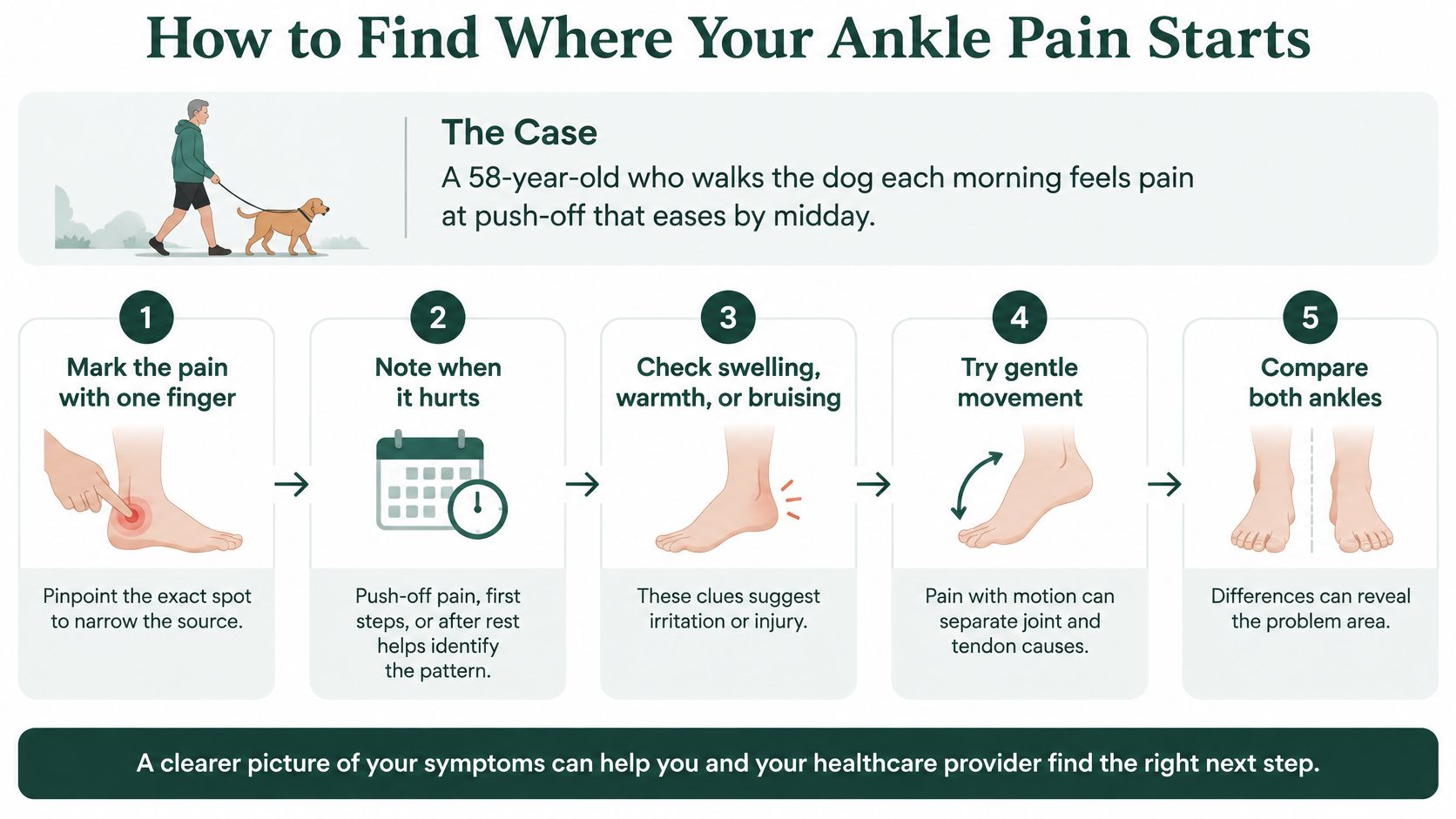
Five Checks You Can Do Carefully
- Mark the pain with one finger. Point to the exact spot, not the whole ankle. A single fingertip on bone means something different from a palm sized ache around the joint.
- Compare surfaces and slopes. Walk on level ground, then try stairs, a gentle hill, and, only if it's safe, slightly uneven ground. Note whether pain hits at heel strike, mid stance, or push-off, because each phase loads tissue differently.
- Try a single leg heel raise. Hold a counter for balance, rise onto your toes on one side, then the other, and count repetitions. Pain, weakness, or a big side to side difference points toward the calf and Achilles mechanism.
- Check swelling, stability, and sensation. Look for puffiness compared with the other ankle, test whether you can stand steadily on one leg, and note any numbness or tingling. Instability and altered sensation change the differential.
- Press gently along the back of the ankle. Tenderness in the tendon a few centimetres above the heel bone supports tendon involvement. Pain that's stronger with pressure in front of the tendon, deep at the back of the joint, raises posterior impingement instead.
What These Checks Can and Cannot Do
For the morning dog walker, the checks might line up neatly. One finger lands above the heel bone, hills provoke it, heel raises reproduce it, and there's no instability. That pattern supports the Achilles row of the earlier map. It still doesn't confirm tendinopathy or rule out a second problem alongside it.
Self checks sort suspicion. They don't replace hands on examination, strength testing, or imaging when the story doesn't fit.
Record four things for your clinician. Write down where you pointed, when in the step it hurt, how many heel raises you managed on each side, and what happened the next morning. That short log is far more useful than reporting that your ankle hurts when walking and leaving it there.
Stop any check that causes sharp pain, a feeling of giving way, or an inability to bear weight. You're gathering information, not proving toughness.
Pain That Starts Elsewhere in the Walking Chain
Some people only notice ankle soreness after a long shift. They rest the ankle, ice it, and buy new shoes, yet the pattern repeats. The missing piece may be that the ankle isn't where the problem starts. It's where extra load ends up.
Walking is a chain. Your foot accepts weight, your ankle lets your shin travel over it, and your knee and hip control the leg above. When one link stiffens or weakens, a neighbor often pays for it.
Four Sources That Masquerade as Ankle Pain
- Plantar fascia or midfoot pain: Sharp pain under the heel or arch with your first steps out of bed, felt under the foot rather than around the ankle. Pressing the sole reproduces it more reliably than moving the ankle.
- Hip or knee compensation: Stiffness higher up shortens your stride and shifts work onto the ankle, so ankle pain arrives late in a walk alongside groin, hip, or knee symptoms. Readers sorting out that pattern often start with guidance on hip pain and numbness in the leg to separate joint stiffness from nerve symptoms.
- Nerve referral from the lower back: Burning, tingling, or numbness spreading down the leg into the foot after standing, often with back stiffness. Ankle movement alone doesn't reproduce it, and coughing or prolonged standing might.
- Toe or midfoot pain: Pain at the ball of the foot or when pushing off through a stiff big toe. You roll to the outside of your foot to avoid it, and the outer ankle takes the strain.
A Simple Way to Check Your Suspicion
Go back to the one finger test. If your finger keeps landing under the arch, on top of the midfoot, or at the ball of the foot, don't force the problem into an ankle category. Note whether back, hip, or knee symptoms appear on the same walks, and in what order.
Bring that sequence to your appointment. Treating only the ankle when a stiff big toe or a weak hip is driving the load usually gives short lived relief, because the walking pattern that overloads the ankle hasn't changed.
When a Sprain Is Not Healing as It Should
A sprain is often considered a minor injury. You twisted it, it swelled, and you kept walking. So when ankle pain when walking persists for weeks, the usual reactions are to wait longer or to think the pain might not be serious.
Both impulses deserve a second look. Slow recovery is common, and the ankle sprain patient information guidance notes that pain and swelling can last three to six months after an ankle sprain. In a 2024 Journal of Athletic Training study, 12 of 50 participants, or 24.0%, had ankle pain 12 months after an acute lateral ankle sprain. Lingering symptoms alone don't prove the original diagnosis was wrong.
Timed Markers That Change the Decision
What matters is trajectory. Are you steadily, if slowly, gaining ground, or have you stalled, worsened, or picked up new signs?
| Marker | Timing | What it can signal |
|---|---|---|
| Boot still needed or progression out of boot difficult | Beyond roughly 8 weeks | Occult fracture, syndesmotic, peroneal or osteochondral injury |
| No improvement, worsening pain or rising disability | After 4 weeks of conservative care | Reassess; imaging per clinician |
| Cannot take four steps after injury | Immediately after injury | Imaging trigger; same day assessment |
| Recurrent giving way | Repeated episodes during recovery | Instability; clinician review |
| Focal bone tenderness | Present at injury or persisting at review | Possible occult fracture |
A stalled trajectory can point to problems that a sprain label hides. An occult fracture is a break that early assessment or imaging missed. A syndesmotic injury affects the ligaments holding the shin bones together above the ankle and often hurts with twisting or pushing off. Peroneal tendon injuries sit behind the outer ankle bone, and an osteochondral lesion involves cartilage and bone inside the joint, sometimes causing catching or deep aching.
The Trap for People Who Must Keep Walking
If you walk for work or childcare, you've probably used one test: can I still get around? That test is unreliable. Being able to walk doesn't exclude a fracture or a significant soft tissue injury, and pushing through changes your gait in ways that create secondary pain.
Practical rule: Judge a sprain by whether each week brings measurable progress in distance, swelling, and trust in the ankle, not by whether you can endure the day.
General advice on how to heal ligaments faster can help you support recovery once the diagnosis is sound. It isn't a substitute for reassessment when the timeline breaks. If a marker in the table fits you, the next step is an examination, and your clinician decides whether radiography or MRI is appropriate based on what's already been done.
Loading Tendon Pain Without Making It Worse
Complete rest feels like the safe choice for a sore Achilles tendon. For nonacute midportion Achilles tendinopathy, it's usually the unhelpful one. The tendon calms down, loses capacity, and then complains again at the first real walk because nothing rebuilt its tolerance for load.
The clinical practice guidelines for Achilles tendinopathy recommend tendon loading exercise at least three times weekly, using the highest tolerable load, because progressive loading improves function and reduces pain when there's no presumed tendon frailty. That last condition matters. This approach is for a gradual onset tendon problem, not a sudden injury.
Six Steps for Controlled Loading
- Load the calf at least three times a week at the highest load you can tolerate with good form, because tendons adapt to progressive mechanical demand, not to avoidance.
- Use ordinary walking as your gauge. Pain during daily walking should be minimal, about 1 to 2 out of 10, before you return to running or jumping, since walking tolerance is the base those activities build on.
- Judge the session the next morning. If walking pain escalates substantially or morning stiffness is clearly worse, you've overshot, so reduce distance, hills, speed, or frequency and rebuild gradually.
- Use a temporary heel lift only early on. It reduces Achilles tension by placing the ankle in relative plantarflexion during the acute painful phase, and it should stop as calf rehabilitation begins so it doesn't become a crutch.
- Progress the type of work, not just the amount. Move from tolerable isometric holds or slow resistance work toward heavier concentric and eccentric loading, then toward task specific activity like brisk hill walking.
- Budget at least 12 weeks. Education, activity modification, and calf strengthening need that horizon, because tendon adaptation is slower than symptom relief and early improvement often tempts people to jump ahead.
How to Dose a Walk in Practice
Say a flat 20 minute walk leaves you at a two out of ten with normal morning stiffness. That's your current dose. Add a small hill or five extra minutes, not both, and check the next day before adding more. Two variables at once leave you guessing which one caused a flare.
Footwear is part of dosing too. A shoe with a modest heel and a stable sole reduces tendon strain on longer walks while you rebuild. Barefoot walking on hard floors first thing in the morning is often the highest load moment of the day for a stiff tendon, so keep supportive shoes by the bed during a flare.
Mild discomfort during loading can be acceptable. A clear next day setback is feedback that the dose was wrong, not that loading itself is wrong.
One group shouldn't self direct this plan. If your story involves a pop, sudden weakness, deformity, night pain, fever, or an inability to bear weight, skip the loading steps and use the urgent checklist in the final section instead. Those signs end home management until a clinician has examined you.
Treatment Options Matched to Each Cause
Treatment follows diagnosis. A brace that steadies an unstable ankle does nothing for nerve entrapment, and a loading program that rebuilds a tendon can aggravate an undiagnosed stress fracture. Matching the tool to the cause is the whole game.
Tendon loading and heel lifts were covered in practical detail already, so the comparison below focuses on the remaining options you're likely to encounter.
| Option | Best fit | What it involves | When to judge response |
|---|---|---|---|
| Lace-up or brace support | Sprain and instability | Supports the ankle during walking | Reassess if giving way persists beyond roughly 4 weeks |
| Supervised physical therapy | Sprain, peroneal and tendon problems | Balance, strength and gait retraining | Typically 12 weeks, adjusted by clinician |
| Osteopathic manipulative medicine | Joint stiffness, restricted mobility, compensation patterns | Hands-on mobilization and movement focused care | At the review date your clinician sets at the first visit |
| Regenerative injections (PRP, prolotherapy) | Ligament or tendon injury after structural diagnosis | Targeted injection to stimulate tissue repair | Evidence mixed; timing per clinician |
Combining Options Sensibly
Options often work in layers. A brace may make walking tolerable while physical therapy rebuilds the balance and strength that make the brace unnecessary. Hands on care that restores joint glide can make strengthening work better, because you're loading a joint that moves through its range. Osteopathic Manipulative Medicine is gentle, hands on osteopathic care designed to improve mobility and support function, which fits that role when stiffness and compensation patterns are part of the picture.
Whatever combination you choose, agree on a review date at the start. Without one, months pass and nobody can say whether the plan worked. Define success in walking terms, such as distance before pain, stairs without a rail, or confidence on uneven ground.
What to Avoid
Don't treat a suspected fracture or tendon rupture with self directed exercise. Those need examination and usually imaging first, and loading them early can convert a manageable injury into a surgical one.
Be equally careful with regenerative injections as a first step. The evidence is mixed, the costs can be real, and an injection into the wrong structure helps no one. Regenerative injection therapy may be evaluated for ligament and tendon injuries, arthritis, and joint instability, among other problems, but that evaluation belongs after a structural diagnosis, in a conversation with the clinician who examined your ankle.
Red Flags and When to See a Clinician
Some ankle symptoms shouldn't wait for a recovery timeline to play out. Work through this list first, before deciding that your pain is a routine sprain or an overuse problem you can load at home.
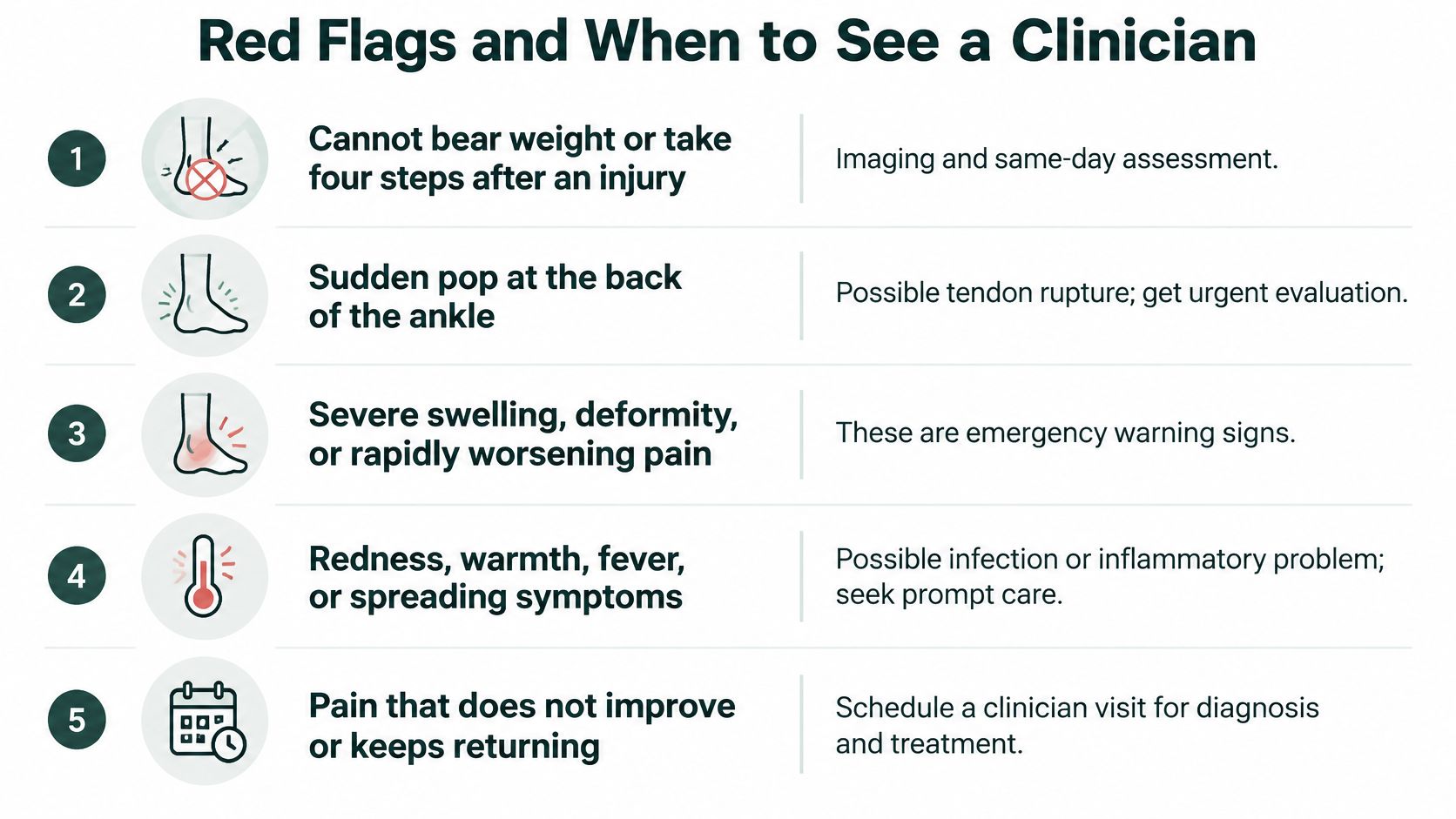
Urgent Checks That Mean Book Now
- You can't bear weight or take four steps after an injury. This is an imaging trigger and needs same day assessment, because fracture moves to the top of the list.
- A sudden pop at the back of the ankle, then you can't rise onto your toes. That combination suggests a possible Achilles rupture and needs urgent assessment, since timing affects treatment options.
- Numbness, spreading tingling, or a cold, pale, or blue foot. These point to nerve or circulation involvement and warrant prompt emergency review.
- A hot, red, rapidly swelling joint, especially with fever. Infection or inflammatory disease can damage a joint quickly, so don't wait to see if it settles.
- Pain at night or at rest, or unexplained weight loss. Pain that doesn't behave mechanically can signal a systemic cause that needs medical workup.
- Visible deformity or focal bone tenderness after a fall or twist. Both raise fracture concern even if you can hobble.
- Swelling that keeps increasing instead of settling. A normal injury response peaks and recedes. Steady worsening means something is still being irritated or was missed.
Any single item on that list overrides the usual advice to give it time. You don't need several red flags to justify a visit.
Non Urgent Rules for Booking Within the Week
If none of the urgent items apply, use timing rules instead. Book within the week if pain persists beyond four weeks without improvement, if a sprain still needs a boot at about eight weeks, or if your pattern doesn't match any clear cause from your self checks.
If you're improving steadily and no rule applies, continuing your plan is reasonable. Set a review date anyway, so slow drift doesn't become six months of ankle pain when walking without anyone noticing.
The question isn't whether your pain is bad enough to deserve care. It's whether your trajectory matches the diagnosis you're assuming.
What to Bring to the Visit
- Your onset timeline: The date of any twist or fall, or when gradual pain first appeared, plus what changed in your activity around then.
- Your pain map: The one finger location, the phase of the step that hurts, and which surfaces provoke it.
- Your walking log: Distances you manage, next morning responses to exercise, and any episodes of giving way.
- Prior imaging and treatments tried: Reports, braces, injections, therapy programs, and what each one did or didn't change.
That preparation lets your clinician examine the right structures and decide selectively about imaging, rather than starting from zero. Do one thing this week. Mark your pain map, check it against the urgent list and the timing rules, and book the visit if any rule applies to you.
If ankle pain when walking has stalled your recovery or doesn't match a simple sprain story, we at Restore Osteopathic Medicine can examine the ankle in the context of your whole walking chain and build a plan around the cause we find. Our care combines hands on osteopathic treatment to improve mobility and support function with individualized rehabilitation guidance, and regenerative injection therapy may be evaluated for ligament and tendon injuries, arthritis, and joint instability when a structural diagnosis supports it. Visit Restore Osteopathic Medicine to schedule an evaluation and take the next step toward walking comfortably again.