
The common advice about a new treatment for facet joint pain starts in the wrong place: pick the most advanced procedure, then check whether you qualify. A safer approach reverses that order. First identify what's causing the pain, then compare treatments by the strength of their evidence and the outcome you need.
Newer ablation techniques and regenerative injections deserve attention, but they don't all answer the same clinical question. A treatment that outperforms a steroid injection hasn't necessarily outperformed conventional radiofrequency ablation. And an impressive pain reduction in a small trial doesn't establish that the result will be predictable for you.
Table of Contents
- New Treatments for Facet Joint Pain Compared
- Confirming the Pain Source Before Any Procedure
- Radiofrequency Ablation Evidence and Limits
- Cooled and Alternative Nerve Ablation Methods
- Regenerative and Steroid Injections Explained
- How to Choose the Right Procedure Step by Step
- Confirm Your Next Step With a Clinician
New Treatments for Facet Joint Pain Compared
New facet joint pain treatments by mechanism, evidence and fit
| Option | Mechanism | Evidence Level | Best Suited For |
|---|---|---|---|
| Conventional radiofrequency ablation | Heats medial branch nerves to interrupt facet pain signals | Established randomized-trial evidence, with important uncertainty | Axial facet pain supported by diagnostic blocks |
| Cooled radiofrequency ablation | A cooled electrode permits a larger lesion at the medial branch | Promising randomized comparison with facet steroid injection | Persistent facet-mediated low-back pain after conservative care |
| Cryoablation | Freezes targeted nerves | Small randomized comparison; improvement without demonstrated superiority | Selected patients whose anatomy or preferences favor it |
| Endoscopic facet denervation | Targets facet nerves under direct visualization | Limited comparative evidence | Selected cases treated by clinicians with endoscopic expertise |
| PRP injection | Delivers platelet-derived factors near the treatment target | Moderate to limited certainty | Patients considering a regenerative option despite uncertain benefit |
| Facet steroid injection | Places anti-inflammatory medication into the joint | Very low-quality evidence | A possible temporary bridge to rehabilitation |
| Focused shockwave therapy | Delivers acoustic energy to tissue | Encouraging sham-controlled evidence awaiting replication | Investigational consideration |
| Mesenchymal stem cell therapy | Uses cells with an intended tissue-repair effect | Weak recommendation | Research or trial settings |
The table separates mechanism, evidence, and fit because none substitutes for another. A plausible biological explanation doesn't establish a reliable clinical benefit. Likewise, a technically successful nerve procedure may disappoint if the treated nerve wasn't carrying the patient's main pain signal.
Conventional radiofrequency treatment has a longer evidence history than the newer alternatives. A clinical-evidence assessment of facet denervation summarized a systematic review of 10 randomized trials involving 715 participants, while also noting small individual trials and uncertainty across evidence syntheses. That history supports considering the treatment in selected patients, not promising that everyone with facet arthritis will improve.
Read positive findings by their comparator
Focused shockwave therapy illustrates the difference between a promising result and an established place in care. A clinical-trial commentary on a randomized sham-controlled trial reported a 64.4% reduction in pain intensity and a 42.3% reduction in disability after treatment in 2025. Those findings warrant attention, but they don't establish superiority over nerve ablation or predictable durability.
The same reasoning applies across the table. Improvement against a sham procedure answers a different question from improvement against an active treatment. Evidence from carefully selected patients also shouldn't be generalized to every person whose scan mentions facet degeneration.
Practical rule: Choose the strongest evidence that matches your diagnosis and goal, not the newest name on a treatment menu.
Confirming the Pain Source Before Any Procedure
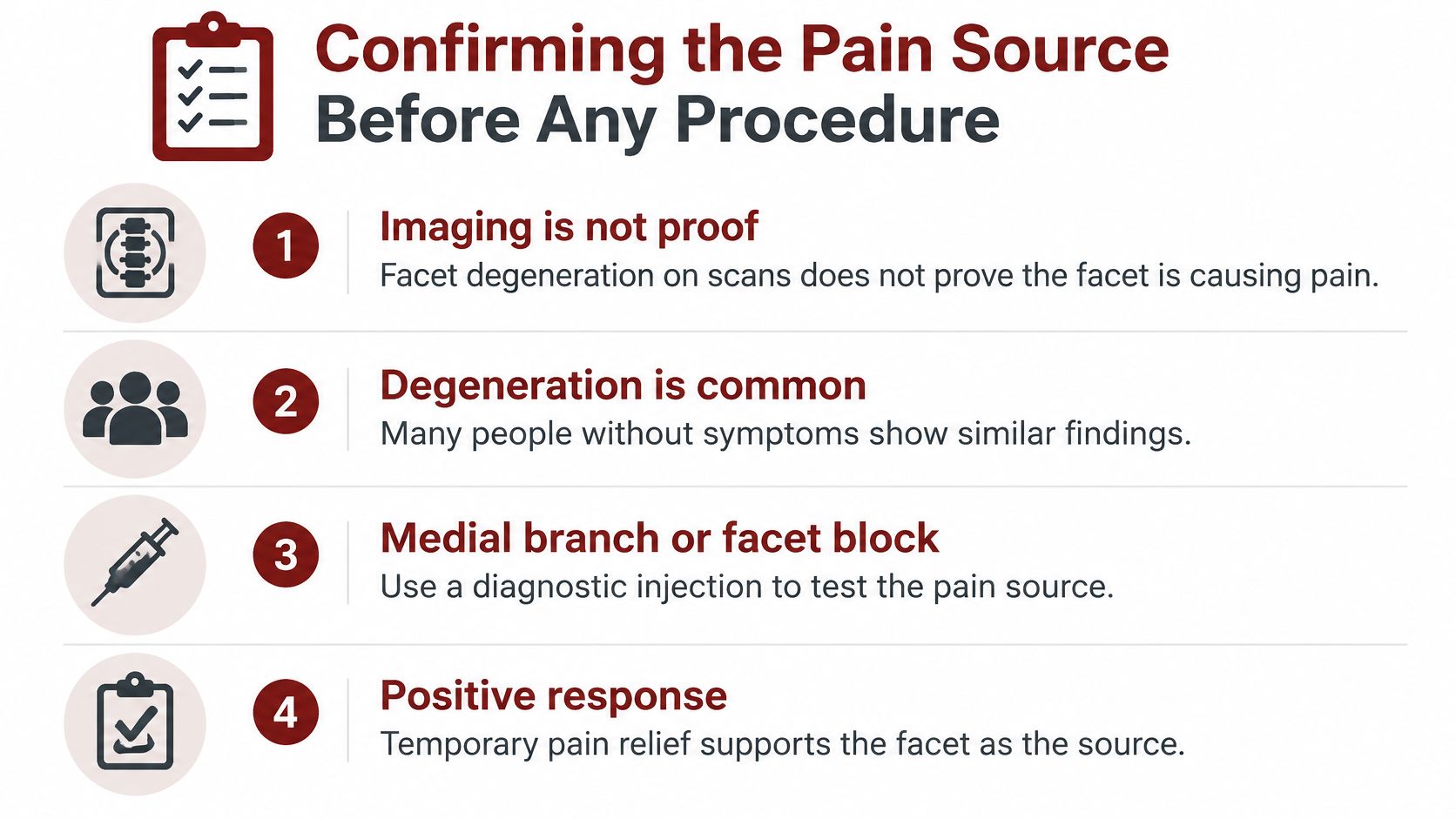
A scan can identify degeneration without identifying the cause of pain. The clinical overview of lumbar facet arthropathy explains why imaging, examination, diagnostic injections, and the broader pain pattern need to be interpreted together. Facet changes alone do not justify a facet procedure.
Move from a structural finding to a testable diagnosis
The first decision is whether pain is predominantly axial, centered in the neck or back, or whether symptoms suggest nerve-root involvement. Disc, sacroiliac joint, muscle, hip, and nerve-root problems can overlap with suspected facet pain. A symptom pattern narrows the differential; it does not confirm the joint.
A diagnostic medial branch block places local anesthetic near the nerves supplying the suspected joints. An intra-articular block tests the joint more directly. The useful result is a substantial, temporary change in the patient's familiar pain during activities that usually provoke it, rather than a vague sense that the injection day went well.
A positive block points to the facet as a contributor, but it cannot rule out coexisting problems. Brief relief is expected from a diagnostic anesthetic injection, so short duration alone should not be mistaken for failure. The response has to fit the medication used, the target tested, and the pain behavior being measured.
Structural findings such as buckling of the ligamentum flavum can appear in the same spine evaluation. Ask the clinician to separate clinically active findings from incidental ones instead of treating every phrase in the imaging report as a target.
Establish the foundation before escalating
Conservative care generally comes first: exercise-based physical therapy, appropriate medication, and movement-focused treatment. Sleep, body weight where relevant, and work demands can also be addressed as modifiers of pain rather than assumed to be the sole cause.
Turn the appointment into a written plan rather than a verbal impression:
- Pain source: What supports a facet diagnosis over disc, sacroiliac, hip, muscle, or nerve-root pain?
- Diagnostic test: What block response would be convincing enough to act on?
- Preparation: Which conservative treatments should be completed or adjusted first, and for how long?
- Outcome: What improvement and timeframe would justify the proposed procedure?
Seek prompt evaluation: Progressive weakness, bowel or bladder changes, fever, or unexplained weight loss require medical assessment rather than routine procedure shopping. New bowel or bladder dysfunction with neurologic symptoms warrants urgent care.
Radiofrequency Ablation Evidence and Limits
Consider a hypothetical patient with persistent lower-back pain that worsens during extension or twisting. They've completed a structured course of physical therapy, and a diagnostic medial branch block substantially reduces their familiar pain. That combination creates a more defensible reason to discuss ablation than an arthritis finding on a scan alone.

Radiofrequency ablation, or RFA, uses thermal energy to coagulate the medial branch nerves carrying pain signals from the facet joints. It interrupts transmission without repairing the arthritic joint. That distinction matters when deciding what a successful result should look like.
A systematic review and meta-analysis of facet-origin spinal pain included 17 randomized controlled trials and found Level II evidence with moderate certainty; it defined clinically meaningful success as at least 50% pain relief with functional improvement lasting six months or longer. This is meaningful support, but moderate certainty isn't a guarantee, and the definition is an outcome benchmark rather than a universal eligibility rule.
Factors that strengthen the case
The most useful selection factors concern whether the procedure matches the pain being treated:
- A coherent diagnosis: The symptoms and clinical assessment support predominantly facet-mediated axial pain.
- A convincing block response: The patient's usual pain improves substantially during the expected anesthetic window.
- Persistent functional restriction: Symptoms still interfere with meaningful activities despite appropriate conservative treatment.
- A rehabilitation goal: The patient can name activities they want to regain, such as standing to prepare meals or tolerating a work shift.
These are reasons to consider treatment, not a validated prediction score. The final decision also requires individualized discussion of procedural risks and alternatives.
Reasons to reconsider the target
Poor selection can undermine an otherwise well-performed procedure:
- An unconvincing block: Little relief, or relief that doesn't match the expected anesthetic effect, weakens the rationale.
- Unresolved radicular symptoms: Nerve-root pain may require a different evaluation.
- An unclear main pain generator: Treating one suspected contributor may leave the dominant problem unchanged.
RFA is symptom-modifying, not disease-reversing. Relief may decline as sensory nerves regenerate, and a successful initial response doesn't mean the underlying joint has returned to normal.
Rehabilitation should therefore be planned alongside the procedure, with attention to spinal loading and movement tolerance. Follow-up should ask what the patient can do, not just what number they assign to pain. Less pain without improved participation may still matter, but it calls for a different discussion than restored function.
Cooled and Alternative Nerve Ablation Methods
Cooled radiofrequency ablation changes how the treatment lesion is created, not the need for a well-supported diagnosis. Fluid circulates through the electrode, allowing a larger lesion around the target. The proposed advantage is better capture of nerve branches whose anatomy varies between patients.
Key results from the two cooled and alternative ablation trials
| Trial | Comparison | Key Result | Limitation |
|---|---|---|---|
| Pragmatic randomized trial | Cooled RFA versus facet corticosteroid injection | The facet-joint denervation evidence assessment describes a 2023 trial in which achieving at least 50% pain reduction at three months significantly favored cooled RFA (P = 0.014); a global-improvement score of at least 6 occurred in 75.0% (15 participants) versus 25.0% (3 participants), with P = 0.006; the pain-response odds ratio was 7.49 (95% CI, 1.60 to 35.01) | Small sample and wide confidence interval; comparator was an injection, not conventional RFA |
| Multicenter randomized trial | Conventional RFA versus cryoablation versus endoscopic denervation | The prospective comparative trial followed 62 patients over 24 months; all groups improved significantly, with less durable referred-leg-pain improvement after cryoablation and no statistically significant between-group differences | Small sample; improvement within groups doesn't establish superiority between methods |
What the cooled trial establishes
The cooled-ablation result supports discussing the procedure with selected patients whose facet-mediated low-back pain persists despite conservative care. Both pain reduction and patient-reported overall improvement favored cooled treatment over the injection comparator.
However, the odds ratio needs careful reading. A wide confidence interval means the estimated size of the advantage is imprecise. It's not a measure of how much pain an individual patient will lose, and it doesn't establish that cooled RFA is better than conventional RFA.
The comparator is the key limit. If the clinical choice is between cooled ablation and a steroid injection, the trial is directly relevant. If the choice is between cooled and conventional ablation, it doesn't settle that question.
Alternatives require a procedural reason
The comparative trial gives cryoablation and endoscopic denervation a place in the discussion, but not a clear claim to first choice. Conventional RFA showed the most consistent long-term relief in that study, while the absence of significant between-group differences leaves substantial uncertainty.
Anatomy, prior treatment response, operator expertise, and patient preference can reasonably influence the choice. Endoscopic access, for example, requires relevant procedural expertise rather than just an interest in a newer technique.
A larger lesion is a technical feature, not proof of a better patient outcome.
Larger lesions also make precise imaging and motor testing important. The appropriate question is why a particular technique improves the treatment plan for this patient, not why it sounds more advanced.
Regenerative and Steroid Injections Explained
How long might relief last, and what happens if it doesn't work? Those questions tell a patient more than whether an injection is called regenerative. The label describes an intended biological effect; whether damaged facet tissue is restored is a separate question the evidence has not settled.
A 2025 systematic review of facet joint injections reports clinically significant pain reduction rates of 13% to 74% across studies of fluoroscopically guided lumbar facet steroid injections, rates the overall evidence very low quality, and summarizes a 2025 regenerative review spanning four randomized trials and six observational studies in which PRP evidence ranged from moderate to limited certainty and mesenchymal stem cell therapies carried a weak recommendation.
That spread in steroid response comes from differences in diagnostic criteria, methods, and bias across studies, so it cannot be converted into a dependable personal probability. Sham-controlled steroid trials had not demonstrated clear efficacy in the same assessment. For a patient with well-confirmed facet-mediated pain, the practical reading is modest: a steroid injection is a reasonable option backed by weak evidence, and the regenerative alternatives sit a rung lower on certainty.
PRP needs comparative evidence
Platelet-rich plasma concentrates platelet-derived factors intended to support healing. Whether it improves facet pain more than a cheaper alternative, lasts longer, or slows arthritis can only be answered by direct comparison.
In a randomized comparison of PRP and corticosteroid injections, 76 patients were treated and, at six months, six PRP patients and five corticosteroid patients had achieved at least 50% improvement in spontaneous pain scores. Counts that small can support neither a claim of PRP superiority nor a verdict that the two injections perform identically. The honest conclusion is that the question remains open.
Someone weighing whether PRP injections are worth it should put uncertainty, cost, the intended target, and the planned next step on the same scale. An injection earns its place as a time-limited opportunity to participate in rehabilitation rather than a promise of tissue restoration.
Agree on the exit plan
Before consenting, ask for concrete answers:
- Expected duration: What supports the proposed relief window for this diagnosis?
- Outcome measurement: Which daily activities will be tracked alongside pain?
- Repeat-treatment evidence: What justifies another injection if the first helps only briefly?
- Adverse effects: What risks apply to the injection, medication, and personal medical history?
- Failure plan: Would no improvement trigger diagnostic reassessment or another treatment?
A weak response is a reason to reconsider the target, the diagnosis, or the purpose of treatment before it becomes a reason to schedule an increasingly expensive series.
How to Choose the Right Procedure Step by Step
Choose a procedure only after making the diagnostic and functional goals explicit. A written plan helps separate a test intended to identify the source from a treatment intended to provide relief.
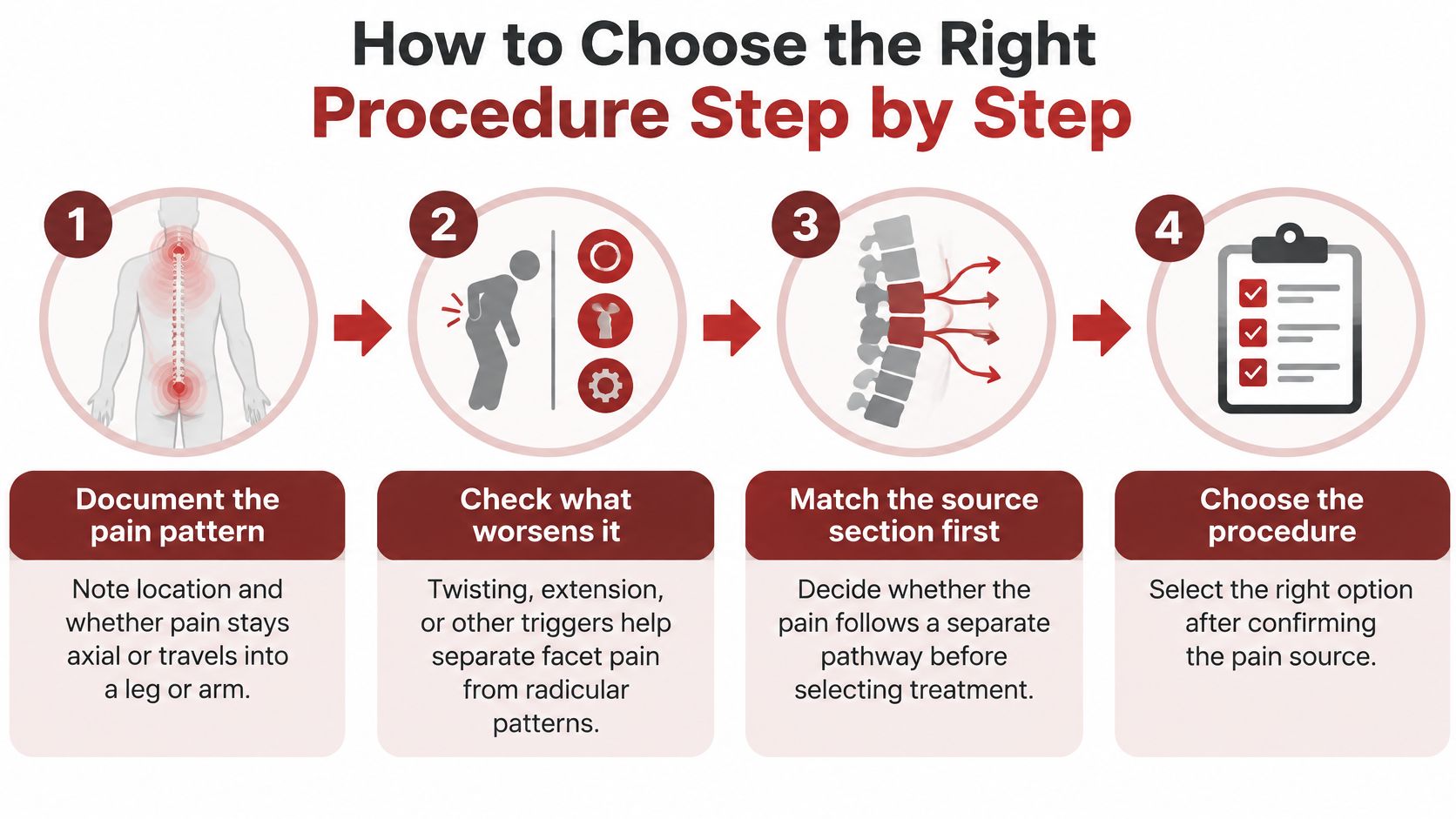
Document the pain pattern. Record where pain starts, whether it stays centered in the spine or travels into a limb, and which activities provoke it, because the dominant symptom should determine the diagnostic pathway.
Complete the clinical safety assessment. Resolve concerning symptoms before pursuing an elective procedure rather than assuming that an existing arthritis diagnosis explains a new problem.
Review the conservative-care course. Identify what was tried, whether it was tolerable, and what changed, because an incomplete or poorly matched program isn't the same as a genuine treatment failure.
Discuss diagnostic testing. If facet pain remains plausible, ask whether a medial branch block is appropriate and record both the degree and duration of relief during familiar activities.
Match the intervention to the goal. A denervation discussion requires convincing evidence of facet-mediated pain, while an injection proposal should explain its intended role and experimental options should be identified plainly.
Set success criteria before treatment. Choose a pain target, a functional target, and an assessment date, so ordinary symptom fluctuation doesn't become the only basis for judging the result.
Plan rehabilitation and reassessment. Specify how activity will progress and what would prompt reevaluation, rather than waiting for the treatment to wear off before deciding what comes next.
Apply the sequence to mixed symptoms
Not every patient fits a single category. Pain near the pelvis, for example, may require consideration of sacroiliac joint pain and its treatment rather than assuming that lumbar facet changes explain the whole presentation.
Suppose a patient reports substantial relief of localized back pain after a diagnostic block but still has pain traveling down a leg. The correct conclusion isn't that the block failed, or that ablation should automatically proceed. The response may support a facet component while leaving a separate problem unresolved.
The clinician should characterize the remaining leg symptoms and assess possible nerve-root involvement before finalizing the procedure plan. A positive test can narrow the explanation without making it complete.
Confirm Your Next Step With a Clinician
New treatments for facet joint pain are real options, but their value depends on a credible diagnosis, appropriate selection, and a plan for restoring activity. The most useful consultation doesn't end with the name of a procedure. It ends with a clear explanation of why that procedure fits, what remains uncertain, and how the result will be judged.
You don't need to arrive knowing which technique to request. Bring your imaging reports, a medication and treatment history, and a short pain diary describing triggers, location, and functional limits. Include changes that matter in daily life, such as difficulty carrying a child, sitting through work, or returning to exercise.
Leave with an answerable plan
One question worth asking before you leave ties the whole visit together: given the pain source that has been confirmed for you, does the proposed technique carry stronger evidence than the alternatives, or is it being offered mainly because it is new? A clinician who can answer that plainly is separating proven options from promising ones. That distinction is what protects you from choosing a procedure on novelty alone.
Cost and coverage should also be clarified before consenting. At our practice, insurance may cover the consultation portion of prolotherapy when we're contracted with the patient's plan, but regenerative injections themselves aren't covered. We require an evaluation to determine whether regenerative injection therapy is appropriate for a particular patient.
Ask for the plan in writing. It should state what remains unconfirmed about the diagnosis and how much confidence the evidence supports for the proposed treatment in people with that diagnosis.
At Restore Osteopathic Medicine, we offer physician-led osteopathic and integrative care, including individualized evaluation of whether regenerative injection therapy fits your musculoskeletal concerns. Use our contact form to request treatment information and arrange an evaluation, then send your imaging reports and pain diary ahead of the appointment so the visit can be spent on the plan rather than on reconstructing your history.