
You lift a foot to pull on your trousers, feel an ache near your hip, and wonder whether your spinal curve has finally worn out the joint. Scoliosis and hip problems can occur together, but pain doesn't automatically mean damaged cartilage. The useful question is what hurts during movement: the joint itself, the muscles supporting your pelvis, or pain referred from your back.
Table of Contents
- Why Scoliosis Rarely Means a Damaged Hip
- Hip Complaints and the Mechanic Behind Them
- How the Spine Pelvis and Hip Move as One
- Why Trunk Shift Beats Cobb Angle for Hip Risk
- Sorting Hip Pain and Booking the Right Visit
- Hip Pain After Pregnancy and in Childhood Curves
- What Improves Walking and Daily Function
Why Scoliosis Rarely Means a Damaged Hip
Standing on one leg to get dressed asks your hip muscles to hold your pelvis steady while your trunk stays balanced. A painful wobble during that task can reflect extra muscular effort rather than a failing ball-and-socket joint.
That distinction matters when an image looks relatively reassuring but walking or stairs still hurt. Your symptoms aren't imaginary, and a quiet-looking hip image doesn't explain how your whole body manages a step.
A systematic review of lower-limb movement in spinal deformity covering 35 studies and 1,941 participants found changes including shorter strides, altered stance and support times, and differences in hip and knee movement. Those findings describe changes in coordination and loading, not an automatic diagnosis of arthritis or a labral tear.
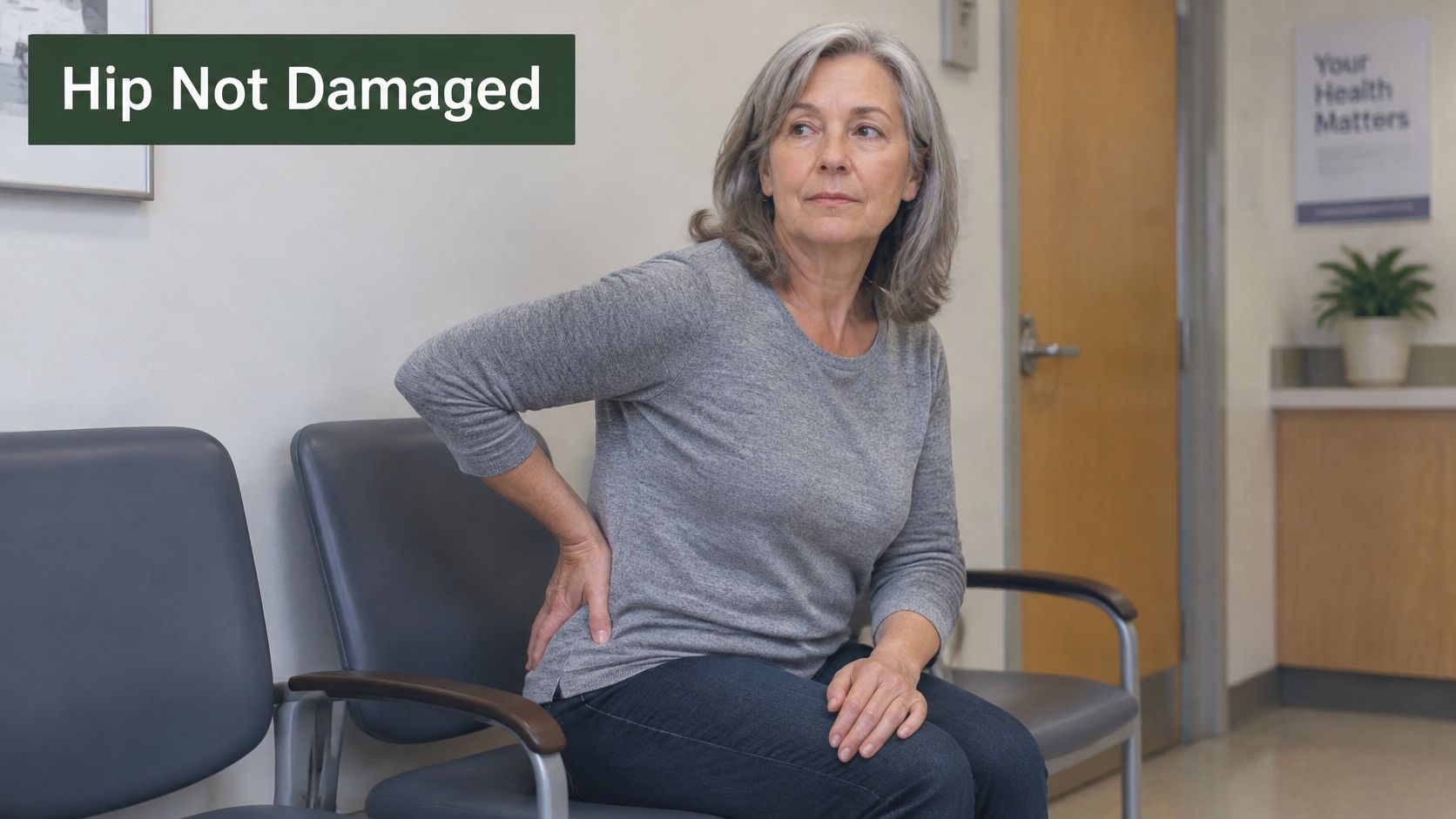
Different sources can feel like hip pain
A useful assessment separates these possibilities, in this order:
- Pelvic compensation: Your pelvis tilts or your trunk shifts sideways, changing the demands on nearby muscles.
- Restricted hip motion: The hip struggles to bend, straighten, or rotate.
- Lumbar nerve referral: Irritated nerves in the lower back produce symptoms near the hip or farther down the leg.
- Sacroiliac dysfunction: Pain comes from the region where the pelvis joins the spine.
- Independent hip disease: Osteoarthritis, labral pathology, or another local condition needs its own assessment.
More than one source can be present. Someone may have limited hip rotation and tired gluteal muscles, for example, without either finding explaining every symptom.
The important distinction: Pain near the hip identifies a region, not a diagnosis. Curve size alone can't tell you which tissue needs attention.
Hip Complaints and the Mechanic Behind Them
Use this complaint map to describe your symptoms more precisely, not to diagnose yourself.
Hip complaints with scoliosis and what to check first
| Symptom pattern | Likely driver | Separating clue | First check |
|---|---|---|---|
| Groin pain with deep squat or rotation | Hip joint, including osteoarthritis or labral irritation | Painful, limited internal rotation; may be independent of curve size | Hip motion tests; imaging if the exam suggests joint disease |
| Outer-hip pain while walking or standing | Pelvic obliquity and gluteal overload | Symptoms on the high or low pelvic side; single-leg stance reproduces them | Standing coronal balance and single-leg stance |
| Buttock or posterior hip ache | Lumbar or sacroiliac referral | Builds with sitting, bending, or prolonged standing | Examination separating hip, sacroiliac, and lumbar sources |
| Uneven stride or early walking fatigue | Asymmetric loading and a costlier gait | Shorter step and fatigue beyond one tender spot | Gait observation and walking-tolerance history |
| One much worse arthritic hip after age 50 | Possible contribution from trunk shift and pelvic obliquity | Similar Cobb angles can accompany different degrees of joint wear | Full-spine coronal balance plus hip imaging |
| Pain turning in bed, on stairs, or carrying a baby | Postpartum laxity, weakness, or pre-existing compensation | Symptoms track lifting, feeding, and recovery, even with a stable curve | Combined spine, pelvis, hip, and daily-load review |
What the location and trigger suggest
Groin pain deserves attention when a deep squat, getting into a car, or turning the thigh inward reproduces it. Painful restriction during internal rotation makes the joint a stronger suspect, but no single movement proves arthritis or a labral injury.
Outer-hip pain during standing or walking can reflect difficulty controlling the pelvis over the supporting leg. Note whether it starts immediately, develops after several steps, or appears when you carry something on one side. The sore side alone doesn't reveal which way your pelvis tilts.
Buttock pain that builds during sitting or bending may come from the lumbar or sacroiliac region. Point to the spot rather than calling everything hip pain. Understanding the ligaments in the hip can help distinguish the joint's supporting structures from the surrounding pelvic region, although an examination still has to locate the source.
An uneven stride with early fatigue calls for observing the whole walk. Someone who shortens a step or leans sideways may be managing stiffness, discomfort, or balance demands. That adaptation isn't proof that a structure has been destroyed.
Patterns that need a broader review
A markedly worse arthritic hip in an older adult warrants more than measuring the spinal curve. The clinician should consider whether sideways displacement of the trunk and an uneven pelvis contribute to the loading pattern, while assessing the arthritis itself.
Postpartum pain needs a history of everyday demands. Turning in bed, climbing stairs, feeding, and carrying a baby challenge the body differently. Record the exact spot, the first movement that starts the pain, and which side hurts for every pattern in the table.
Inability to bear weight, fever, trauma, progressive weakness, new or worsening numbness, or persistent night pain warrants prompt medical assessment. New bowel or bladder changes, especially with leg weakness or saddle numbness, require emergency evaluation. These aren't symptoms to sort through at home.
The table is a sorting aid, not a diagnosis.
How the Spine Pelvis and Hip Move as One
Think of a three-legged table. If one support tips, the tabletop can't stay level unless something else changes position. Your body is more adaptable than furniture, but the analogy explains why a hip problem can affect the spine and why a spinal curve can affect the hip.
The pelvis is the connecting platform. The spine rests above it, and the hip sockets sit within it. When you step forward, sit down, or reach toward a shoe, movement must be shared across these regions.
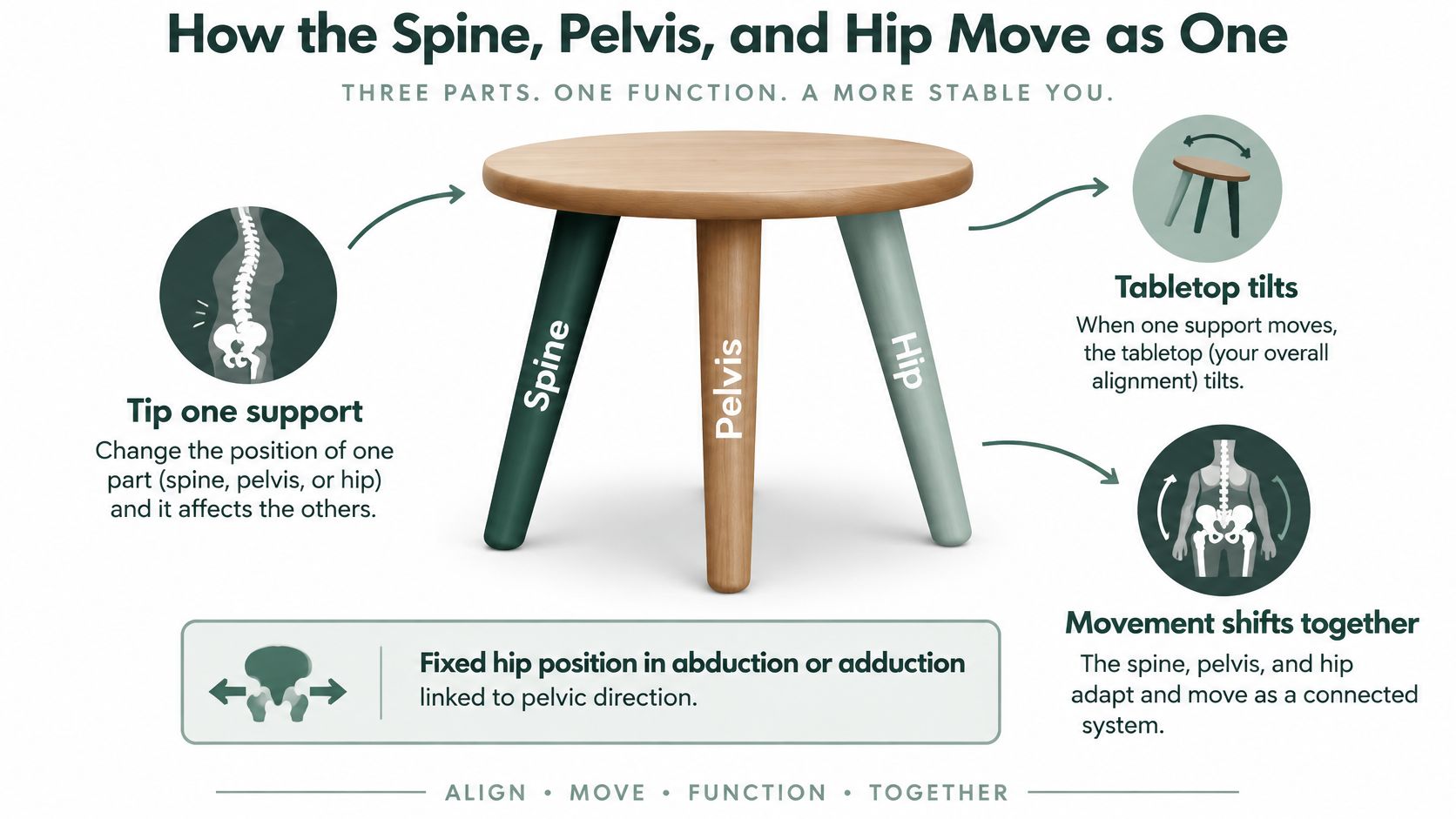
A fixed hip can change the platform
Abduction means moving the thigh away from the body's midline. Adduction means moving it toward or across that line. A hip fixed in either position can leave the pelvis uneven, a position clinicians call pelvic obliquity.
In a study of patients with ankylosed hips, the correlations were r = 0.831 between hip position and pelvic-obliquity direction, r = 0.770 between hip position and lumbar-curve direction, and r = 0.832 between pelvic-obliquity and lumbar-curve direction. These strong relationships came from patients with severely restricted hips, not ordinary muscle tightness.
The practical meaning is straightforward. If a hip can't move freely, a person may tilt the pelvis and bend the lower back to remain upright. Conversely, a structural lumbar curve can change pelvic orientation and how the hip socket receives load.
This doesn't establish that everyone's curve began at the hip. It shows why clinicians shouldn't assume the direction of cause before examining both regions.
Why the same walk can feel harder
Walking requires more than moving forward. During each supporting phase, you also control side-to-side movement and keep your trunk balanced over the leg beneath you. A shortened step or sideways lean may help you manage that task, but it can require extra effort.
That explains why endurance and joint damage aren't interchangeable. You can finish a familiar route with tired hip muscles even when cartilage damage isn't the main problem. Equally, a person with genuine joint disease may use similar compensations to avoid painful motion.
Treating the painful spot alone can miss the movement restriction that keeps asking it to work harder.
For runners whose symptoms appear as back discomfort during a stride, Swift Running's guide to understanding back discomfort on runs offers additional activity-specific context. It shouldn't replace assessment when pain persists or changes your gait.
The clinical aim isn't perfect visual symmetry. It's enough coordinated movement that the spine, pelvis, and hips can share daily tasks without repeatedly overloading one region.
Why Trunk Shift Beats Cobb Angle for Hip Risk
Two people can have similar spinal curve measurements and very different hip findings. Cobb angle measures the curve's sideways angulation, but it doesn't fully describe where the trunk sits over the pelvis or how level the hip sockets are.
Apical vertebral translation, or AVT, describes sideways displacement of the vertebra at the curve's apex. It captures a different feature from curve angle: how far part of the spine has shifted laterally.
A retrospective study of 189 adults older than 50 with Cobb angles greater than 10 degrees found that severe hip osteoarthritis was associated with greater AVT and pelvic obliquity even when scoliosis magnitude was similar; AVT correlations with osteoarthritis were r = 0.259 on the worse side, r = 0.246 on the concave side, and r = 0.154 on the convex side, with adjusted odds ratios of 1.062 for worse-side osteoarthritis and 1.077 for concave-side osteoarthritis.
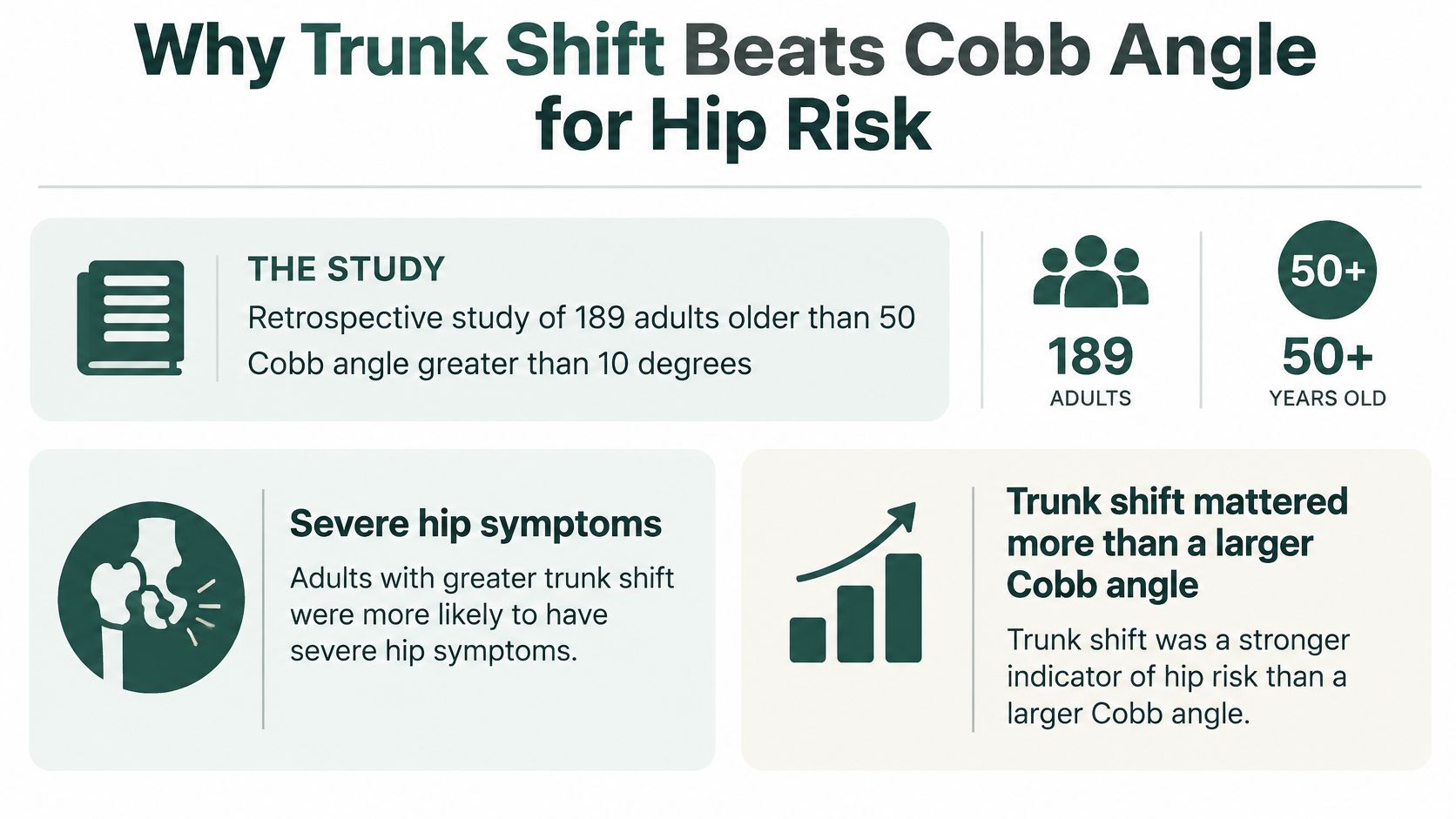
What those findings mean for an individual
These are associations, not proof that trunk shift caused the arthritis. The correlations also aren't strong enough to predict the condition of an individual hip from a spine image alone. The finding supports a broader examination, not a replacement for examining the joint.
The proposed mechanism is a change in contact. A tilted pelvis changes how the acetabulum, the hip socket, faces the femoral head, the ball. A sideways-shifted trunk can also change the load passing through that contact area, potentially concentrating stress unevenly.
For that reason, a useful review includes:
- Standing coronal balance: Where your trunk sits relative to the body's midline.
- Pelvic obliquity: Whether the pelvis is level from side to side.
- Limb-length discrepancy: Whether there's a true length difference or an apparent difference related to posture.
- Hip motion and imaging: Whether restriction and joint changes match the symptoms.
Age changes the clinical question
An adolescent curve often becomes apparent during growth. Degenerative hip disease has a different history, involving aging, prior injury, and other joint-loading factors. In an adult, the conditions can coexist without one explaining the entire history of the other.
Children with severe motor impairment are a separate population whose hip displacement and scoliosis require coordinated pediatric orthopedic surveillance, rather than interpretation through this adult finding.
For an adult with unequal hip symptoms, the useful question is: Were trunk shift and pelvic obliquity assessed, or only the degree of the curve?
Sorting Hip Pain and Booking the Right Visit
A whole-chain visit should establish a working explanation for your symptoms, not just confirm that you have scoliosis. Each part of the examination answers a different question.
The visit sequence
History. Record the exact spot, side, onset, and first painful movement. Stairs, sitting, lifting, and standing on one leg place different demands on the body, so the trigger helps narrow the possibilities.
Urgent screening. The clinician checks for the warning symptoms described above before asking you to load or stretch the painful area. A concerning history can change the visit from mechanical testing to urgent investigation.
Standing alignment. Shoulder height, pelvic height, and trunk position help describe how you stand. Leg-length assessment distinguishes a possible bony difference from the appearance created by a tilted pelvis.
Gait and supported single-leg stance. Watching you walk can reveal a shortened step, trunk lean, or difficulty accepting weight. Single-leg testing should be adapted or omitted if balance or pain makes it unsafe.
Hip motion. The clinician compares flexion, extension, abduction, adduction, and rotation on both sides. The important finding isn't just stiffness, but whether a particular movement recreates your familiar pain.
Source separation. Targeted maneuvers help distinguish pain inside the hip from lumbar and sacroiliac referral. An explanation of how sacroiliac joint pain is treated is most useful once that region has been identified as a contributor.
Neurologic screening. Traveling pain, altered sensation, or reduced strength calls for checking nerve function. A clinician may assess strength, sensation, and reflexes rather than assuming all leg symptoms come from muscular imbalance.
Selective imaging. Imaging should answer a clinical question, such as suspected joint disease, neurologic risk, or changed alignment. Knowing that scoliosis exists isn't, by itself, a reason to image every painful region.
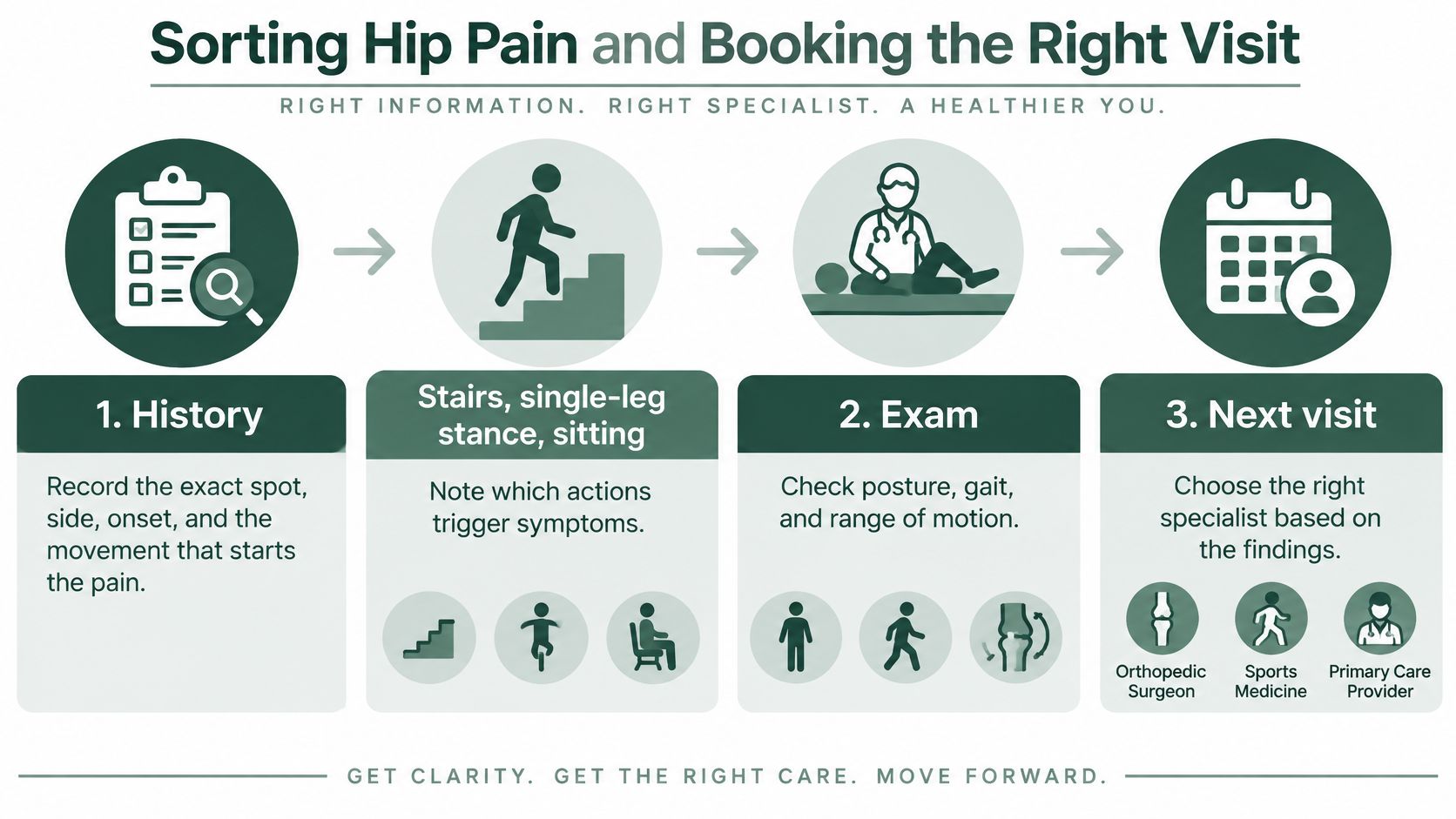
What to bring and when to book
Bring a short note with pain location, worst movement, and walking distance before pain or fatigue. Previous imaging reports can help, especially if your posture or symptoms have changed. Describe what you can no longer do comfortably rather than trying to name the diagnosis.
Booking rule: Arrange a spine, pelvis, and hip assessment when pain limits walking, sleep, stairs, or lifting a child, when one hip is clearly worse, or when postpartum symptoms aren't easing.
Our physician, Dr. Keaton, provides osteopathic care for adults, athletes, children, and mothers throughout pregnancy and postpartum. The evaluation should determine whether musculoskeletal care fits or whether orthopedic, neurologic, or other specialist assessment is needed.
A reassuring spinal angle doesn't clear the hip joint. Likewise, established hip arthritis doesn't remove the need to understand the pelvis and back.
Hip Pain After Pregnancy and in Childhood Curves
A mother who managed well during pregnancy may find that turning in bed or carrying her baby now produces pelvic pain. It's understandable to worry that delivery worsened the scoliosis, particularly when the pain feels unfamiliar.
The National Scoliosis Foundation's patient guidance explains that scoliosis rarely affects pregnancy and delivery and that pregnancy generally doesn't accelerate curve progression. That's reassuring about the curve, but it doesn't mean postpartum symptoms should be dismissed.
A stable curve doesn't guarantee an easy recovery
Consider a parent who feeds with the trunk turned, lifts the baby from a low cot, and carries on the same hip. During recovery, temporary ligament laxity, reduced pelvic-floor or gluteal strength, and those repeated positions can contribute to discomfort. Existing movement compensations may make the new workload harder to manage.
The symptom pattern matters more than whether a repeat curve measurement changes. Does pain settle when the carrying position changes? Is walking gradually becoming easier, or are ordinary tasks becoming more restricted?
- An improving pattern: Graded activity and practical support allow more comfortable movement over time.
- A stalled pattern: Turning, stairs, or carrying remain difficult without a clear trend toward recovery.
- A concerning pattern: Warning symptoms from the urgent-screening sequence require medical care rather than waiting for routine recovery.
Our explanation of postpartum lower back pain offers context for discomfort that overlaps the back and pelvis. For another recovery-focused resource, The Axelrad Clinic's Managing back pain after childbirth can help readers think through everyday postpartum demands. Neither resource can identify the source of persistent hip pain without an examination.
Childhood neuromuscular curves need a different approach
A child with severe motor impairment, such as cerebral palsy, has a different risk pattern from an adult with mechanical hip pain. A study of scoliosis and hip displacement in children with cerebral palsy found that hip displacement generally developed before clinically significant scoliosis and that risk increased with reduced gross motor function.
These children need coordinated pediatric surveillance of hip position, pelvic asymmetry, sitting balance, and spinal alignment. Families shouldn't wait for a visibly large curve before raising concerns about hip movement or comfortable seating.
The shared lesson is timing: symptoms and functional changes can matter before, or without, a change in the spinal curve measurement.
What Improves Walking and Daily Function
Treatment should match the identified source and produce a useful change in daily life. A straighter-looking posture isn't enough if you still can't walk comfortably or lift your child.
A plan tied to observable progress
Begin with appropriate hands-on care. Osteopathic treatment may address mobility restrictions and musculoskeletal strain when the examination supports it. Judge its value by changes in comfortable hip motion, standing balance, and the task that brought you in, not by a promise to erase the curve.
Build capacity through individualized movement. Strengthening should reflect which movements are restricted and which side struggles to control load. Progress might include steadier supported single-leg stance, more even steps, or less trunk leaning during ordinary walking.
Change the recurring daily demand. Adjust sleep support, standing habits, lifting height, and carrying positions rather than repeatedly provoking the same pattern. A meaningful result could be easier turning in bed or carrying a child without the usual ache.
Review persistent tissue-specific pain. A physician may consider whether regenerative injection therapy, including platelet-rich plasma or prolotherapy, fits persistent joint, ligament, or tendon symptoms after conservative care. It isn't an automatic next step, doesn't straighten scoliosis, and requires discussion of evidence, risks, alternatives, and the suspected pain source.
Measure function rather than chasing symmetry
Track walking tolerance and the distance before pain or fatigue under reasonably similar conditions. Note stride comfort and your most difficult daily task at consistent follow-ups, so a better day isn't mistaken for lasting progress.
Keep unrelated problems separate. If reflux interferes with comfortable meals or rest, AloeCure's guide to find foods for acid reflux relief addresses that distinct concern, not scoliosis or hip treatment.
Restore Osteopathic Medicine is a physician-led clinic in Aurora, Colorado, providing combined spine, pelvis, and hip care for adults, athletes, children, and mothers. Comfort and function can improve through better whole-chain movement even when the curve measurement stays the same.
Restore Osteopathic Medicine offers individualized osteopathic evaluation and care for pain and movement limitations involving the spine, pelvis, and hips. If walking, stairs, sleep, or postpartum lifting remain difficult, visit Restore Osteopathic Medicine to arrange an assessment and bring a note describing where you hurt, what starts it, and how it limits your day.