
Ozone therapy has been marketed as if it can fix almost anything. That framing is the problem. In legitimate clinical use, ozone is not a miracle cure, it's an adjunctive tool that may support specific problems when a clinician matches the route, dose, and indication to the patient.
That distinction matters because the question isn't just what is ozone therapy used for, it's what it can realistically improve without replacing standard care. Good clinical judgment means separating investigational support from established treatment, then checking whether the proposed use fits the evidence and the safety boundaries. For a plain-language primer on that mindset, the VirusFAQ.com guide to evidence-based medicine is a useful companion.
Table of Contents
- Moving Beyond the Miracle Cure Marketing
- How Controlled Oxidation Stimulates Healing
- The Strongest Evidence for Chronic Wound Care
- Evaluating Ozone for Musculoskeletal Pain
- Delivery Routes and Critical Safety Boundaries
- How to Screen an Integrative Ozone Provider
- Integrating Ozone into a Whole-Person Care Plan
Moving Beyond the Miracle Cure Marketing
The strongest first step is to stop treating ozone therapy as a universal fix. In practice, it is used as a targeted adjunct, not a standalone answer for chronic disease, aging, autoimmunity, or general “detox.” What matters is whether a specific route can support a specific goal under medical supervision while standard care stays in place.
The clearest signal in the literature is localized support for select problems, especially chronic wounds and some pain conditions, with inconsistent results outside those uses. A systematic review on wound care supports that narrower reading, while the pain medicine review and the umbrella review on broader safety and efficacy show that the evidence is mixed rather than sweeping. That is a very different claim from saying ozone cures infections, cancer, autoimmune disease, or everything in between.
Practical rule: if a claim sounds broad enough to cover every diagnosis, it is usually broader than the evidence.
A responsible clinician asks narrower questions. Is the patient dealing with a wound that will not close, or with nonspecific fatigue? Is the goal reduced local inflammation, or is someone promising systemic change? Those are not the same use case, and the evidence does not treat them the same way.
Patients should separate language from outcomes. “Supports healing” is not the same as “replaces vascular assessment,” and “may help pain” is not the same as “proven for all back pain.” In credible settings, ozone belongs inside a plan that still includes diagnosis, follow-up, and measurable endpoints. For a plain-language primer on that mindset, the VirusFAQ.com guide to EBM is a useful companion.
How Controlled Oxidation Stimulates Healing
Medical ozone is discussed as a form of controlled oxidation. That sounds counterintuitive until you compare it to exercise, which briefly stresses tissue so the body adapts and gets stronger. The intended effect isn't to flood the body with ozone, it's to create a small redox signal that can activate repair pathways when used carefully.
The biological idea in plain language
When ozone interacts with tissue or blood outside the body's airways, it doesn't just sit there as ozone. It reacts quickly and produces secondary oxidative signals that can influence inflammation, local circulation, and repair. That's the theory behind using it in settings where healing has stalled, especially wounds that need a local push rather than a systemic promise.
The mechanism is often described as redox signaling. In practical terms, that means the body senses a mild stressor, then responds by turning on its own antioxidant defenses and repair processes. Clinically, that's why ozone is usually framed as an adjunct, not a replacement for the fundamentals of care.
Why “more oxygen” is the wrong explanation
A common oversimplification is that ozone therapy just “adds oxygen.” That isn't how the clinical reasoning works. The useful effect is not about oxygen as a buzzword, it's about a controlled biological response that may influence tissue repair, microbial load, and local inflammation.
Controlled oxidative stress can be useful only when the dose, route, and target are tightly controlled.
That's also why protocols vary so much. A wound dressing, an ozonated liquid, and an injected route are not interchangeable, and the expected outcome changes with the delivery method. If a clinic can't explain that distinction clearly, the protocol probably isn't being handled with enough precision.
The Strongest Evidence for Chronic Wound Care
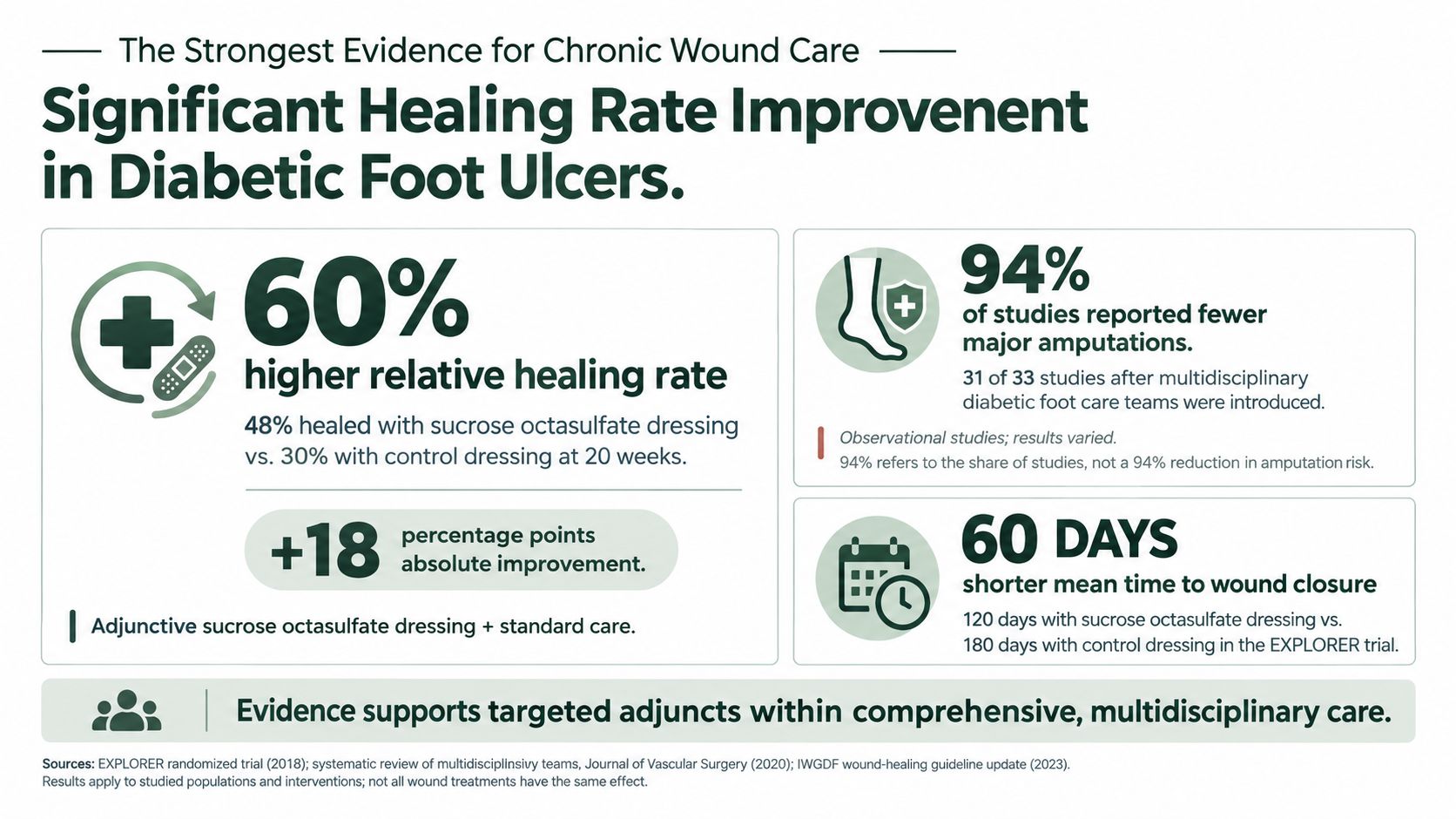
Chronic wounds are the clearest place to discuss ozone therapy. The strongest case is for topical or local adjunct use in difficult wounds, especially diabetic foot ulcers, alongside standard wound care such as debridement, infection control, perfusion assessment, and off-loading (2024 review of diabetic-foot-ulcer studies, earlier randomized-study review, 2022 systematic review and meta-analysis).
What improved, and what did not
The 2022 meta-analysis found ozone therapy was associated with a clear improvement in wound area versus standard care, with a standardized mean difference of 0.66 (95% CI 0.46 to 0.87, P < 0.00001) (2022 systematic review and meta-analysis). It also reported a lower amputation risk, with a risk ratio of 0.36, about a 64% relative reduction.
The same meta-analysis did not find a significant improvement in complete wound healing or hospital length of stay. That is the kind of trade-off patients need to hear. A treatment can help shrink a wound without fixing every outcome that matters.
How it's used in practice
In a wound clinic, ozone belongs in the role of a support layer. It may be considered when tissue conditions are poor, the wound has stalled, or local microbial and inflammatory pressure is slowing repair. It does not replace blood-flow assessment, pressure relief, glucose control, or careful debridement.
A separate review screened 61 potentially relevant studies and included only 6 after eligibility checks. It reported higher healing rates, shorter hospital stays, increased catalase activity, and reduced blood glucose, while also stressing a considerable risk of bias. That keeps the clinical reading grounded. Ozone for wounds is promising as an adjunct, but the evidence is still uneven enough that route, dose, and case selection matter just as much as the therapy itself.
Evaluating Ozone for Musculoskeletal Pain
Patients ask about ozone because they want relief without surgery or long-term medication. For musculoskeletal pain, especially nonspecific low back pain, the evidence is mixed. Ozone helps a subset of lumbar-pain patients, and the trial data do not support it as a predictable, universal pain solution.
Short term and longer term don't look the same
In a review of lumbar pain trials, 779 records were identified and 6 clinical trials were included. At 3 months, there was no statistically significant difference in pain relief between ozone therapy and comparison treatments, with a risk ratio of 1.98 and a 95% confidence interval of 0.46 to 8.42 (P = 0.36) based on 366 participants.
At 6 months, the same lumbar-pain review reported greater apparent effectiveness for ozone versus steroid or placebo comparators, with a risk ratio of 2.20 and a 95% confidence interval of 1.87 to 2.60 (P < 0.00001) based on 717 participants. The authors also classified many studies as high or uncertain risk of bias, so that longer-term signal should be read cautiously.
Ozone Therapy Evidence by Condition
| Condition | Evidence Level | Realistic Clinical Outcome |
|---|---|---|
| Diabetic foot ulcer | Strongest available support among common uses, but still adjunctive | Smaller wound area, possible lower amputation risk, not guaranteed complete healing |
| Lumbar pain | Mixed, methodologically fragile | Some patients may improve, but short-term certainty is limited |
| Broader inflammatory or pain conditions | Low and inconsistent | May be considered case by case, not as a universal fix |
Where it fits, and where it doesn't
For back pain, ozone belongs inside a broader plan that may also include movement rehab, manual care, regenerative injection therapy, and medication discussion when needed. For people with structural instability, nerve irritation, or an unclear diagnosis, the first job is evaluation, not injection.
If the diagnosis is vague, the treatment should stay cautious.
Realistic counseling matters. Patients should hear the likely benefit, the alternative approaches, and what a meaningful response would look like before anyone starts a protocol. Without that, ozone becomes marketing instead of medicine.
Delivery Routes and Critical Safety Boundaries
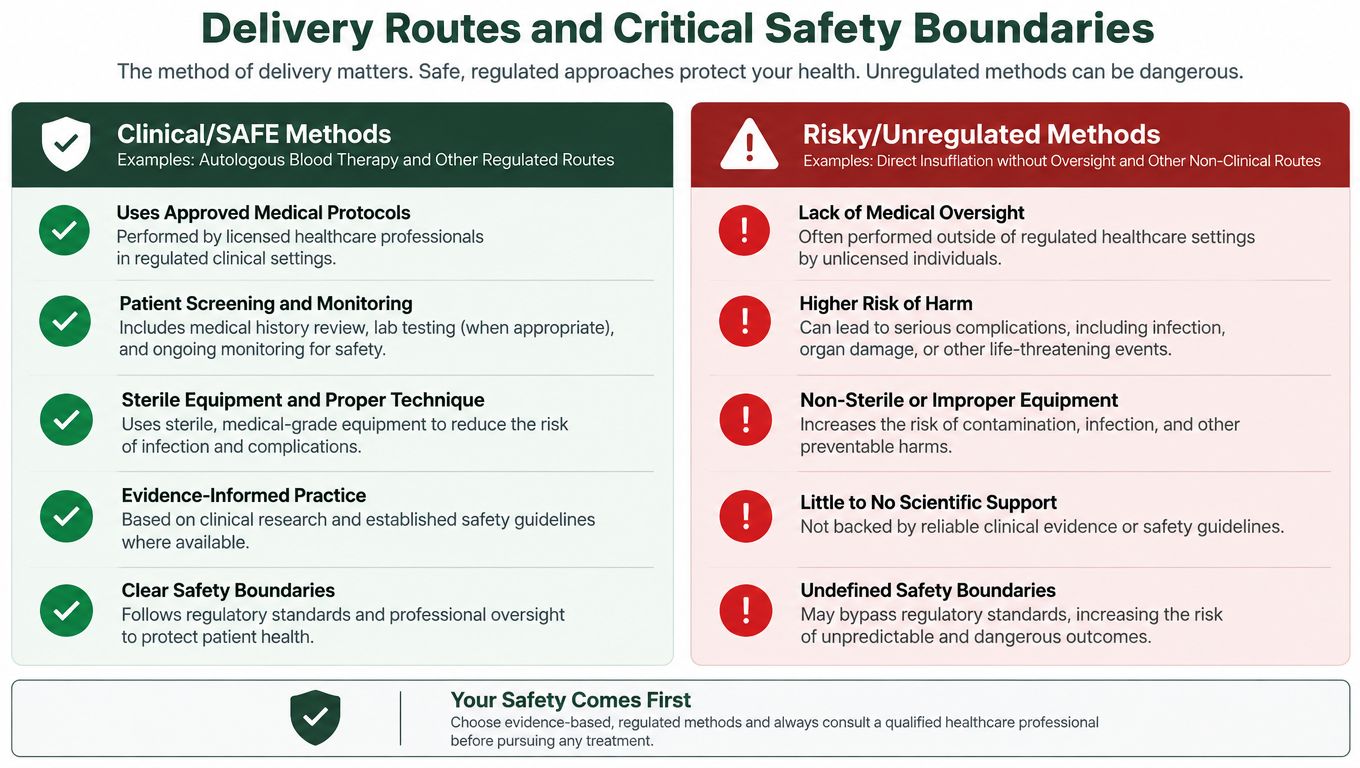
Route of administration determines most of the safety profile with ozone. The evidence and the risk change depending on whether it is used topically, injected, or exposed to the airways. Direct inhalation is the clearest red line. Ozone can irritate and injure respiratory tissue, so it should never be treated as harmless “oxygen therapy” (review focused on route-specific risk screening).
What's used clinically
In medical settings, ozone is typically delivered in controlled ways such as topical application or carefully protocolized blood-based or localized techniques. For a plain-language look at the routes used under physician oversight, see our ozone therapies overview. The route has to match the clinical problem, and it has to be delivered with documented concentration and exposure details.
The lack of immediate side effects does not prove long-term safety. The umbrella review on safety and rare serious events describes short-term tolerability, but also very-low-quality evidence, limited safety monitoring, and rare severe events including stroke, myocardial infarction, thrombosis, and hemolysis. The same umbrella review points to the need for caution rather than broad confidence.
What patients should never normalize
Accidental inhalation, casual “detox” marketing, and poorly supervised systemic use all reduce the safety margin. Any clinic offering ozone should be able to explain contraindications, emergency procedures, and how adverse events are tracked. If that explanation is vague, the patient should not proceed.
Safe use is not defined by the word ozone. It is defined by the route, the protocol, and the medical setting. Anything outside that framework deserves skepticism.
How to Screen an Integrative Ozone Provider
A patient doesn't need to memorize ozone chemistry to ask smart safety questions. Start with the basics: who is supervising, what route is proposed, and what makes that route appropriate for your specific condition. In a gray regulatory space, the burden of clarity falls on the clinic.
The questions that matter
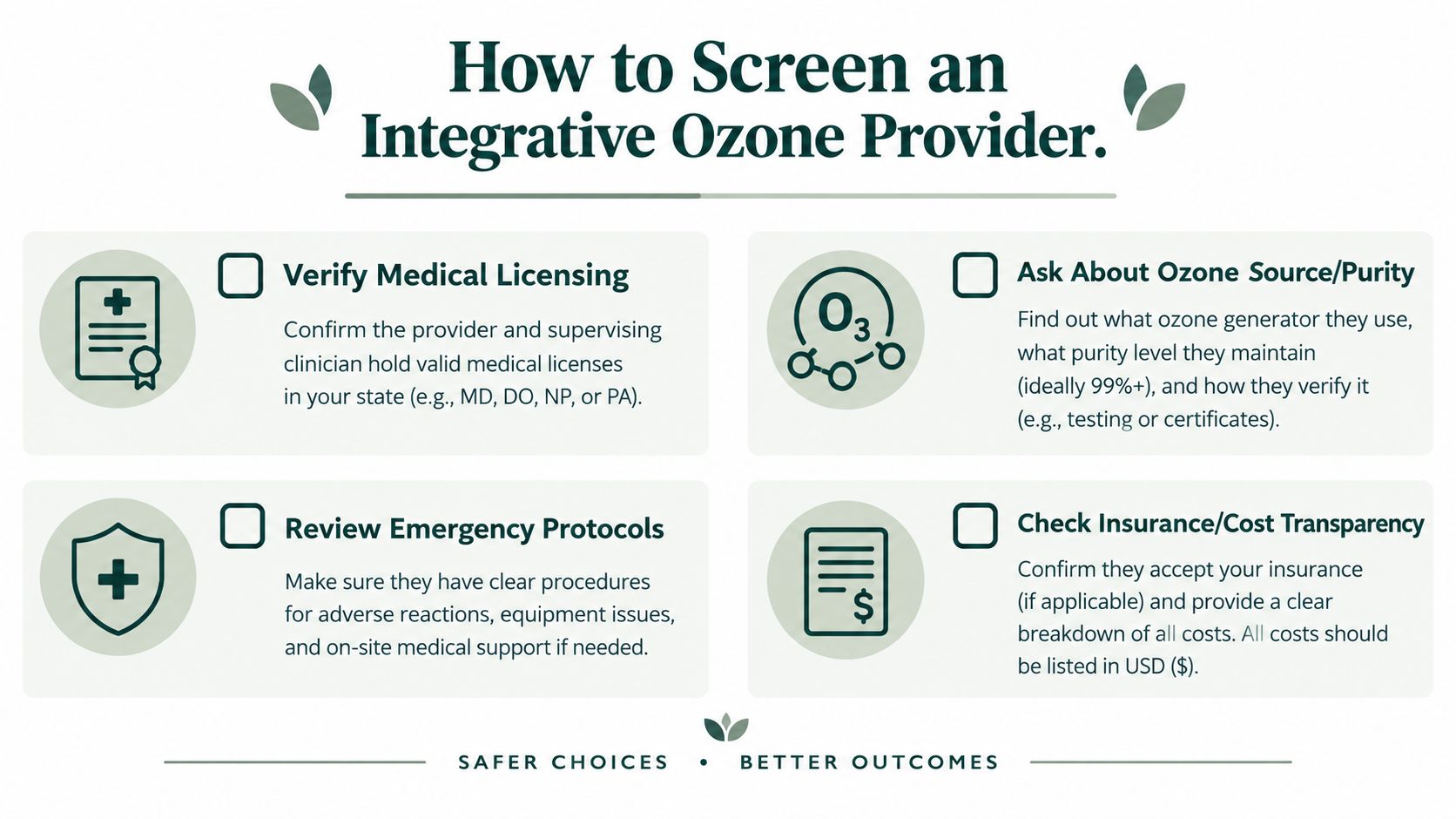
- Verify Medical Licensing: Ask which licensed clinician is responsible for assessment, consent, and follow-up, not just who operates the equipment.
- Ask About Ozone Source and Purity: The clinic should explain how medical-grade ozone is generated and documented.
- Review Emergency Protocols: If a systemic or injection-based route is proposed, ask how the clinic handles adverse events and what monitoring is in place.
- Check Insurance and Cost Transparency: Get the full price in USD ($), including evaluation, treatment sessions, and follow-up, before you consent.
What to ask about risk
The most important screening question is whether the proposed route is appropriate for your diagnosis. Ask whether the route is FDA-authorized for that use, what the contraindications are, and how pregnancy, anticoagulant use, or cardiopulmonary disease change the plan. If the answers are vague, that's a warning sign.
Good ozone care sounds clinical, not mystical.
That clinical tone should extend to documentation. Dose, concentration, exposure time, and outcome measures should all be written down. If the clinic can't show you a protocol, it's not individualized care, it's guesswork.
A practical benchmark
A serious provider will talk about measurable goals, not just how you feel on the day of treatment. For a wound, that might mean serial measurements. For pain, it might mean function, sleep, and activity tolerance. For either case, the discussion should include alternatives, not just the treatment the clinic wants to sell.
Integrating Ozone into a Whole-Person Care Plan
Ozone is most useful when it's one part of a broader plan, not the center of it. In physician-led integrative care, that usually means pairing it with the basics that change outcomes, such as mobility work, nutrition support, rehabilitation, and diagnostic follow-up. A clinic like Restore Osteopathic Medicine's functional medicine care can place ozone inside that larger framework when it makes sense clinically.
For example, a patient with a stubborn wound may need perfusion assessment, pressure relief, and wound care first, with ozone considered only as an adjunct. A patient with pain may need manual treatment, movement restoration, or regenerative options alongside any local ozone use. The order matters because adjunctive therapies work best when the foundation is already stable.
Realistic expectations protect patients here. Ozone can support tissue repair or symptom control in select cases, but it doesn't replace diagnosis, it doesn't erase risk, and it doesn't turn a complex condition into a one-visit fix.
If you're trying to decide whether ozone belongs in your care plan, visit Restore Osteopathic Medicine and ask for a physician-led evaluation that looks at your diagnosis, your route options, and your safety profile together. The right clinic will tell you where ozone may help, where it won't, and what the rest of your treatment needs to include.