
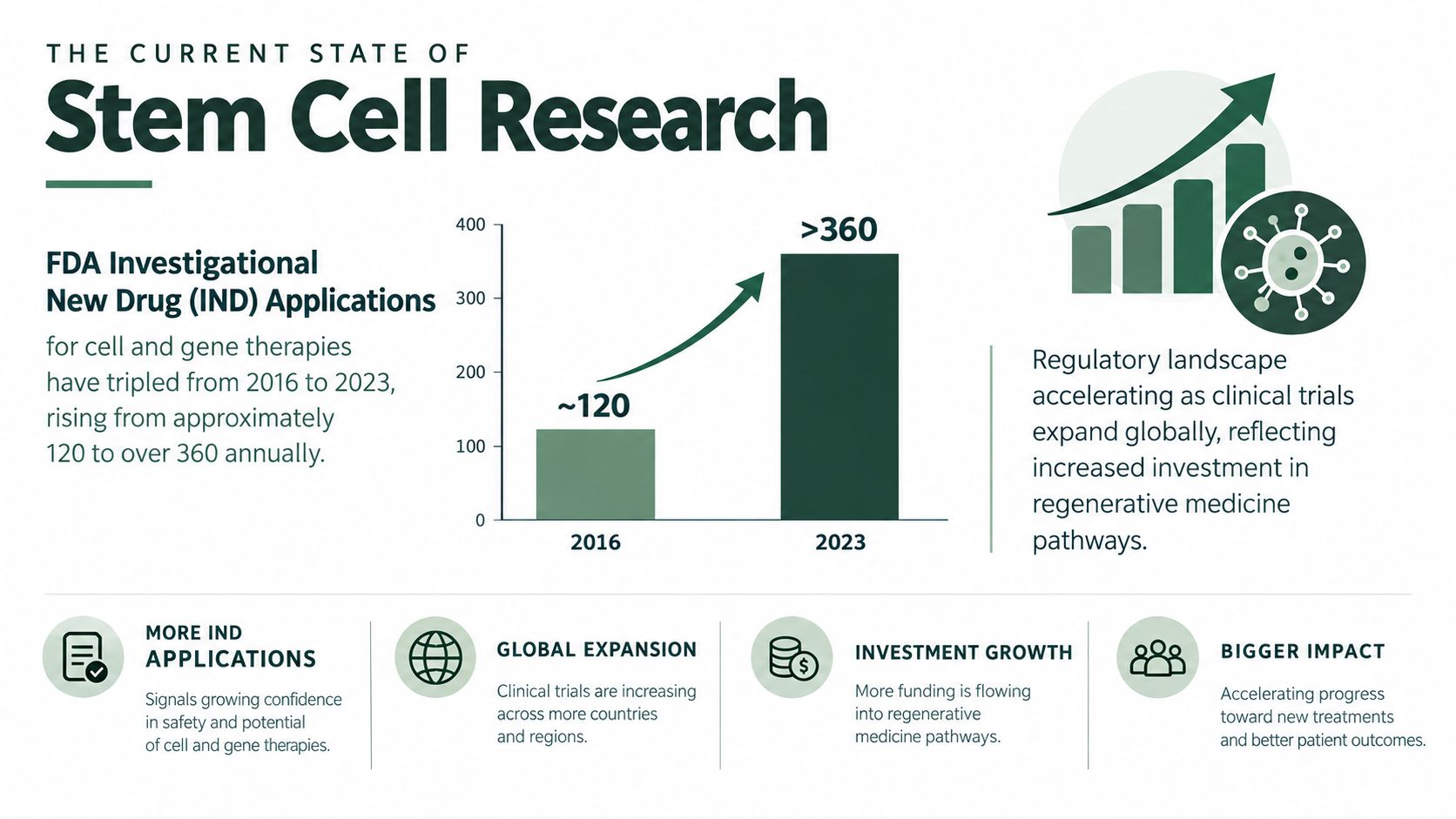
FDA-reported new Investigational New Drug applications for cell and gene therapies tripled between 2016 and 2020, signaling rapid growth but also showing that most candidates remain experimental rather than approved cures. The pros and cons about stem cell research therefore come down to a clear tension: the science can create human cells for better research and possible repair, while clinical use still demands evidence, regulation, and long-term monitoring.
That gap matters more than the headline promise. A laboratory can produce specialized cells and observe encouraging biological activity, but a patient needs a treatment with a defined product, controlled dosing, known risks, reliable manufacturing, and evidence that benefits last. Stem cell research has moved toward regulated clinical development, yet progress in the pipeline shouldn't be mistaken for immediate availability at a clinic.
| Potential advantages | Clinical and practical limitations |
|---|---|
| Generates specialized human cells for disease research | Many applications remain experimental |
| Supports medicine testing and patient-derived disease models | Results vary by cell source, dose, delivery route, and trial design |
| May help repair or replace damaged tissue | Cells can trigger immune reactions, abnormal growth, or tumors |
| Creates options for conditions with limited treatments | Manufacturing and quality control are demanding |
| Could advance personalized medicine | Cost, access, donor rights, and long-term monitoring remain unresolved |
Table of Contents
- The Current State of Stem Cell Research
- Scientific Potential and Clinical Applications
- Risks of Unapproved Stem Cell Treatments
- Comparing Stem Cell Types and Sources
- Ethical and Access Considerations
- How to Evaluate Stem Cell Therapies Safely
The Current State of Stem Cell Research
New Investigational New Drug applications for cell and gene therapies tripled between 2016 and 2020, a useful marker of how quickly the field is moving from laboratory work into formal human testing. That figure does not describe approved care. It describes a larger development pipeline, where proposed therapies still have to pass through staged evaluation before they can be offered as standard treatment.
Why the pipeline isn't the same as a cure
The gap between scientific potential and clinic availability is where confusion often starts. A laboratory can show that a cell product survives, changes tissue behavior, or produces an intended biological signal. None of those findings, on their own, show that a treatment improves patient outcomes in a reliable way, or that the benefits outweigh the risks across a defined group of patients.
Clinical development is slower for good reason. Investigators have to establish what cells are being delivered, how they are manufactured, whether the product stays consistent from batch to batch, how it should be dosed, who should receive it, and what outcomes would count as meaningful benefit. Safety questions also extend well beyond the procedure itself. Cell-based interventions may carry risks such as immune reactions, abnormal growth, contamination, or effects that appear only after longer follow-up.
Early studies can look encouraging and still fail later. A treatment may be feasible to administer yet fall short when tested in larger or better-controlled trials. That result does not mean the science was worthless. It means the clinical standard is higher than biological plausibility, especially when patients may be exposed to irreversible or poorly characterized effects.
Practical rule: A growing research pipeline signals opportunity, not proof that a stem cell intervention is ready for routine care.
This distinction matters most for patients evaluating real-world offers. Some clinics market interventions that sound similar to products under legitimate investigation, but research activity and commercial availability are not the same thing. If a provider presents an experimental stem cell procedure as an established cure, the claim is running ahead of the evidence and outside the caution expected in regulated medicine.
What the current stage means for patients
Stem cell research currently offers its strongest value as long-term medical innovation. It helps researchers test mechanisms, refine cell sources and manufacturing methods, and identify which diseases may justify larger clinical programs.
For patients, the practical takeaway is narrower. “Available” may only mean a clinic is willing to sell an intervention. It does not confirm that the product has shown reliable safety, durable benefit, or the level of evidence expected before standard medical use.
Scientific Potential and Clinical Applications
Stem cell research has produced a wide range of specialized human cells that scientists can use to study disease mechanisms, test candidate drugs, and examine whether damaged tissue might be repaired. That laboratory value is real. It still does not mean a clinic can offer the same idea as a proven treatment.
From patient cells to disease models
Patient-derived cells give researchers a way to study disease in a form that more closely reflects human biology. A lab can generate cells that carry features of a person's condition, then use them to investigate how a disease develops or to screen medicines before human trials. This can make early research more informative and, in some settings, reduce dependence on animal models. It does not remove the need for controlled clinical testing in patients.
The same scientific flexibility explains why the field continues to draw attention across very different conditions, including blood cancers, diabetes, neurodegenerative disease, and certain forms of blindness. Some proposed uses involve modeling disease in a dish. Others aim to replace, support, or repair injured tissue. Those are distinct goals, with different evidentiary standards and different safety questions.
That distinction matters.
A cell model may help identify a disease pathway or reveal which drug candidate deserves more study, yet offer no basis for assuming that the cells themselves will work as a treatment. Cells that appear stable, functional, or biologically active in a laboratory may behave differently after delivery into the human body, where dose, distribution, immune response, and manufacturing consistency all affect outcome. This is the gap between scientific potential and clinic-ready medicine, and it is where many public claims become misleading.
Why protocol details determine the result
“Stem-cell therapy” is not a single intervention. A systematic review of six ALS clinical studies selected from 748 screened records found mixed results, with some trials reporting benefit and others finding no statistically significant difference from control groups. The review also noted meaningful variation in cell source, route of administration, number of doses, and cells delivered per dose. The ALS systematic review shows why broad claims about stem cells often hide major differences between protocols.
Researchers therefore have to specify far more than the cell label. They need clear definitions of cell identity, potency testing, viability, dose, release criteria, and long-term endpoints before results can be interpreted across studies. Without that structure, a positive finding in one program may have limited relevance to another that uses different sourcing, processing, or delivery methods.
Patients looking into narrowly marketed uses should apply the same standard. Hair-related claims, for example, are often presented in language that sounds scientific while relying on a much thinner evidence base than patients may assume. An overview of how stem cell therapy restores hair may be useful for understanding the concept, but it does not establish regulatory approval or reliable clinical benefit for a specific product.
The same caution applies to treatments described as regenerative more generally. Some services presented as regenerative injection therapy may involve a regenerative framing without corresponding evidence for a validated stem-cell product.
Risks of Unapproved Stem Cell Treatments
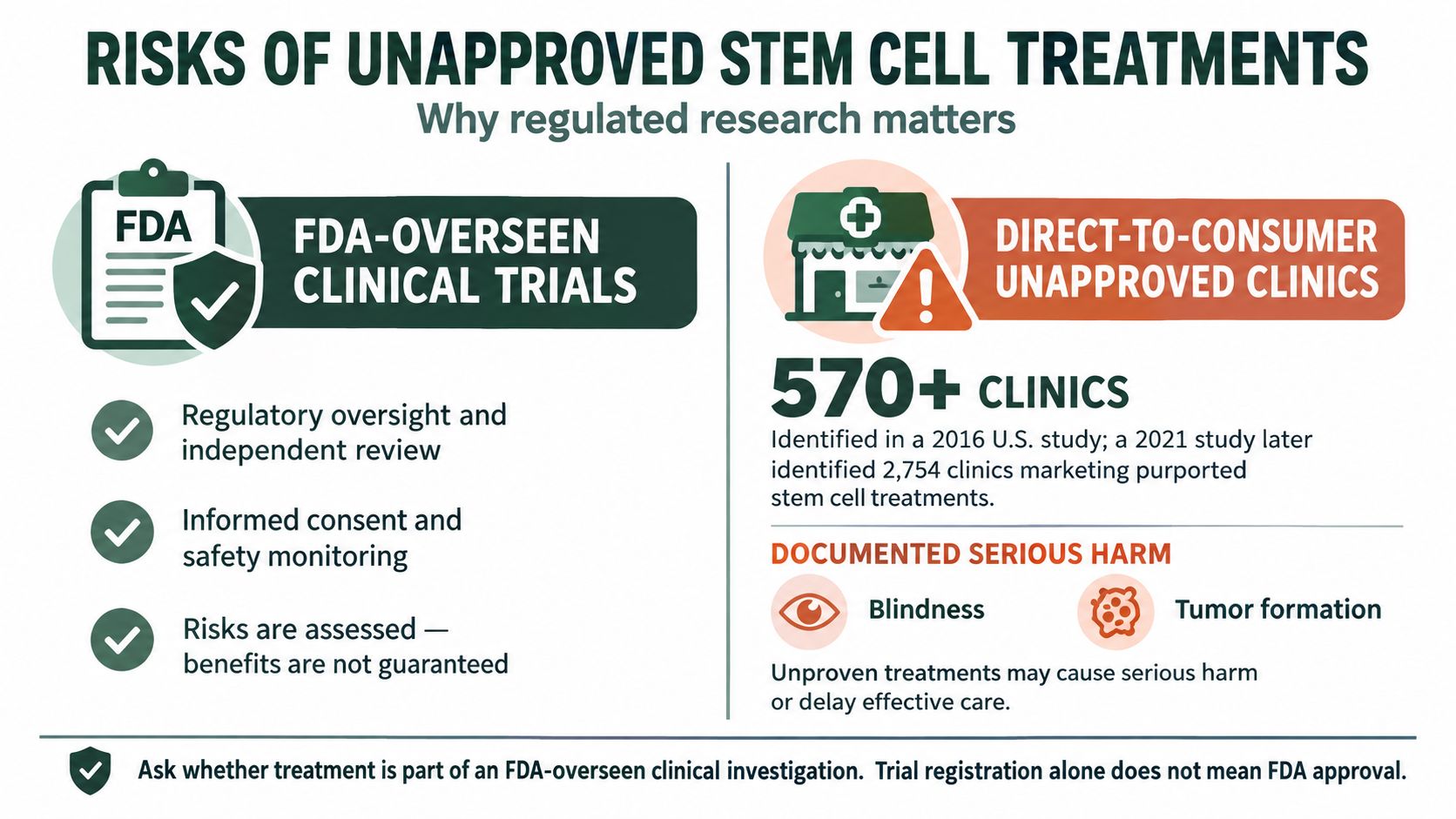
The most serious danger isn't stem cell research itself. It arises when preliminary findings are converted into direct-to-patient treatments without adequate clinical validation, manufacturing controls, or transparent follow-up. In the United States, at least 716 clinics across 45 states and the District of Columbia were offering unapproved stem-cell products by May 2017, according to a review summarized by the Pew Charitable Trusts. A later estimate placed the number of U.S. stem-cell clinics at approximately 2,750 in 2021, illustrating how access expanded faster than rigorous evidence.
The harm isn't theoretical
Reported harms associated with unapproved interventions include bacterial infections, chronic pain, blindness, strokes, abnormal tissue growth, and tumors. The Pew summary identified 334 adverse-event cases associated with unapproved interventions and 20 subsequent deaths. The National Eye Institute reported 360 adverse-event reports, including 20 deaths, while warning that the total was probably underestimated because some products fall outside normal FDA oversight.
These figures don't establish that every experimental intervention causes harm. They do establish that patients can face substantial injury when providers market uncertain products without the safeguards expected in a clinical trial. Financial exploitation compounds the medical risk, particularly when people pay for unproven care while delaying treatments with stronger evidence.
What makes cells biologically risky
Cells aren't inert substances. After administration, they may migrate, multiply into unintended cell types, trigger immune or inflammatory reactions, or form tumors. The outcome depends on the product's identity, processing, dose, delivery route, patient characteristics, and monitoring plan.
A clinic's polished website can't answer those questions. Patients need access to a defined protocol, informed consent, adverse-event reporting, and follow-up arrangements. Claims such as “natural,” “minimally invasive,” or “your own cells” don't remove the possibility of infection, abnormal growth, immune complications, or treatment failure.
Warning sign: A provider who treats regulatory review as an obstacle rather than a patient-safety requirement is giving you information about the provider, not evidence about the therapy.
Patients should also be cautious about combining unapproved cellular interventions with unrelated wellness claims. Questions about adjunct approaches, including ozone therapies, should remain separate from the evidence supporting a particular stem-cell product. Different interventions require different evidence, consent, and risk assessments.
Comparing Stem Cell Types and Sources
The phrase stem cell covers biologically different materials. Their advantages and liabilities can't be assessed as if they were interchangeable. Pluripotent cells offer broad developmental flexibility, while adult and tissue-specific cells may have narrower potential. Yet narrower potential doesn't automatically mean clinical safety, and broad potential doesn't automatically mean therapeutic superiority.
| Cell type or source | Main scientific advantage | Key safety or translation burden |
|---|---|---|
| Embryonic stem cells | Broad pluripotency and ability to generate specialized human cells | Ethical questions, incomplete differentiation, immune and tumor-related concerns |
| Induced pluripotent stem cells | Pluripotency without using an embryo for each cell line | Genomic instability, chromosomal damage, abnormal epigenetic changes, and tumorigenic clones |
| Adult or tissue-derived cells | More limited developmental range and potential source-specific uses | Variable potency, protocol dependence, and uncertain effectiveness for many proposed applications |
| Umbilical-cord-derived blood-forming progenitor cells | Established use for certain hematopoietic disorders | Narrower clinical indication than the broader claims made for regenerative medicine |
Pluripotency creates a trade-off
Embryonic and induced pluripotent stem cells can generate specialized human cells, making them valuable for disease modeling, drug screening, and possible regenerative treatment. That flexibility also increases the number of ways a product can go wrong. Induced pluripotent cells may carry genomic instability, chromosomal damage, abnormal epigenetic changes, incomplete differentiation, contaminating undifferentiated cells, or selected tumorigenic clones.
These risks require more than routine cell-culture observation. Manufacturing programs need genomic testing, residual-pluripotency assays, cell-purity testing, sterility and endotoxin testing, controlled differentiation, and long-term surveillance for ectopic tissue or tumor formation.
Adult sources aren't a universal shortcut
Adult stem cells may avoid some ethical objections associated with embryonic sources, but that doesn't settle the clinical question. Their properties can vary by tissue, preparation, donor, processing method, and intended use. A lower ethical burden or familiar source doesn't prove that a particular product repairs tissue or improves a disease outcome.
The practical comparison is therefore not “new cells versus old cells.” It's defined product versus undefined product, and tested protocol versus unsupported claim. The FDA's consumer information on regenerative-medicine therapies states that the only broadly FDA-approved stem-cell products are blood-forming progenitor cells derived from umbilical cord blood for hematopoietic disorders. That narrow approval scope should recalibrate expectations about what is currently established.
Ethical and Access Considerations
Scientific success doesn't automatically produce fair access. A therapy may work under controlled conditions yet remain unavailable to patients who can't afford personalized manufacturing, travel, monitoring, or follow-up. The ethical question is therefore broader than whether researchers can create a useful cell product. It asks who receives the benefit, who bears the risk, and who gets to decide how biological materials are used.
A 2025 global review reported 1,511 registered stem-cell therapy trials in autoimmune and inflammatory disease as of January 2, 2025, while identifying high costs, limited long-term safety data, and insufficient standardization as major barriers to clinical translation. The review's findings show why trial volume shouldn't be confused with broad patient access or proven effectiveness.

Access depends on infrastructure
Personalized cell manufacturing can be difficult to scale. If a treatment requires patient-specific collection, processing, testing, storage, and delivery, wealthy health systems may be better positioned to provide it than under-resourced systems. Private payment can further separate access from clinical priority, allowing ability to pay to influence who receives an experimental intervention.
This creates a less obvious disadvantage of innovation. The first patients to access a technology may not be those with the greatest medical need. They may be those with geographic access, financial resources, or the ability to tolerate uncertain outcomes.
Consent must follow the cells
Organoids and gene-edited induced pluripotent stem cells create governance questions that older consent forms may not answer. Donors may need clear information about future commercial use, genetic reprogramming, data sharing, and whether researchers might discover unexpected medical findings.
Gene editing may improve precision, but off-target changes can produce harmful unintended effects. Permanent germline alterations raise an additional boundary because their consequences could extend beyond the individual who initially consented. Strong oversight should therefore address not only laboratory safety but also privacy, donor compensation, community representation, and responsibility for delayed or unrealized benefits.
A fair system measures more than breakthroughs. It also measures who can participate, who can refuse, and who remains protected when the promised benefit never arrives.
How to Evaluate Stem Cell Therapies Safely
Start by separating a clinical trial from a commercial procedure. A legitimate trial should identify the responsible investigators, explain the study purpose, define eligibility, describe risks and potential benefits, disclose the intervention and follow-up plan, and provide a consent process that acknowledges uncertainty. Regulatory registration and transparent reporting don't guarantee success, but they give patients a basis for judging whether the intervention is being evaluated rather than just sold.
Ask for evidence that matches the claim
Before considering treatment, ask these questions:
- What exact product will be administered? Request the cell source, processing method, dose, delivery route, and release criteria.
- What evidence applies to my condition? A result involving one disease, cell source, or protocol can't automatically support another.
- What is known about harm? Ask about infection, immune reactions, abnormal tissue formation, tumors, and treatment failure.
- Who provides follow-up? Confirm how long monitoring continues and who pays for evaluation if complications occur.
- What happens if I decline? A credible clinician should discuss established alternatives and the consequences of waiting.
Be wary of guaranteed cures, dramatic before-and-after language, pressure to pay immediately, vague descriptions of the cells, and claims that regulatory review is unnecessary. “Experimental” should mean that uncertainty is explained openly, not that the patient is expected to accept uncertainty without documentation.
Protect your decision-making
Bring the consent form home if possible and discuss it with an independent physician who isn't selling the intervention. Confirm whether the treatment is approved for your specific condition or offered only within a regulated study. Also distinguish evidence for stem cells from evidence for adjacent services, including nutraceutical recommendations or other supportive care. A complementary service can't validate an unapproved cell product.
Readers evaluating broader regenerative or supportive approaches may also explore Hyperbaric business solutions insights, but any proposed therapy still needs condition-specific evidence and a clear safety discussion. The central decision rule is simple: don't pay for a promise when the provider can't show what is being administered, why it should work, how risks are monitored, and what happens if it fails.
Restore Osteopathic Medicine offers physician-led osteopathic and integrative care, including individualized evaluation, regenerative injections, functional support, and follow-up planning. If you're weighing regenerative options and want a careful discussion grounded in your health history rather than promotional claims, visit Restore Osteopathic Medicine to learn more.