
Prolotherapy for neck instability is an investigational adjunct, not a proven method for stabilizing the cervical spine. The strongest prospective series in this specific diagnosis enrolled six patients, and no study has shown that proliferant injections restore ligament integrity or lower the risk of neurologic injury.
That verdict sits awkwardly beside the demand for the treatment. People with a loose, clicking, painful neck are often looking for something between a lifetime of medication and a fusion, and a course of injections looks like a reasonable middle path. The evidence does contain a signal. Several small series describe genuine reductions in pain and real gains in daily function after treatment.
What the evidence lacks is the one thing that would settle the question, a controlled comparison against a credible alternative. That gap turns a clinical choice into a judgment call, and judgment calls need rules. The rules run in a fixed order: confirm that instability exists, exclude the findings that make an elective injection unsafe, state the functional goal in measurable terms, and set a date to decide whether the treatment worked.
Table of Contents
- The Short Answer on Prolotherapy for Neck Instability
- What Prolotherapy Is and How It Tightens Loose Ligaments
- Who Qualifies and How Doctors Confirm Instability
- How a Prolotherapy Course Unfolds Step by Step
- Expected Outcomes and How Much Weight They Deserve
- Risks, Complications and Recovery Time
- Prolotherapy Compared With OMM, PRP and Surgery
- Confirm the Next Step With a Specialist
The Short Answer on Prolotherapy for Neck Instability
The short answer takes one sentence. The published evidence describes symptom relief in small, uncontrolled groups, not structural repair of the cervical spine.
The most detailed prospective look at the question followed six patients with traumatic cervical instability, each selected for more than 2.7 mm of absolute cervical translation and at least 50% pain relief during a two-day rigid-collar immobilization test. Three injection sessions at radiographically identified translation sites moved mean pain from 5.75 to 3.83 on a visual analogue scale, a change that reached significance at p = 0.04, and imaging showed reduced flexion and extension translation (the fluoroscopically guided cervical case series). Six patients, no control group, and no way to separate the injections from the natural history of a ligament that was already beginning to settle.
| Prolotherapy for neck instability at a glance | ||
|---|---|---|
| Question | Short answer | Evidence strength |
| Does it stabilize the cervical spine? | Not shown; no study proves structural stabilization | Very weak |
| Does it relieve neck pain? | Small uncontrolled studies report pain reduction; controlled evidence is weak | Weak |
| Is it recommended in neck pain guidelines? | No; general neck-pain guidelines don't include it | Not recommended |
| Is it standard care? | Investigational adjunct used by some clinicians | Not applicable |
| Who might be considered? | Selected patients with objective excessive translation and no red flags, after specialist review | Clinician-dependent |
Three conclusions follow from that table, and they matter more than any single percentage.
- What the evidence supports today: a defined trial of treatment in a carefully selected patient, with pre-agreed measures and a stop date written down before the first session.
- What it cannot support: any claim that injections tighten a loose cervical ligament, halt progression, or substitute for surgery when surgery is indicated.
- The rule that matters most: objective confirmation of instability comes before any injection, because a subjective sense of looseness is not a diagnosis and it doesn't predict who responds.
What Prolotherapy Is and How It Tightens Loose Ligaments
Ligaments help limit movement between the vertebrae, but the idea that an injection can reliably tighten a loose cervical ligament remains unproven.

A tent's guy lines anchor its canvas to the ground. If a line stretches, the canvas sags. Prolotherapy applies a similar mechanical analogy to ligaments, which connect bones and help limit movement at a joint. The analogy illustrates the proposed rationale, not proof that an injection restores ligament tension.
Prolotherapy involves injecting a solution, commonly containing a dextrose-based proliferant, into targeted musculoskeletal tissues. The proposed mechanism is a controlled local tissue injury intended to prompt a repair response. A review of prolotherapy's biology and application in cervical instability discusses this theory, including the possibility of changes in collagen organization and tissue stiffness over time. Whether those changes reliably occur in cervical ligaments, and improve instability, remains uncertain.
Prolotherapy is intended to stimulate a local tissue response. That proposed mechanism differs from an injection intended primarily to reduce inflammation.
Where the tent analogy stops
A ligament's mechanical properties cannot be assessed by testing it like a tent line. The cervical evidence described in the review of prolotherapy's biology and its application in cervical instability is observational and limited. Retrospective clinic reports also cannot separate a treatment effect from factors such as patient selection and expectations.
For a person considering an elective injection, evidence limits are part of the candidacy decision. A clinician should first consider whether another condition makes injection inappropriate or calls for a different course of care. Symptoms or pain scores alone cannot establish that a ligament has become mechanically stronger.
A patient who asks about collagen supplements after a second session is asking a related, but separate, question: what might support connective tissue while treatment is underway? Peptides for joint health discusses peptides and tissue repair, while guidance on how to heal ligaments faster addresses loading and recovery. Neither establishes that a supplement or injection tightens a cervical ligament.
Who Qualifies and How Doctors Confirm Instability
Many patients arrive at this topic with one question: my neck feels unstable, so do I qualify? Those are two different questions, and the space between them is where most of the harm in this field happens.
Clicking, dizziness, headache and neck pain are real symptoms. None of them prove ligamentous instability. A structured differential has to separate traumatic instability, degenerative disease, hypermobility-related symptoms, and possible neurologic or vascular conditions, because each of those looks different, behaves differently, and needs different care.
Why the examination alone doesn't settle it
A 2025 overview of systematic reviews found that the spinal-physiologic translation test has poor reliability and diagnostic accuracy when used alone, and that no single examination should establish instability in isolation (an overview of the diagnostic evidence in cervical instability). The same review indicates that CT is more reliable than plain radiographs for upper-cervical fractures or malalignment, and that MRI combined with static and dynamic radiographs may be needed to evaluate the disco-ligamentous complex.
That's a more extensive imaging workup than many expect for a condition they self-diagnosed online. It's also the part that decides whether an injection is even the right conversation.
What a research definition looks like
Studies that have treated cervical instability have used entry criteria: objectively measured excessive translation on dynamic imaging, plus a documented response to a short period of rigid-collar immobilization. Those were study criteria chosen to assemble a clean sample. They aren't clinical rules, and applying them in an ordinary exam room is a judgment call rather than a protocol.
Regenerative injection therapy requires an evaluation to determine whether it's appropriate for a particular patient, and that evaluation is where these questions get answered. A useful test of any clinic is to ask which findings would make them decline to inject. A clinic that can't name them isn't screening.
The findings below move a patient out of the elective-injection pathway and into imaging or specialist care first.
| Red flags that rule out elective injection first | ||
|---|---|---|
| Finding | Why it matters | Required action |
| Suspected spinal-cord compression | Risk of permanent neurologic injury | Urgent imaging and specialist referral |
| Objective weakness or sensory loss | Possible nerve or cord involvement | Neurologic assessment before any injection |
| Major trauma or suspected fracture | Injection does not treat a fracture | Emergency imaging; CT for upper-cervical fractures |
| Progressive neurologic symptoms | A changing course needs an urgent diagnosis | Specialist assessment |
| Major craniocervical instability | Possibly surgically urgent | Spine surgery referral |
| Inflammatory disease | Can change the treatment plan | Exclude before treatment |
How a Prolotherapy Course Unfolds Step by Step
A course of treatment follows a predictable shape even though the details vary by clinic, and knowing the shape helps you spot a clinic that skips the parts that don't generate revenue.
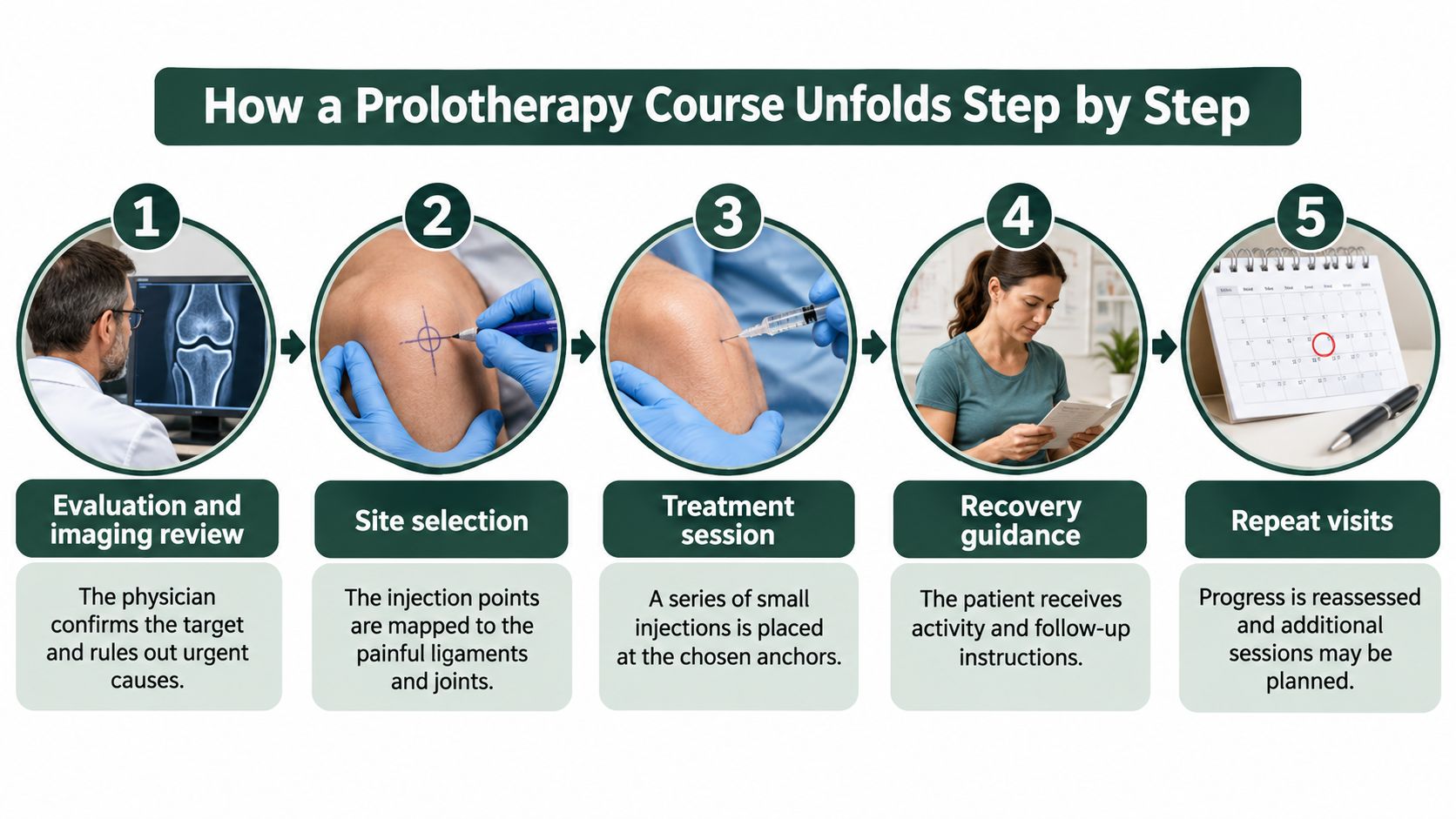
The six steps in order
- Evaluation and imaging review. The physician confirms the target and rules out urgent causes, because an injection can't treat a fracture or a compressed cord. If this step is compressed into five minutes, everything downstream is guesswork.
- Site selection. Findings from imaging and the exam map injection points onto specific ligament attachments. A diffuse "whole neck" approach leaves nothing to reassess afterward.
- Preparation and plan confirmation. The skin is cleaned, the plan is restated aloud, and most protocols use ultrasound or fluoroscopy for guidance; the published cervical series used fluoroscopy to place injections at radiographically identified translation sites.
- Injection. A series of small injections places the proliferant at each chosen anchor, usually within a single session. Discomfort is brief and the total procedure time is short.
- Recovery guidance. Short-term soreness is the expected response, managed with relative rest and ice, and the patient should leave with explicit activity instructions rather than a vague suggestion to take it easy.
- Reassessment. After enough time for tissue to respond, outcomes are checked against pain, function, neck range of motion and, where clinically justified, imaging. This is the step that determines whether session five happens.
How long a course runs
Protocols vary by clinician, and no single standard exists. A 2025 review that describes a 2024 patient case of cervical prolotherapy for ligamentous instability states that 4 to 10 treatment sessions are generally necessary for severe cases (a 2025 PMC review of cervical prolotherapy). Other published protocols have used a shorter fixed schedule. The right number is unknown, so it's reasonable to ask why your plan uses the count it does.
Cost and commitment scale with that count, which is one more reason to define success before session one rather than after session eight.
Set the exit before the entry: agree in writing what improvement would look like, how it will be measured, and the date you'll stop if it hasn't appeared.
What to track between sessions
Bring data to each visit instead of impressions. Note pain at rest, during normal activity, and during exercise separately, since these move at different rates. Log activity tolerance in minutes of walking, overhead work or screen time before symptoms flare. Record any new neurologic symptom the same day it appears, not at the next appointment. Keep the agreed stop rule in the same notebook so it stays a decision rather than a feeling.
Expected Outcomes and How Much Weight They Deserve
A cervical prolotherapy case series followed 21 patients for 1 to 39 months, with a mean follow-up of about 24 months. In that series, 95% said treatment met their expectations for pain relief and functional improvement, 86% reported sustained overall improvement, 33% reported complete functional recovery, and 31% reported complete relief of all recorded symptoms. Pain scores also declined, and the authors recorded no adverse events in this small group (the cervical instability case series summarized with prolotherapy's biology).
A related report on unresolved neck pain found average pain scores fell from 6.6 to 2.1, while the proportion reaching at least 75% of expected range of motion rose from 29% to 86%. The share limited to 30 minutes or less of exercise fell from 86% to 19%. These changes describe what participants reported; they do not establish that injections caused the improvement.
What those percentages can support
Study design determines how confidently an outcome can be attributed to treatment. Case reports document individual outcomes. Retrospective series can identify patterns, but cannot reliably separate treatment effects from patient selection, other care or changes over time. Prospective studies add planned follow-up; controlled trials provide a stronger basis for distinguishing an injection's effect from comparison care and the natural course of symptoms.
A state medical-review decision cited only case reports as support for prolotherapy for chronic neck pain and noted that available studies had not significantly outperformed placebo. That finding limits confidence in claims of benefit, even when individual series report substantial improvement.
For a comparison with another injection approach, what PRP injections involve can clarify how the treatments differ. Neither mechanism alone establishes which option is more appropriate.
A realistic outcome to discuss is partial relief with better daily activity tolerance. Complete symptom resolution appears in some reports, but should not be treated as the expected result. A Pain and Sleep Therapy Center timeline can help frame questions about when changes might be noticed. Functional improvement is useful to track alongside pain, but it is not proof that prolotherapy caused the change.
Risks, Complications and Recovery Time
The available complication figures come from a practitioner survey, not a controlled prospective registry. They describe clinicians' reports, not the risk for an individual patient (the prolotherapy consensus document summarizing the survey and Cochrane review).
The survey received 171 completed responses, a 50% response rate, from practitioners with a median of 10 years of experience. Respondents reported roughly 2,000 treatments in 500 patients and about 500 adverse events, or roughly 25% of treatments. They also reported 69 events requiring hospitalization, affecting approximately 14% of the patients represented. These figures are self-reported and retrospective, and were not independently verified by a registry.
A 2004 Cochrane review concluded that prolotherapy injections had not been shown to be more effective than placebo injections. Later assessments continued to describe prolotherapy as investigational for chronic neck and back pain. The University of Queensland's RECOVER Injury Research Centre stated that no research studies had examined prolotherapy for whiplash-associated symptoms and that general neck-pain guidelines do not recommend it. Its summary also described conflicting findings from two high-level studies of epidural or facet-joint prolotherapy. One reported pain reduction only during the first 48 hours, with the effect becoming statistically insignificant afterward.
Why the neck concentrates the risk
In the cervical spine, a needle may pass close to nerve roots, the spinal canal and the apex of the lung. That anatomy makes the injection approach, the operator's training and the plan for responding to complications relevant parts of candidacy. A patient should be able to understand those details before deciding whether to proceed.
| Reported complications and the warning sign to act on | ||
|---|---|---|
| Complication | What it involves | Warning sign to report |
| Hemorrhage | Bleeding at or near injection sites | Expanding swelling, bruising or unusual pain |
| Infection | Bacteria introduced at the injection site | Fever, spreading redness, warmth or pus |
| Nerve damage | Injury to nearby nerve tissue | New numbness, weakness or shooting pain |
| Pneumothorax | Lung puncture, a concern near the lung apex | Sudden chest pain or shortness of breath |
| Spinal headache | Leak of spinal fluid after needle entry | Headache that worsens when sitting or standing |
| Spinal-cord injury | Rare but serious neurologic injury | Weakness, gait change or bladder problems; seek emergency care |
| Systemic reaction | Whole-body response to the injected solution | Rash, dizziness or breathing difficulty; seek emergency care |
Recovery, and when to call instead of wait
The available section does not establish a reliable proportion of patients who experience soreness or a precise recovery duration. Soreness or stiffness at injection sites may occur, but the course varies with the sites treated, planned sessions and baseline function. Ask the clinician what symptoms to expect and what activity guidance applies to the proposed treatment.
New weakness, numbness or shortness of breath after a neck injection warrants a same-day call. Bladder problems or signs of a severe systemic reaction, such as breathing difficulty, require emergency care.
Prolotherapy Compared With OMM, PRP and Surgery
Four options come up in the same conversation, and they're usually compared on the wrong terms: cost, convenience, or how the clinic describes itself. Comparing them on goal, evidence, invasiveness and best fit produces a more useful answer.
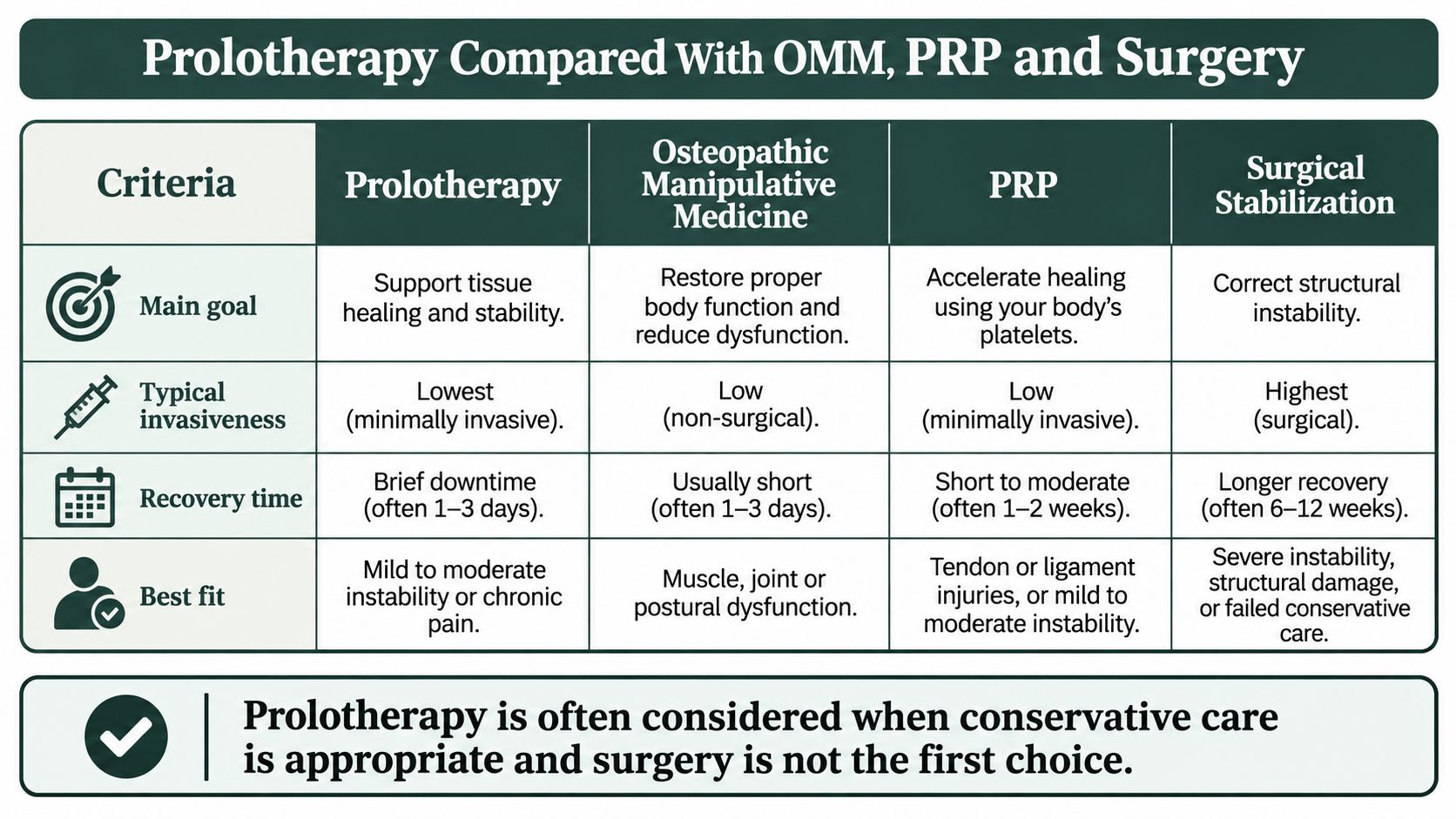
| Neck instability options compared on the same criteria | ||||
|---|---|---|---|---|
| Option | How it works | Evidence for neck instability | Invasiveness | Best fit |
| Prolotherapy | Dextrose stimulates a local repair response | Weak; investigational | Several injections | Selected patients with objective laxity and no red flags |
| Osteopathic manipulative medicine | Hands-on mobilization and soft-tissue techniques | Limited; mostly studied for general neck pain | Non-invasive | Mechanical neck pain; avoid high-velocity manipulation if instability is suspected |
| PRP | Platelet-rich plasma from the patient's own blood | Limited and mixed | Injection-based | Patients who want a blood-derived option after specialist review |
| Surgical stabilization | Fusion or ligament reconstruction | Strongest for documented instability needing surgery | Major surgery | Progressive instability, cord compression or failed conservative care |
When each option fits
Prolotherapy fits a narrow case: objectively demonstrated laxity, no red flags, a specialist-led plan, and a patient who accepts that the outcome is uncertain and measurable. Outside that case it becomes an expensive experiment with a needle.
Osteopathic manipulative medicine suits mechanical neck pain and mobility limits, where the problem is tissue tone and segmental motion rather than a torn ligament. The important caveat is technique: high-velocity manipulation is inappropriate when cervical instability is confirmed or suspected, and gentle mobilization is the safer entry point. Osteopathic neuromusculoskeletal medicine explains what that hands-on evaluation involves.
Platelet-rich plasma is another regenerative injection using the patient's own blood, and its evidence for this specific use is limited and mixed. It's usually weighed alongside a structured plan rather than chosen on its own, and it doesn't answer the diagnostic question any more than prolotherapy does.
Surgical stabilization covers the situations the other three can't: progressive instability, cord compression, or conservative care that has failed on objective measures.
The decision rule that sorts them
The more objective the instability and the greater the neurologic risk, the less suitable an elective injection becomes. A patient with 2 mm of movement and a normal exam has room to try something conservative. A patient with progressive weakness, changing gait or cord signal change does not, and offering injections first delays the treatment that matters.
Matching a diagnosis to a treatment is a specialist judgment. The value of the comparison above is that it tells you which questions to bring, not which row you're in.
Confirm the Next Step With a Specialist
Before considering an elective injection, ask how the clinician will decide whether it is appropriate and what findings would change that recommendation. A focused consultation should leave you with a clear decision process.
- Bring the record, not just your recollection. Existing imaging, prior reports and a symptom diary can help the clinician understand your history and goals.
- Ask what criteria would support a diagnosis of instability, how progress will be measured, and what would lead the clinician to stop or reconsider treatment.
- Ask which alternatives were considered and why. Osteopathic care, supervised rehabilitation, PRP or surgery may be discussed depending on the clinical picture.
At Restore Osteopathic Medicine in Aurora, Colorado, regenerative injection therapy requires an evaluation to determine whether it is appropriate. A single prolotherapy treatment costs $255. Insurance may cover the consultation portion when Restore is contracted with your plan, but the regenerative injections themselves are not covered. Confirm coverage with your plan before scheduling.
Before the consultation, gather relevant records and write down a functional goal you would want reassessed. A defined goal makes it easier to judge whether a proposed course remains appropriate.
If you are considering treatment at Restore, visit Restore Osteopathic Medicine to schedule an evaluation.