
If a clinic says ozone therapy is safe, which procedure is it calling safe: treatment applied to skin, gas introduced into a body cavity, or a procedure involving blood? Those aren't interchangeable exposures. A useful consultation starts with the delivery method, not with a blanket promise about “medical ozone.”
Table of Contents
- Why the Safety Question Is Harder Than It Looks
- What Ozone Actually Is and Why That Matters
- What the Evidence Shows About Side Effects and Adverse Events
- A Route-by-Route Look at Risk
- Who Should Avoid Ozone Therapy
- What Safe Clinical Administration Actually Looks Like
- Pregnancy, Postpartum, and Specialized Populations
- Weighing Potential Benefits Against Real Risks
Why the Safety Question Is Harder Than It Looks
Asking “Is ozone therapy safe?” is understandable, but it leaves out the details that determine whether a safety claim applies to you. A provider needs to name the proposed procedure, explain its purpose, and describe how exposure will be controlled. Without that information, reassurance is premature.
The practical question is narrower: Is this particular procedure justified for this particular patient? That question requires a discussion of potential benefit as well as harm. A treatment can be tolerated without being effective, and a technically careful procedure can still have an unfavorable risk-benefit balance.
The lens to use in a consultation
Start with these connected variables:
- Route: Ask exactly where ozone will contact your body. “Systemic treatment” or “IV ozone” isn't a sufficiently detailed explanation.
- Dose: Request the intended concentration, administered quantity, and rationale for choosing them. A description such as “gentle” doesn't substitute for a documented protocol.
- Supervision: Identify who evaluates you, who performs the procedure, and who responds if something goes wrong.
These questions aren't an invitation to calculate your own dose. They're a way to distinguish a clinical explanation from a sales explanation.
Consultation rule: If the provider can't describe the procedure plainly, you don't yet have enough information to consent.
Consider a patient seeking help with persistent fatigue. Before discussing an adjunctive procedure, the clinician should clarify what's being treated, what evaluation is needed, and which established options remain available. Otherwise, the conversation can drift toward a treatment package before anyone has defined the medical problem.
Good informed consent also allows uncertainty to remain visible. A clinician should be able to say that evidence is incomplete, that another approach may be preferable, or that treatment should be deferred. Qualified supervision is necessary, but it isn't proof that ozone therapy is broadly safe or useful.
What Ozone Actually Is and Why That Matters
Ozone shouldn't be understood as ordinary oxygen therapy with an added wellness benefit. The clinically important distinction is that it's a reactive oxidant. That property makes the tissue exposed, the concentration used, and the handling of the gas central to any safety discussion.
U.S. federal regulation describes ozone as a toxic gas with no known useful medical application and warns that inhalation can damage the lungs, including causing delayed pulmonary edema. That's a regulatory safety statement, not an endorsement of non-inhalational treatment, as documented in the federal ozone device regulation.
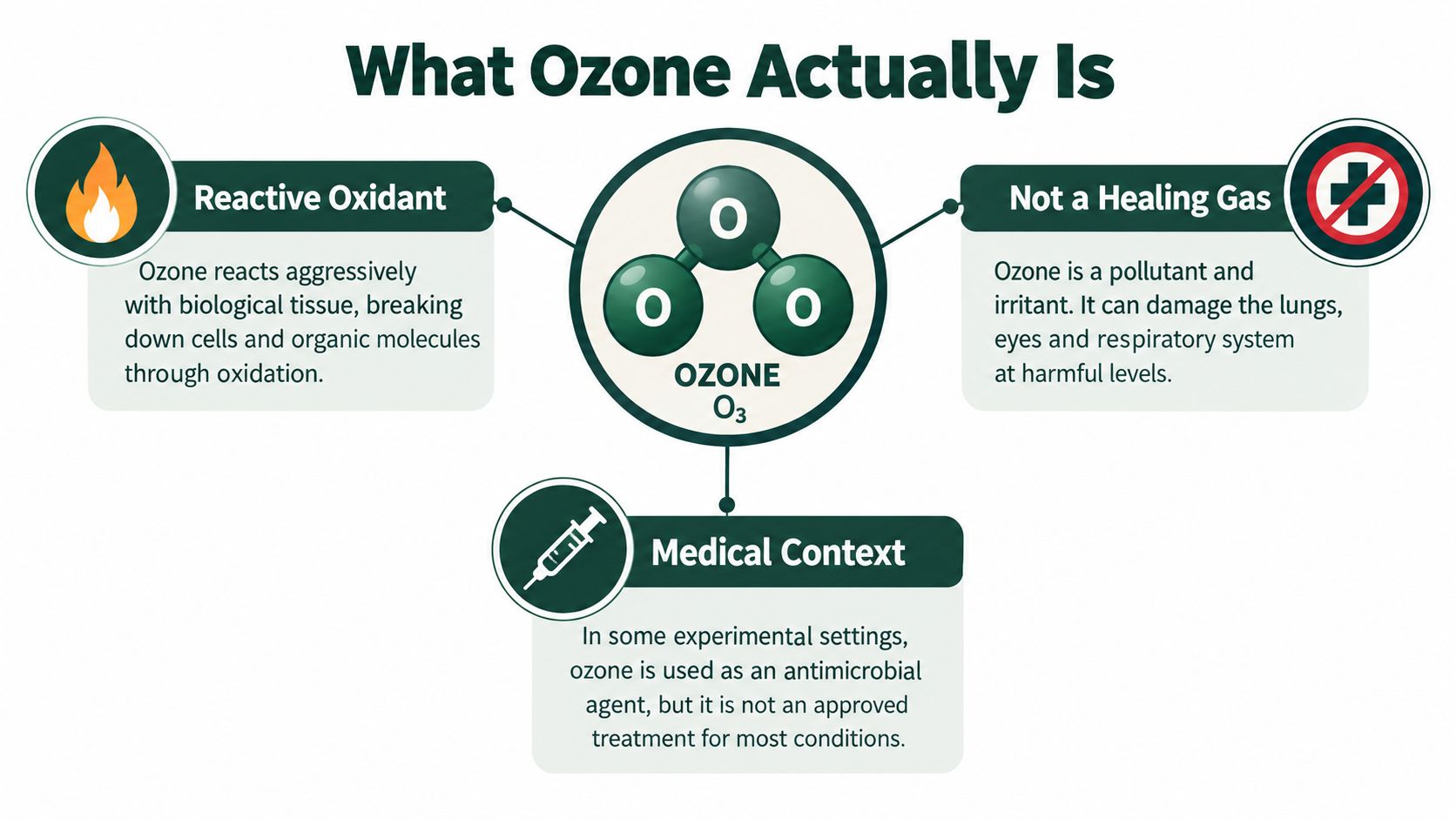
Reactivity isn't the same as healing
A controlled flame is a useful analogy. Knowing that someone can control a flame doesn't establish that applying it to a particular material is beneficial. With ozone, controlling exposure likewise doesn't answer whether the proposed treatment improves a patient's condition.
The diagram's terminology should therefore be read cautiously. Describing an experimental medical context doesn't establish an approved indication, a reliable benefit, or a safe protocol.
Two separate questions belong in the discussion:
- Biological effects: What does the proposed exposure do to the tissue involved?
- Clinical value: Does evidence show that those effects produce a meaningful benefit for this condition?
A proposed mechanism can help researchers formulate a hypothesis. It can't replace clinical evidence or justify claims about immune support, recovery, or overall vitality.
Why concentration needs context
A concentration written on a consent form isn't enough by itself. Ask how that concentration relates to the delivery method, the quantity administered, and the procedure studied. Also ask how the clinic confirms what its equipment delivers.
Terms such as “medical-grade” shouldn't end the conversation. Patients still need an explanation of equipment suitability, gas containment, and procedure-specific evidence. A professional label doesn't neutralize the hazards of a reactive gas.
What the Evidence Shows About Side Effects and Adverse Events
Published safety findings require careful reading because investigators haven't used a uniform approach to identifying harm. Some studies report adverse events explicitly; others provide little detail about monitoring. These aren't equivalent forms of reassurance.
A systematic review of 18 dermatological trials found adverse effects reported in 4 studies, approximately 22.2%. Three reported mild effects, while one reported severe complications; these findings and the comparison below are documented in the review of ozone therapy in dermatological conditions.
Adverse Event Reporting Across Two Ozone Therapy Reviews
The following table summarizes study-level reporting from that review's discussion. Percentages describe studies, not the probability that an individual patient will experience a complication.
| Review Scope | Studies Reviewed | No Adverse Events | Mild Events | Moderate to Serious Events |
|---|---|---|---|---|
| Dermatological clinical trials | 18 | Absence of reporting shouldn't be treated as confirmed absence of harm | 3 studies | 1 study reported severe complications |
| Separate broader review summarized in the same publication | 27 | 77.8% reported none | 14.8% | 3.7% moderate; 3.7% serious |
In the severe-effects study described in the cited dermatology review, 5 patients, 8.2% of the treated group, developed symptoms including osteomyelitis, fever, wound infection, and pulmonary congestion. The same review also describes skin peeling in 1.6%, numbness in 7.5%, and fatigue in 5.0% after subcutaneous injections. These are findings from particular treatment settings, not universal ozone complication rates.
What those findings can't establish
The reviewed studies differed in concentration, route, patient population, and adverse-event definitions. Follow-up was generally short, so the review didn't establish long-term safety. A statement that participants tolerated a specific protocol must stay attached to that protocol.
Evidence check: “No adverse events reported” and “adverse events actively sought and not found” are different claims.
Ask whether researchers recorded symptoms systematically, how long participants were followed, and whether patients resembled you. Those details matter more than a reassuring percentage presented without context.
For broader reading about another integrative treatment category, insights from Longevity Clinics offer a separate peptide-therapy resource. It shouldn't be used as evidence for ozone safety; each intervention needs its own assessment.
A Route-by-Route Look at Risk
Route determines which hazards deserve attention. Clinical reviews describe inhalation-related respiratory injury and rare serious events associated with systemic procedures, including thrombosis, hemolysis, and gas embolism. They also emphasize inadequate systematic monitoring and missing long-term data, as discussed in this review of ozone therapy safety and regulatory concerns.
Direct inhalation should be avoided. For other routes, the available evidence doesn't support a precise, universal ranking from safe to unsafe.
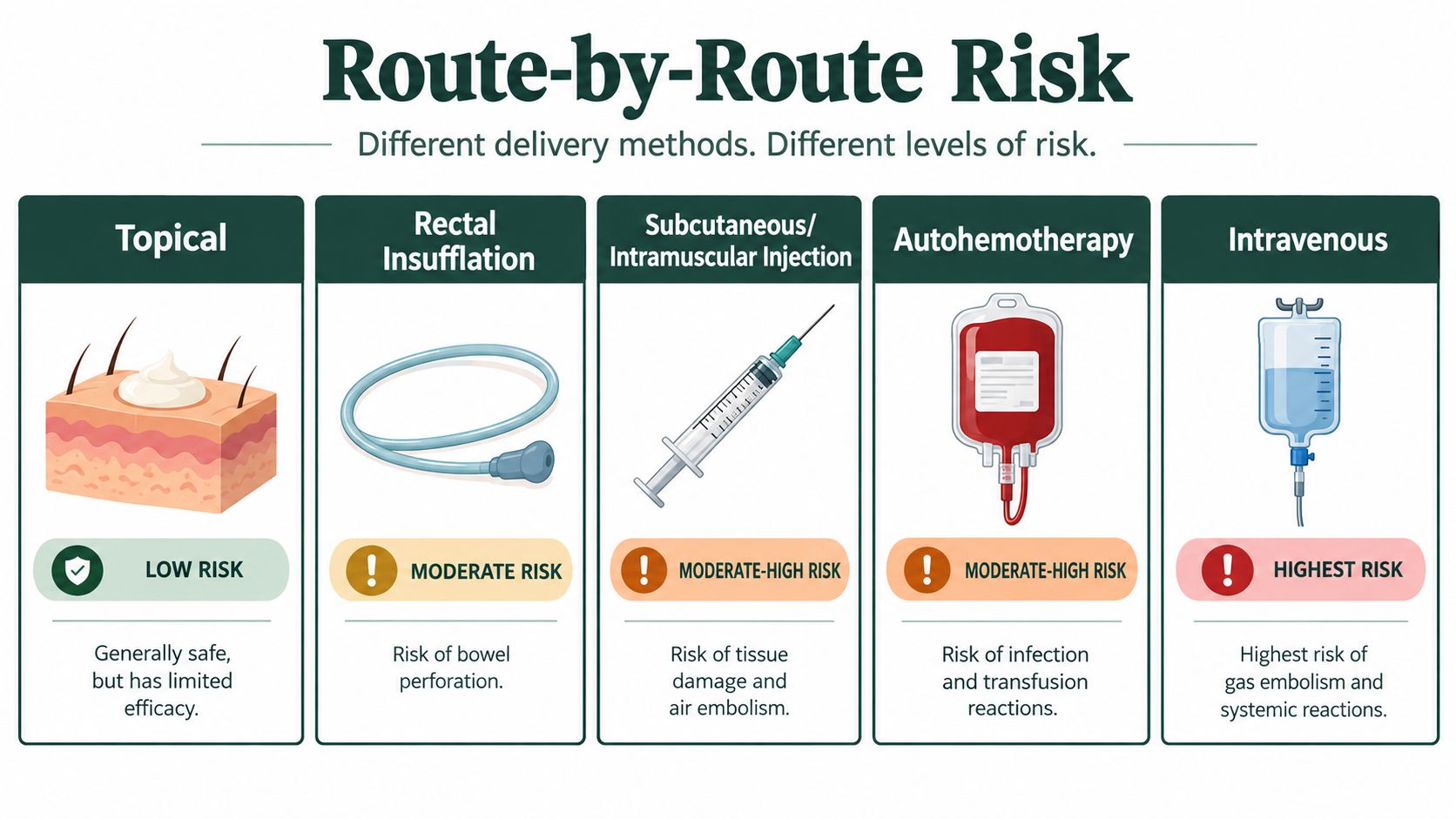
The graphic is a discussion aid, not a validated risk scale. Its categorical labels and individual complication claims shouldn't be interpreted as established frequencies or as proof that topical treatment is low risk.
Compare the procedure, not just its name
| Delivery Route | What Needs Clarification | Main Consultation Question |
|---|---|---|
| Topical or localized application | Exposed tissue, formulation, containment, and evidence for the intended condition | How will unintended exposure be prevented? |
| Rectal insufflation | Delivery equipment, concentration, quantity, and patient eligibility | What evidence supports this exact protocol? |
| Subcutaneous or intramuscular injection | Injection site, technique, and monitoring for local reactions | How are complications recognized and evaluated? |
| Autohemotherapy | Blood withdrawal, external processing, reinfusion, and safeguards | How is gas kept from entering the circulation? |
| Intravenous approaches | Whether the term means treated-blood reinfusion or direct gas injection | Does free gas ever enter a blood vessel? |
Topical studies provide some evidence relevant to selected dermatological applications, but their findings don't establish tolerability for every skin condition or localized technique. Rectal insufflation likewise shouldn't borrow reassurance from research on another route.
For injections, ask about both the target tissue and the possibility of unintended vascular exposure. A local procedure isn't automatically harmless because it avoids inhalation.
The distinction that must be explicit
Autohemotherapy and direct intravenous gas injection aren't the same procedure. Autohemotherapy involves processing withdrawn blood before reinfusion. Direct gas entry into vessels presents an embolic hazard that can obstruct circulation and cause catastrophic injury.
The federal warning also reinforces that respiratory exposure can cause injury that isn't immediately apparent, as described in the published federal ozone safety provision.
When reviewing available ozone therapy approaches, ask for the actual procedural steps. Don't consent to an ambiguous “IV ozone” label, and don't treat availability as evidence of safety.
Who Should Avoid Ozone Therapy
Pregnancy is a reason to avoid elective ozone treatment. A literature review identifies pregnancy among contraindications because treatment hasn't been thoroughly tested, as described in this review addressing ozone therapy and contraindications. Specialist assessment is appropriate if an unusual clinical circumstance prompts consideration, but uncertainty must not be presented as reassurance.
Beyond pregnancy, eligibility needs an individualized medical assessment. A generic online contraindication list can't determine whether a specific procedure is appropriate, especially when the proposed routes differ.
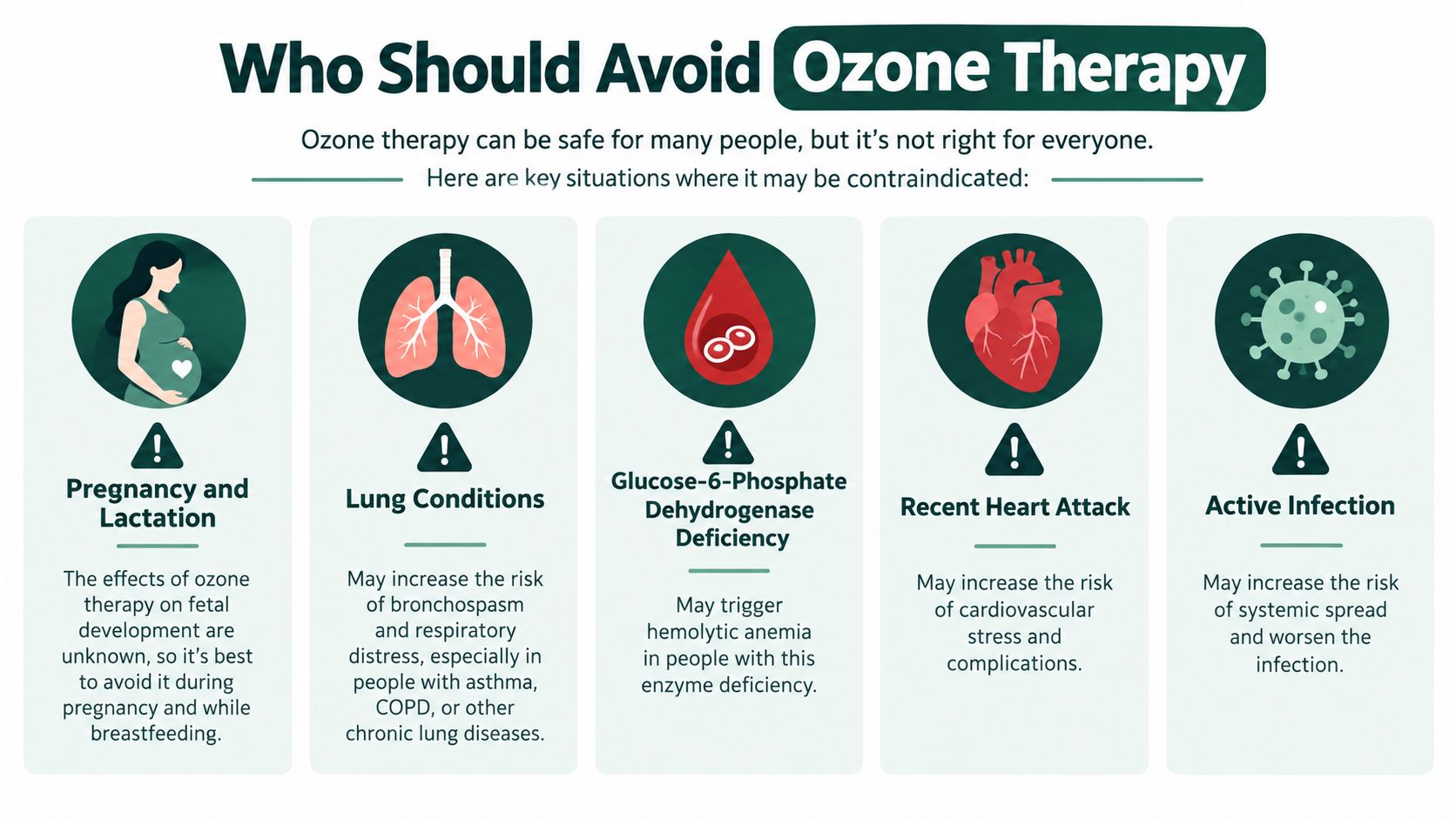
Treat this graphic as a prompt to disclose medical history, not as a complete or validated screening protocol. In particular, lactation shouldn't be assigned the same evidence status as pregnancy, and the image's condition-specific explanations don't establish universal contraindications.
Bring the history that changes the discussion
Tell the evaluating clinician about:
- Respiratory conditions: Include current symptoms and previous lung diagnoses.
- Cardiovascular or clotting history: Disclose heart disease, prior clots, stroke, and current treatment.
- Blood disorders: Mention anemia, bleeding problems, and known glucose-6-phosphate dehydrogenase deficiency.
- Other active conditions: Include thyroid disease, cancer treatment, infection, and recent procedures.
- Medications and supplements: Bring a complete list, including antioxidants and nonprescription products.
These disclosures are questions for clinical review, not a claim that every listed condition has an established ozone-specific risk estimate. The clinician should explain which finding matters to the proposed procedure and why.
Screening must lead to a decision
A completed intake form isn't a safety assessment unless someone qualified reviews it and acts on the findings. Ask whether treatment should be postponed, whether further evaluation is needed, and whether another approach makes more sense.
Don't stop prescribed medication or supplements to qualify for treatment without medical advice. If a clinic recommends changes, request the rationale and coordination with your prescribing clinician. A willingness to decline treatment is a meaningful part of responsible screening.
What Safe Clinical Administration Actually Looks Like
A clinical setting should make safeguards observable. Clean surroundings and a professional title aren't enough; patients need answers about equipment, exposure control, sterile handling, and emergency response.
The phrase “safe administration” describes risk reduction, not a guarantee. Engineering controls address preventable exposure, while medical evaluation addresses whether the procedure should be offered at all.

A pre-treatment checklist you can use
Bring these questions to the appointment:
- Written procedure: What route is planned, and what are its steps?
- Dose verification: How are generator output, concentration, and administered quantity checked and documented?
- Gas containment: Are generation and delivery systems sealed? How are leaks checked?
- Environmental controls: How does the clinic use scavenging or ventilation to prevent ambient accumulation?
- Equipment compatibility: Are the components suitable for the oxygen-and-ozone system being used?
- Sterile handling: Which components are single-use, and how are invasive connections protected?
- Staff qualifications: Who has procedure-specific training, and who holds responsibility for medical decisions?
- Emergency readiness: What happens after respiratory symptoms, a suspected embolic event, or another serious reaction?
A useful answer names a process. “We're very careful” doesn't explain calibration, leak testing, or emergency transfer arrangements.
Monitoring continues after the procedure
Ask what symptoms will trigger stopping treatment, how you'll be observed, and whom to contact afterward. Request written instructions rather than relying on a verbal assurance that discomfort is expected.
New or worsening symptoms deserve assessment. They shouldn't automatically be labeled detoxification or proof that treatment is working.
The treatment location deserves scrutiny too. A resource describing IV therapy at home in Dubai illustrates a different service setting, not evidence that ozone belongs in home care. Location-specific emergency capability and gas handling still require separate evaluation.
Similarly, conventional IV infusion therapy shouldn't be confused with ozone procedures. Familiarity with an IV line doesn't establish the safety of everything delivered through it.
If a clinic can't provide clear answers, postpone the procedure. You shouldn't have to accept an incomplete explanation because treatment has already been scheduled.
Pregnancy, Postpartum, and Specialized Populations
Consider a hypothetical postpartum patient seeking help with fatigue and musculoskeletal discomfort. She's breastfeeding, taking prescribed medication, and has been offered ozone as an adjunct. The first clinical decision shouldn't be which ozone route to choose; it should be how to evaluate her symptoms and identify appropriate care.
Pregnancy, postpartum recovery, and breastfeeding aren't interchangeable categories. The pregnancy concern described earlier is explicit; postpartum and lactation decisions involve additional unanswered questions. The absence of a precise risk estimate doesn't establish safety for either mother or infant.
Separate elective treatment from accidental exposure
For elective treatment during pregnancy, the prudent recommendation is to defer rather than assume a controlled procedure has been proven safe. A specialist should evaluate any exceptional circumstance in the context of established alternatives.
Accidental inhalation requires a different response. Move away from the exposure into fresh air without re-entering an unsafe area, and seek medical advice about the exposure. Because respiratory effects can be delayed, feeling well immediately afterward shouldn't be the only basis for deciding whether evaluation is needed.
- Seek emergency care: Severe breathing difficulty, chest pain, sudden weakness, or speech changes warrant urgent assessment.
- Report the procedure: Tell the treating team whether exposure was inhaled, injected, or involved blood processing.
- Preserve useful details: Bring available information about the product, procedure, timing, and clinic.
Breastfeeding needs its own conversation
Don't rely on an unsupported claim that ozone is harmless during lactation, and don't assume there's a validated waiting period after treatment. Discuss the planned procedure with a clinician familiar with maternal care and lactation before making a decision.
For Denver–Aurora mothers, a useful integrative visit can focus on symptom evaluation, movement-related pain, sleep, nutrition, and coordination with existing care. That approach doesn't require making an elective ozone procedure the starting point.
Weighing Potential Benefits Against Real Risks
The most useful risk-benefit discussion starts with a defined treatment goal. Relief of a specific symptom, improved function, and support for general wellness are different aims. A provider should explain which outcome is expected and what evidence supports that expectation.
The safety reviews discussed earlier support a limited conclusion: some selected applications may be tolerated under controlled conditions, but broad safety hasn't been established. They don't justify promises that ozone will reliably improve energy, strengthen immunity, or replace established treatment.
Decide what would make treatment worthwhile
Before proceeding, agree on how the clinician will evaluate benefit and when treatment will stop. A plan without reassessment can continue even when the patient isn't improving.
Use this short decision checklist:
- Indication: What exactly are we treating?
- Evidence: Does the research match this route and condition?
- Alternatives: What established options should I consider first?
- Safeguards: What preventable risks does this clinic actively address?
- Exit plan: What findings would lead us to stop or change course?
A broader functional medicine evaluation is one option for discussing symptoms, lifestyle contributors, and coordinated care before selecting an adjunct. The evaluation should guide the intervention, not serve merely as a gateway to it.
Declining ozone is a reasonable outcome of an informed consultation. So is postponing it while a medical problem is clarified. Integrative care is most useful when clinicians combine individualized attention with a candid account of evidence, uncertainty, and alternatives.
Restore Osteopathic Medicine offers physician-led osteopathic and integrative care in Aurora, including personalized evaluation and adjunctive ozone services. Visit Restore Osteopathic Medicine to request a consultation, review your medical history and treatment goals, and discuss whether ozone should be considered, deferred, or avoided in your care plan.