
The most striking answer to how long does perimenopause and menopause last is that frequent hot flashes and night sweats can have a median total duration of 7.4 years, including time before and after the final menstrual period, according to a longitudinal analysis of vasomotor symptoms. That's a symptom timeline, not the length of menopause itself: menopause is a confirmed milestone, while the transition and its symptoms can each follow a different course.
Table of Contents
- Perimenopause and Menopause Timeline by Stage
- How Long Hot Flashes and Other Symptoms Last
- What Makes the Transition Longer or Shorter
- Telling Perimenopause From Other Changes
- Managing Symptoms Across the Transition
- Plan Your Timeline With a Clinician
Perimenopause and Menopause Timeline by Stage
| Stage | How it is defined | Typical length or timing |
|---|---|---|
| Early perimenopause | Persistent difference of at least 7 days between consecutive cycle lengths | Can begin 6 to 8 years before the final period |
| Late perimenopause | 60 or more days without a menstrual period | Roughly 1 to 3 years before the final period |
| Full transition | From first persistent cycle changes to the final period | Median about 4 years; commonly cited range 2 to 8 years |
| Menopause | 12 consecutive months without a period, with no other cause | A single point, confirmed afterward; final period median age 51 to 52 |
| Postmenopause | Every year after menopause is confirmed | Symptoms may continue for years after the final period |
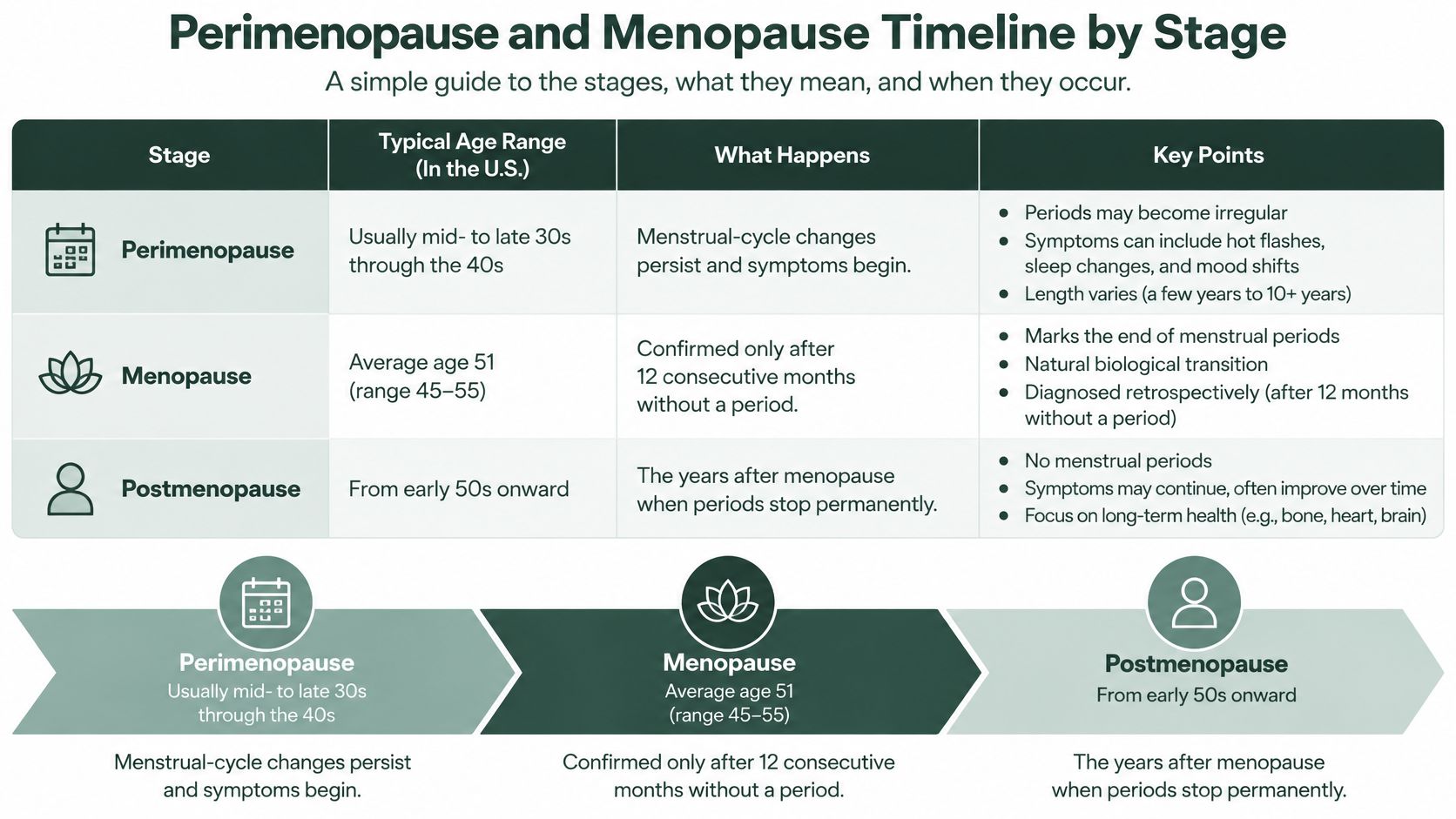
Menopause works like a mile marker on a long road: one point you can name only after you have passed it. The years of perimenopause are the stretch leading up to that marker, and each symptom can keep its own schedule on either side. A clinical review of perimenopause stages reports that early cycle changes can begin 6 to 8 years before the final period, that the full transition has a median of about 4 years (commonly cited range 2 to 8 years, with a plausible span of 8 to 10 years for some women), and that the final period has a median age of 51 to 52, with natural menopause most often between 45 and 55. Those figures describe the middle of a wide road. Individual timing can sit well to either side and still be ordinary.
Early perimenopause is a pattern of cycle-length change that keeps showing up. Consecutive cycles differ by at least 7 days, again and again, as ovarian follicles decline and ovulation plus hormone levels grow less predictable. Cycle length and bleeding shift with that unpredictability. When the amount of flow is hard to interpret, this explanation of hormonal causes of changing menstrual flow spells out the hormone side of those shifts.
Late perimenopause uses a different marker: a stretch of 60 days or more without a period, often in the closing part of the transition. The same review uses these cycle markers to separate early from late. The markers locate someone on the road. The exact date of the last period stays open until it has already passed.
The milestone and what follows
Twelve consecutive months without a period, and no other cause for the missing periods, confirms menopause. Confirmation is always retrospective. The final period commonly falls in the early 50s, inside a broader window that runs through the mid-40s and mid-50s. That is a population pattern, so a confirmation age earlier or later can still sit inside the normal range.
Postmenopause is every year after that confirmation. Periods have stopped for good, while symptoms can continue for years on a separate clock. Some women notice cycle changes for only a few months. Others remain in transition well past the median, sometimes out toward the longer span described above. Use the table to plan around typical timing. It shows the ranges you can expect, and your own date stays personal.
How Long Hot Flashes and Other Symptoms Last
Hot flashes and night sweats have the clearest long-term duration estimates among menopause symptoms. A longitudinal analysis of vasomotor symptoms reported a median total duration of 7.4 years; among women whose final period could be observed, symptoms continued for a median of 4.5 additional years afterward, and when frequent symptoms began before menopause or in early perimenopause, the median total duration exceeded 11.8 years, with symptoms persisting a median of 9.4 years after menopause.
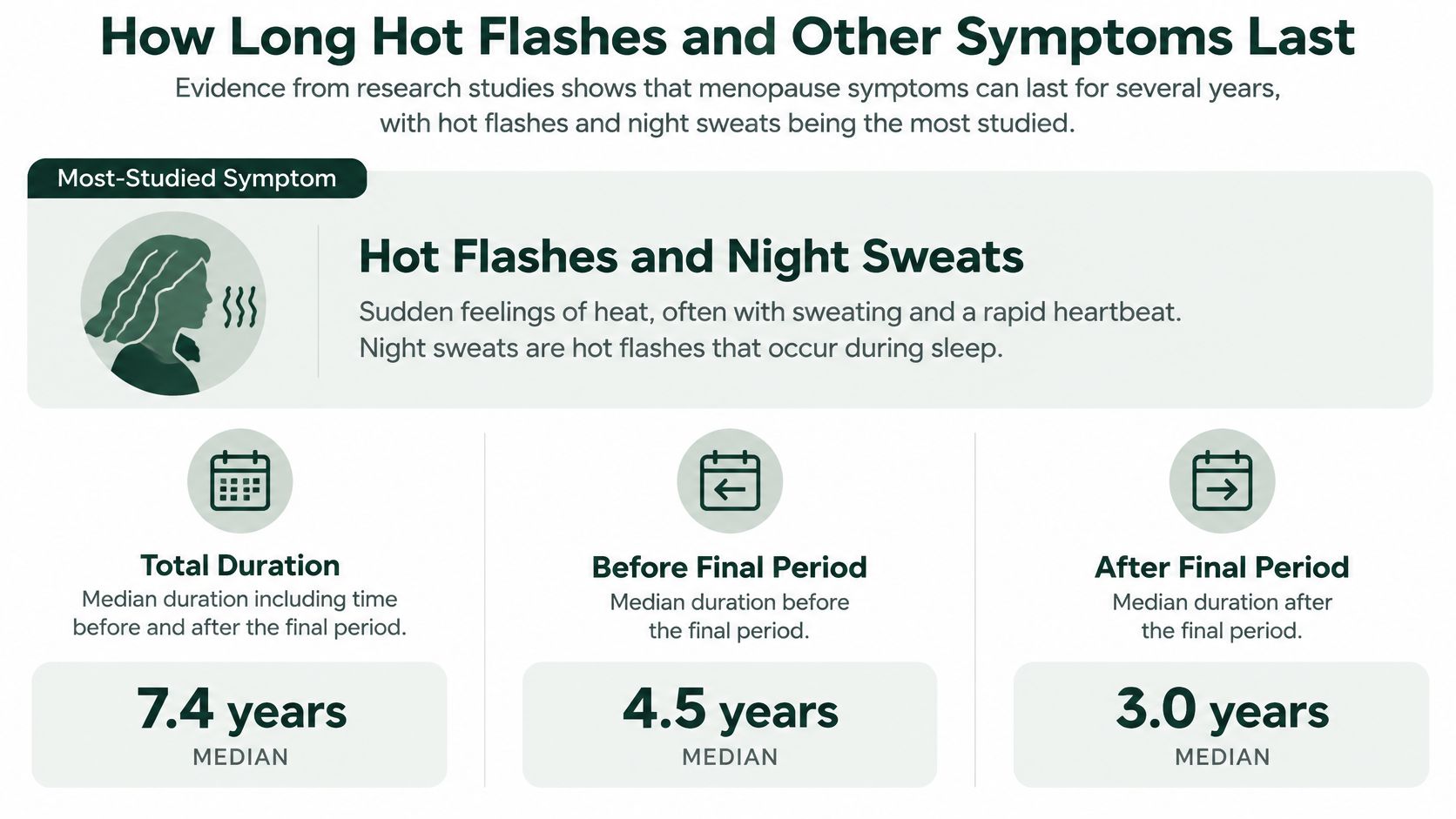
Older estimates suggested hot flashes faded quickly, which fits shorter observed courses more than the longer follow-up in that analysis. Later guidance describes a wider spread: some symptoms settle within a few years, while others continue well beyond a decade. Those figures describe lived symptoms; menopause remains the single confirmed point reached after a full year without a period.
| Symptom | Typical duration or course | What changes it |
|---|---|---|
| Hot flashes and night sweats | Commonly years across the transition; longest courses begin early | Earlier or more frequent onset lengthens both total time and time after the final period |
| Sleep disruption | Often tracks night sweats; no single published median | Usually eases when night sweats are treated |
| Mood and anxiety changes | Fluctuate through the transition; no single end year | Persistent low mood needs its own assessment |
| Vaginal dryness and urinary symptoms | Often continue and may worsen after menopause | They can persist after periods have ended |
| Joint and muscle pain | Can start in the transition; study length isn't fixed | Address separately when mobility is limited |
Symptoms follow separate clocks. Sleep may become difficult when night sweats wake you, while mood and anxiety changes can rise and fall with stress, cycle shifts, and broken sleep. Vaginal dryness and urinary symptoms may continue or worsen after periods stop, and joint or muscle aches can appear during the transition. For these concerns, there is no reliable end year to use as a personal forecast.
Symptoms can also change order: night sweats may ease while sleep, mood, joint discomfort, or vaginal symptoms remain. Track each concern separately rather than waiting for every symptom to disappear at once.
What Makes the Transition Longer or Shorter
Menopause is one confirmed point on the calendar, yet the distance to that point varies widely from woman to woman. In the Study of Women's Health Across the Nation, a long-term research project that followed women through midlife, participants whose transition symptoms began earlier had a median transition of about 8.6 years, compared with about 4.3 years among women whose symptoms began later. Starting earlier stretches the calendar, and a single average cannot describe both experiences.
The same study reported different median durations of vasomotor symptoms, meaning hot flashes and night sweats, across ethnic groups:
| Group | Median duration of vasomotor symptoms |
|---|---|
| Black women | 10.1 years |
| Hispanic women | 8.9 years |
| Non-Hispanic White women | 6.5 years |
| Chinese women | 5.4 years |
| Japanese women | 4.8 years |
A median is the middle of a large group, so roughly half of the women in each group ran longer and half ran shorter. Your own timeline sits somewhere inside a wide band, and these figures describe populations rather than predict a personal course.
Factors that shape an individual timeline
Timing works like a dimmer switch: several inputs push the transition earlier or later and change how symptoms unfold along the way. Genetics, overall health, smoking, and treatment history all play a role. Medical or surgical treatment that affects ovarian function can switch symptoms on abruptly, rather than letting them build gradually alongside changing cycles. Ethnic background may influence which symptoms appear, how severe they feel, and how long they last.
General health belongs in the same conversation as the calendar. Weight management support is one topic to raise with a clinician when you review overall health alongside menopause symptoms.
A short course and a long course can both fall within the normal range. The more useful signals are how symptoms affect your daily life and whether any bleeding pattern is unusual for you. Plan around a range rather than a single number of years.

Telling Perimenopause From Other Changes
Perimenopause rarely announces itself cleanly. Cycles shorten, lengthen, or skip, and symptoms such as hot flashes or poor sleep can appear while periods still arrive. Menopause is a single point you can only confirm in hindsight, once the 12-month milestone has passed and no alternative cause explains the gap.
That gap between living through symptoms and naming a stage is where confusion starts. Symptoms often continue after menopause is confirmed, and bleeding patterns alone cannot tell you the exact date of the final period.
Blood tests add less certainty than many expect. The National Institutes of Health explains that a single estradiol or FSH reading is usually less useful for routine diagnosis because ovarian activity fluctuates, so one result may not reflect the broader pattern (NIH guidance on telling perimenopause from other changes). Hormone levels during perimenopause behave like a flickering signal rather than a steady dial: a test taken on a calm day can look normal even when symptoms say otherwise.
A clinician reads the whole pattern, meaning cycle history, symptoms, and age together, rather than any single marker.
Managing Symptoms Across the Transition
You can often seek relief even though you can't set or shorten the biological timeline. The best approach depends on which symptoms are affecting you, your health history, and whether a treatment is suitable for you. Discuss prescription and hormone-based options with a clinician before starting them.
| Symptom | Options to discuss | Notes |
|---|---|---|
| Hot flashes and night sweats | Menopausal hormone therapy, non-hormonal prescription options, cognitive behavioural therapy, a cool bedroom, and layered bedding | A clinician weighs age, health, and history before any choice |
| Sleep disruption | Cognitive behavioural therapy for insomnia, a consistent sleep schedule, and a cool bedroom | Treat night sweats first so sleep advice isn't the only step |
| Mood and anxiety | Regular exercise, cognitive behavioural therapy, and depression screening | Persistent low mood needs assessment |
| Vaginal dryness | Non-hormonal moisturisers and lubricants, and low-dose vaginal estrogen | A clinician should guide the choice |
| Joint and muscle pain | Strength training, physiotherapy, and osteopathic manipulative care | Consider when mobility is limited |
For sleep problems, it helps to consider whether night sweats are waking you and what else is interfering with rest. This practical overview of why sleep changes during menopause offers context for discussing sleep support, but persistent sleep loss still deserves individual attention.
Match the option to the symptom
For vaginal dryness, non-hormonal moisturisers are used regularly, while lubricants can help with sexual activity. A clinician can help decide whether low-dose vaginal estrogen is appropriate. For joint or muscle pain that limits movement, strength training, physiotherapy, or osteopathic manipulative care may be considered as part of an individualized plan.
The right choice depends on more than the symptom name. Age, health history, personal preferences, and the pattern of symptoms all matter. If you're exploring hormone-related care, bio-identical hormone optimization is one option to discuss with a qualified clinician, including its suitability and potential risks. Bring a symptom diary to the appointment so treatment can be matched to what's happening rather than to an assumed timeline.
Plan Your Timeline With a Clinician
A useful appointment ends with three decisions: what to treat first, when to check progress, and what should bring you back sooner.
The first is a relief goal. Pick the symptom that costs you the most, whether that is broken sleep, frequent hot flashes, low mood, or pain that limits movement. One clear target makes it easier to judge whether a treatment is working.
The second is a review date. Perimenopause is a moving target, and a plan that fits early in the transition can stop fitting as cycles space out or stop altogether. A set date means the plan gets revisited even when symptoms feel manageable.
The third is escalation criteria. Agree in advance on which changes mean booking an earlier visit: a symptom that suddenly worsens, a new symptom outside the pattern you recorded, or side effects from a treatment you have started.
These concerns rarely sit in separate boxes, and integrative primary care for whole-body health is one setting where sleep, hormones, metabolic health, and musculoskeletal symptoms can be weighed in a single plan.
At Restore Osteopathic Medicine, our physician-led, integrative care includes individualized evaluation for menopause symptoms and osteopathic support for mobility concerns. If you'd like to discuss your symptom timeline and care options, contact Restore Osteopathic Medicine to plan a visit.