
“Eat less and move more” leaves out the hardest part of weight management: finding an approach you can keep using when life changes. It doesn't explain what to do when weight returns, sleep falls apart after childbirth, or pain makes exercise difficult.
A useful plan starts with a different question: What would help you stay healthier and function better over time? Weight loss may be part of the answer, but maintenance, recovery, and medical support deserve attention from the beginning.
Table of Contents
- What Weight Management Actually Means
- Reading Your Weight Category on the BMI Scale
- How the Pieces Work Together Over Time
- Medical and Behavioral Options Compared
- Adapting Weight Management for Mothers and Midlife Women
- Set Your First Measurable Goal This Week
What Weight Management Actually Means
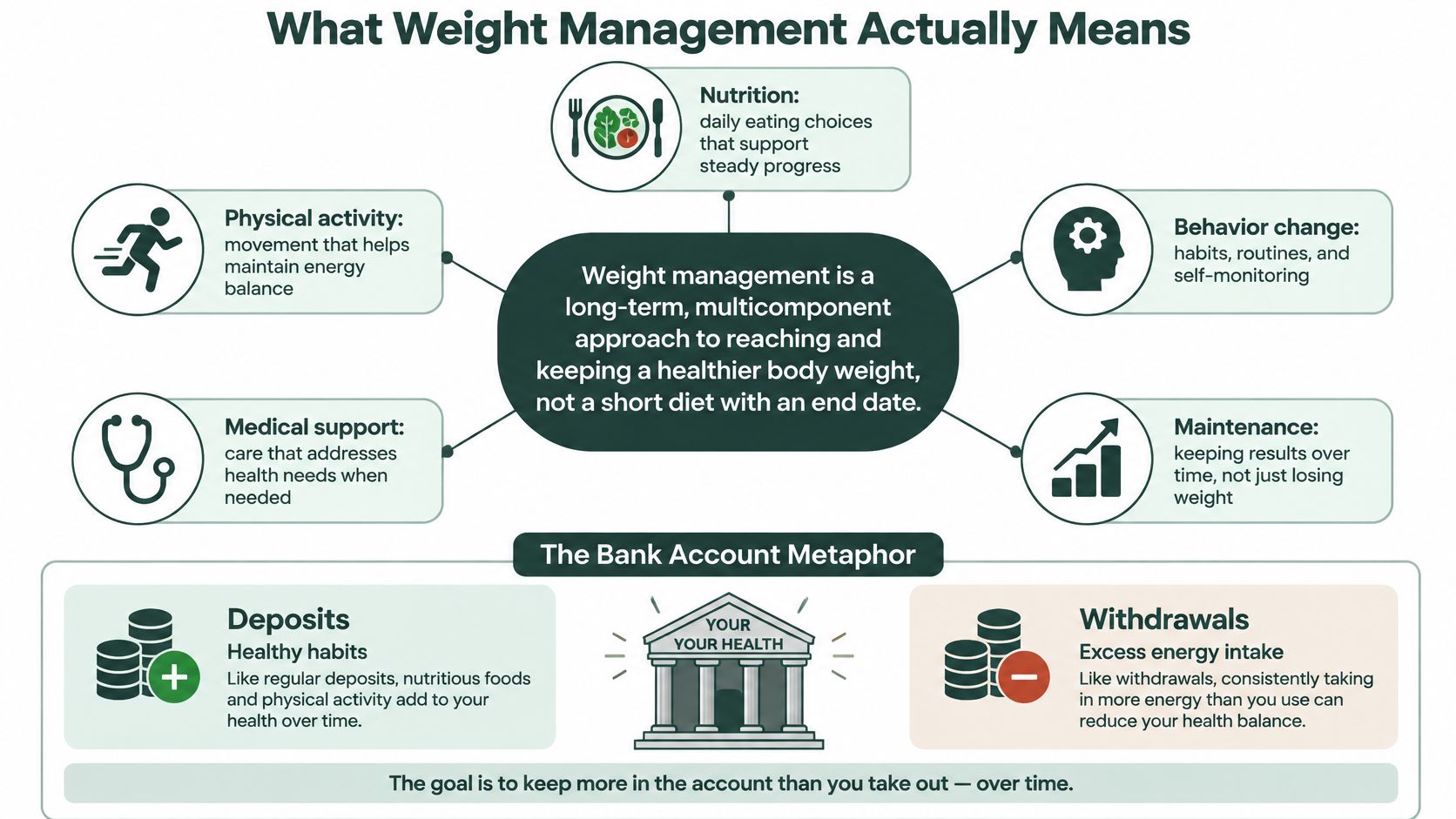
Weight management is a long-term, multicomponent approach to reaching and keeping a healthier body weight, not a short diet with an end date. It brings together nutrition, physical activity, behavioral habits, sleep, and clinical support when appropriate.
Say you start preparing lunch instead of skipping it and arriving home intensely hungry. You also find a comfortable walking route, protect your bedtime, and discuss a weight-affecting medication with your clinician. Those changes belong to the same plan, even though only some involve food.
The bank-account analogy and its limits
Think of energy balance as a bank account. Food and drinks supply energy, while metabolism and movement use it. Sustained intake below expenditure produces weight loss; matching intake to expenditure supports maintenance.
The analogy explains the arithmetic, not the entire person. Hunger, illness, medications, sleep disruption, and physical limitations influence what you can comfortably sustain. A body isn't a spreadsheet with perfectly predictable transactions.
Weight management is ongoing care, not a finish line you cross before returning to your previous routine.
The scale of the need is substantial: more than 1 billion people worldwide were living with obesity in 2022, according to a Lancet study reported by the World Health Organization. That makes this a public-health issue, not a matter of individual appearance.
Start with what already works
Dieting often centers on reaching a number and stopping. Weight management asks whether your approach supports metabolic health, mobility, cardiovascular health, and quality of life over the years.
Practical food choices still matter. If snacks are a recurring challenge, Gym Snack weight-management snack advice can help you think through alternatives without treating every snack as a mistake.
Make a brief inventory:
- Nutrition: Which meals or shopping habits already help?
- Activity: What movement feels accessible and enjoyable?
- Behavior: Which routines make healthy choices easier?
- Sleep: What helps you protect rest?
- Clinical support: What care or follow-up is already available?
Write down existing strengths before adding demands. An empty category identifies somewhere to seek support, not a personal shortcoming.
Reading Your Weight Category on the BMI Scale
BMI categories and typical next steps
| BMI screening range | Category | Common next step |
|---|---|---|
| Below the overweight threshold | Needs interpretation within the full weight-category framework | Assess nutritional health and weight history |
| At or above the overweight threshold, below the obesity threshold | Overweight | Discuss whether weight reduction would improve health |
| Within the obesity range | Obesity, including class 1 | Consider a structured program and discuss medical options |
| Within a higher obesity class | Obesity, class 2 | Arrange clinical evaluation for treatment needs |
| Within the highest obesity class | Obesity, class 3 | Seek specialist assessment; surgery may be considered |
BMI sorts weight relative to height into a screening category. The Pan American Health Organization identifies adult BMI of 25 or higher as overweight and 30 or higher as obesity; those broad thresholds don't, by themselves, determine which treatment someone needs.
The calculation uses weight in kilograms divided by height in metres squared. A clinician or calculator can do the arithmetic, but interpreting the result requires more than entering height and weight.
What BMI cannot tell you
BMI doesn't separate muscle from fat. Someone with substantial muscle may have a higher BMI without the same body composition as another person in that category. Check next: strength, weight history, and body composition when clinically useful.
BMI also doesn't show where fat is carried. Waist circumference can provide a companion measurement, particularly when abdominal weight gain accompanies changes in blood pressure or glucose. Check next: a consistent waist measurement and relevant metabolic markers.
Use the category as a starting marker, not a verdict about your health or character.
Risk can also differ across populations, including some Asian populations, so a clinician may interpret BMI using a population-appropriate framework. Check next: whether your personal and family history changes the assessment.
A category should open a conversation, not automatically trigger a prescription. Recent weight change, eating difficulties, pregnancy, medications, and physical function all matter. If weighing yourself encourages compulsive restriction or distress, tell your clinician so monitoring can be adapted.
How the Pieces Work Together Over Time
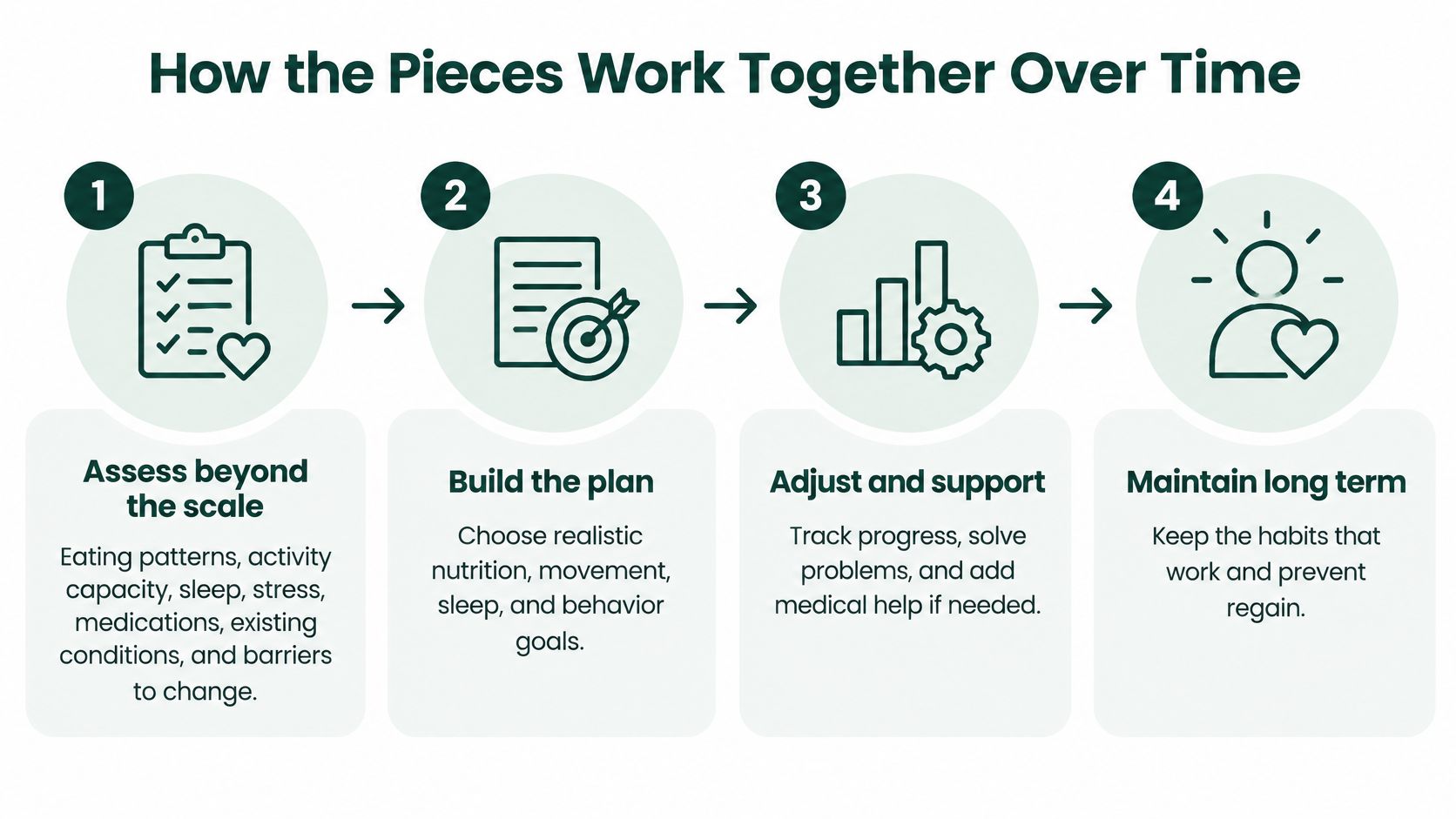
A workable plan connects assessment, treatment, adjustment, and maintenance. These aren't separate projects. Decisions made at the beginning should account for what happens when motivation drops, schedules change, or treatment becomes difficult to access.
Build the plan around real constraints
Assess beyond the scale. Review eating patterns, activity capacity, sleep, stress, medications, existing conditions, and barriers to follow-through. If back pain prevents walking, prescribing more walking doesn't solve the immediate problem. The assessment should identify a tolerable starting activity and whether the pain needs evaluation.
Start a structured program. The National Institute of Diabetes and Digestive and Kidney Diseases treatment guidance describes effective programs that typically include at least 14 counseling sessions over six months, an individualized eating plan, at least 150 minutes of moderate aerobic activity weekly, daily food and activity tracking, weekly weight monitoring, and professional feedback. These are program features to discuss and adapt, not a demand to perform everything perfectly immediately.
Adjust during active weight loss. Look at both progress and feasibility. If meal preparation repeatedly fails during evening shifts, change the meal arrangement rather than repeatedly setting the same unworkable goal. If fatigue, excessive hunger, or declining strength appears, review the plan instead of automatically restricting food further.
Move deliberately into maintenance. Decide which habits will continue, what follow-up will remain available, and what changes should prompt contact. Include a response to increasing hunger, reduced activity, or an upward weight trend before those problems become overwhelming.
A planning resource such as the Venus Health Co. weight management guide can help organize questions for an appointment. A whole-body primary-care discussion can also connect weight concerns with sleep, pain, medications, and other health priorities.
Why regain deserves a treatment response
Medication withdrawal offers a clear example of why maintenance needs planning. In the subgroup described by the American College of Cardiology's SURMOUNT-4 analysis, participants had lost at least 10% of body weight after 36 weeks of tirzepatide; among those switched to placebo, 82% regained more than one-quarter of their prior weight loss within one year.
That finding concerns a particular treatment and group. It doesn't predict every person's outcome or establish what will happen after every weight-management medicine.
It does challenge the assumption that regain proves someone stopped trying. Biological adaptation and treatment discontinuation can influence outcomes, alongside changes in eating, activity, and circumstances.
Maintenance is an active treatment phase. Regain is a reason to reassess support, not automatically assign blame.
A maintenance review should consider appetite, strength, mobility, sleep, stress, mental health, and eating patterns. Sustainable nutrition and resistance exercise belong alongside follow-up, not in place of it. Any decision to continue, stop, or taper medication needs clinician supervision, including a discussion of what support will replace it if treatment changes.
Medical and Behavioral Options Compared
The right option depends on health conditions, weight category, medication history, preferences, and previous treatment response. A useful comparison asks what each approach requires over time, rather than which promises the largest change.
Weight management options compared
| Approach | Typical fit | What it requires | Main limitation |
|---|---|---|---|
| Lifestyle program | Most adults starting a plan | Individualized nutrition, activity, behavioral support, and follow-up | Difficult to sustain without accessible support |
| Prescription medication | Adults meeting the medicine's prescribing criteria | Clinical assessment, prescribing, and regular monitoring | Side effects, access, and a long-term treatment decision |
| Metabolic surgery | Adults meeting surgical criteria | Specialist evaluation and lifelong follow-up | Procedure risks and ongoing nutritional monitoring |
| Peptide therapy | Selected patients with an appropriate clinical indication | Clear identification of the medicine, appropriate sourcing, and medical oversight | Evidence and regulatory status differ between products |
| Nutraceuticals and supplements | People with an identified nutritional-support need | Review of ingredients, goals, medications, and suitability | Not appropriate for every person or condition |

Match the approach to the problem
Lifestyle programs provide a foundation for learning and practicing repeatable behaviors. They should offer problem-solving support, not just a food list. Pain, financial constraints, caregiving, and limited cooking facilities are practical treatment issues.
Prescription medication may be appropriate when a clinical assessment supports it. It isn't a substitute for nutrition or monitoring, and needing medication doesn't make someone less committed. Ask what benefit would justify continuing and what adverse effects would require a review.
Metabolic surgery requires a specialist conversation about eligibility, expected benefits, risks, and lifelong care. It shouldn't be presented as a shortcut or as something a person must earn by failing repeatedly.
Understand what peptide and supplement labels mean
Peptides are short chains of amino acids. Some peptide-based treatments, including certain GLP-1 receptor agonists, are approved prescription medicines with substantial clinical trial evidence. Other products marketed as peptide therapy don't have comparable evidence, and quality, sourcing, and regulation can differ.
A discussion of weight-loss peptides for women should therefore identify the specific treatment, not treat all peptides as interchangeable. Ask whether the proposed product is approved for the intended use and what is known about longer-term safety.
Nutraceuticals can complement an individualized plan, but they aren't appropriate for every person or every medical condition and can interact with medications. We review suitability rather than assuming that a product is safe because it's sold as natural.
Bring these questions to the decision:
- Fit: Which option matches my health conditions and treatment goals?
- Monitoring: What symptoms, measurements, or laboratory tests need review?
- Stopping: What happens if treatment ends or becomes unaffordable?
- Life stage: Does pregnancy planning or breastfeeding change the choice?
Adapting Weight Management for Mothers and Midlife Women
One calorie plan doesn't fit every life stage. For postpartum mothers and midlife women, restoring function may be a more sensible first target than rapid weight loss.
Weight management priorities by life stage
| Life stage | Main priority | Activity target | Medication caution |
|---|---|---|---|
| Postpartum, after provider clearance | Restore strength, sleep, and metabolic health | Progress toward aerobic and resistance activity using postpartum guidance | Discuss stopping GLP-1 medicines before attempting pregnancy |
| Breastfeeding | Maintain adequate energy and nutrients | Gradual progression guided by recovery and clinical advice | Review every medication choice with a clinician |
| Perimenopause | Preserve muscle and support sleep | Individualized aerobic activity and progressive resistance training | Evaluate symptoms before changing hormones or medicines |
| Menopause | Protect muscle, bone, and mobility | Regular aerobic and resistance activity suited to capacity | Individual medical review remains necessary |
Postpartum recovery and breastfeeding
The postpartum recommendations summarized in this review of weight management across reproductive stages include a 2025 Canadian guideline target of at least 120 minutes of moderate-to-vigorous activity weekly, across four or more days, incorporating aerobic and resistance exercise; the review also advises discontinuing GLP-1 medicines before attempting pregnancy.
That activity target isn't an immediate prescription after delivery. Begin with provider clearance, then progress according to healing, delivery recovery, pelvic-floor symptoms, back pain, and available support. Discuss medication-specific timing before trying to conceive rather than stopping or restarting treatment independently.
Breastfeeding adds another consideration: adequate nourishment. Aggressive food restriction can conflict with recovery needs, and interrupted sleep can make meal planning harder. Keep convenient meals available, seek help with preparation, and have every proposed medication reviewed for breastfeeding suitability.
Perimenopause and menopause
Midlife body-composition changes aren't a useful measure of willpower. Resistance training, adequate protein, sleep support, and individualized evaluation deserve attention alongside weight goals.
A resource on building muscle in perimenopause can help you prepare questions about strength progression. Start with movements you can perform comfortably and increase difficulty gradually rather than chasing exhaustion.
Hormone symptoms and weight concerns may overlap, but that doesn't mean hormone treatment is a universal weight-loss solution. A discussion of bio-identical hormone optimization should distinguish symptom-treatment goals from weight-management goals and address individual risks.
Osteopathic and lifestyle care can support mobility and function when discomfort limits movement. Neither should be presented as a guarantee of weight loss or a replacement for appropriate medical evaluation.
Set Your First Measurable Goal This Week
Start with a measurable goal and a clinician check, not a complete lifestyle overhaul. You don't have to reach an idealized weight before meaningful health benefits become possible.
The National Institute of Diabetes and Digestive and Kidney Diseases recommends an initial goal of losing 5% to 10% of starting weight over approximately six months; for a 200-pound adult, that means 10 to 20 pounds. The calculations below apply that benchmark, not a personalized prescription.
5% and 10% weight-loss goals by starting weight
| Starting weight (lb) | 5% goal (lb) | 10% goal (lb) | Timeframe |
|---|---|---|---|
| 150 | 7.5 | 15 | About 6 months |
| 180 | 9 | 18 | About 6 months |
| 200 | 10 | 20 | About 6 months |
| 250 | 12.5 | 25 | About 6 months |
| 300 | 15 | 30 | About 6 months |
These are pounds to lose, not final body weights. They're a starting point for adults for whom weight reduction is appropriate, not an automatic target during pregnancy, early recovery, or an eating disorder.
Modest weight loss can improve health without a dramatic transformation. The Centers for Disease Control and Prevention notes potential improvements in blood pressure, blood glucose, and cholesterol; people with diabetes may also find glucose easier to manage and sometimes need less medication. Medication adjustments belong with the prescribing clinician.
Turn a target into an action
Record a useful baseline. Note your current weight and, when appropriate, waist measurement. Use the same scale and a consistent measuring method so comparisons are meaningful. If self-monitoring causes distress, ask for an alternative, such as clinician-managed measurements or function-focused tracking.
Choose an appropriate outcome. Discuss whether weight loss, weight stability, recovery, or improved function should come first. If weight reduction is suitable, use the table as a conversation starter rather than choosing the largest target automatically. Add a practical reason for the goal, such as walking comfortably with your child or returning to a favorite activity.
Select a health marker and a repeatable habit. A marker could be blood pressure, sleep quality, waist trend, or physical function. A habit should describe something you can do, such as preparing lunch before work or completing a comfortable strength routine. Choose a review date and assess the pattern rather than treating every daily fluctuation as a result.
Arrange a clinician review when the plan needs medical context. This includes obesity, pregnancy, postpartum recovery, pregnancy planning, perimenopause or menopause concerns, and medications that could interact with a new treatment. Bring your medication and supplement list, relevant symptoms, previous approaches, and the activities you want to regain.
Decide what you'll do when life interrupts
Write a fallback version of your habit. If cooking isn't possible, identify a simple meal you can assemble; if pain prevents your usual activity, ask which alternatives are appropriate. A fallback isn't an excuse, it's a way to avoid turning an interrupted routine into an abandoned plan.
Keep your review practical. Ask whether the action was feasible, whether you felt adequately nourished, and whether strength, energy, or symptoms changed. A plan that looks effective on paper but leaves you exhausted needs adjustment.
At Restore, care starts with listening to what your body is keeping you from doing. The purpose of setting a goal is to help you return to the activities and experiences that matter to you, not just produce a smaller number.
Restore Osteopathic Medicine offers physician-led integrative weight management that considers nutrition, movement, lifestyle, and appropriate medical options. Visit Restore Osteopathic Medicine to schedule a consultation, bring your first goal and medication list, and build a plan around the activities you want to return to.