
The most popular advice for sacroiliac joint pain is to stretch the sore side and strengthen your core. That can help, but it skips the essential question: is the SI joint causing your pain? Buttock or low-back pain can also come from the hip, lumbar spine, nerves, or surrounding muscles, and treating the wrong source can keep you stuck.
A safer approach moves in stages: rule out urgent and competing causes, establish whether an SI-joint problem is plausible, then match treatment to what the evaluation supports. Don't move to injections or surgery just because one spot is tender.
Table of Contents
- Which Stage of SI Joint Care Fits You
- Confirm the SI Joint Before You Treat It
- Run the Four to Six Week Trial and Adjust for Load
- Compare Steroid and PRP When Rehab Stalls
- Use Prognostic Blocks Before Lateral-Branch Ablation
- Book Hands-On Care Before You Consider Fusion
Which Stage of SI Joint Care Fits You
Buttock pain doesn't automatically mean SI-joint pain, and a routine scan rarely proves that the joint is the source. Start by identifying which stage fits your symptoms, then follow the next action rather than repeating stretches or pursuing a procedure without a clear reason.
| Stage | Who it fits | Next action |
|---|---|---|
| Red flags | Fever, unexplained weight loss, cancer history, major trauma, progressive leg weakness, saddle numbness, or bowel and bladder change | Urgent clinician or emergency care, not a home program |
| Provisional SI pain | Buttock or low-back pain with a clear hip and nerve screen and at least three of five provocation tests positive | 4 to 6 weeks of exercise, activity change, a pelvic belt if the joint feels unstable, and manual therapy as an adjunct |
| Still unsure | Pain persists, tests conflict, or the pattern is inflammatory or post-traumatic | Image-guided diagnostic block rather than repeating one maneuver |
| Confirmed and still limiting | Anesthetic block gives at least 75% temporary relief, then pain returns | Discuss steroid, PRP, or lateral-branch options with a clinician |
| Refractory confirmed pain | Structured rehab and appropriate interventional care have failed | Surgical opinion only, not the default next step |
Urgent symptoms skip the home program. New progressive weakness, saddle numbness, or changes in bowel or bladder control need prompt medical assessment.
Choose a row before you choose an exercise
If there are no red flags, a clinician should assess the hip and nerves and test a cluster of SI-joint provocation maneuvers. At least three of five positive tests can support a provisional diagnosis, but tenderness or one positive maneuver isn't enough to justify escalating care. The American Family Physician's staged approach recommends screening for competing causes, using a provocation battery, and confirming persistent or procedure-eligible cases selectively.
For a provisional mechanical problem, start with individualized exercise, adjusted activities, anti-inflammatory medicine only when safe, and a pelvic belt when support seems helpful. Manual therapy may complement the plan, but it shouldn't be the whole plan. If the pattern is atypical, follows trauma, or remains limiting despite a structured trial, ask about further evaluation rather than trying the same maneuver repeatedly.
Patients exploring nonprescription joint products can use a resource on choosing lab-tested CBD for joints to understand what to look for, but a supplement can't confirm an SI-joint diagnosis or replace assessment.
Before starting a home program, name your current row. If you can't identify one confidently, the next step is an evaluation, not a guess.
Confirm the SI Joint Before You Treat It
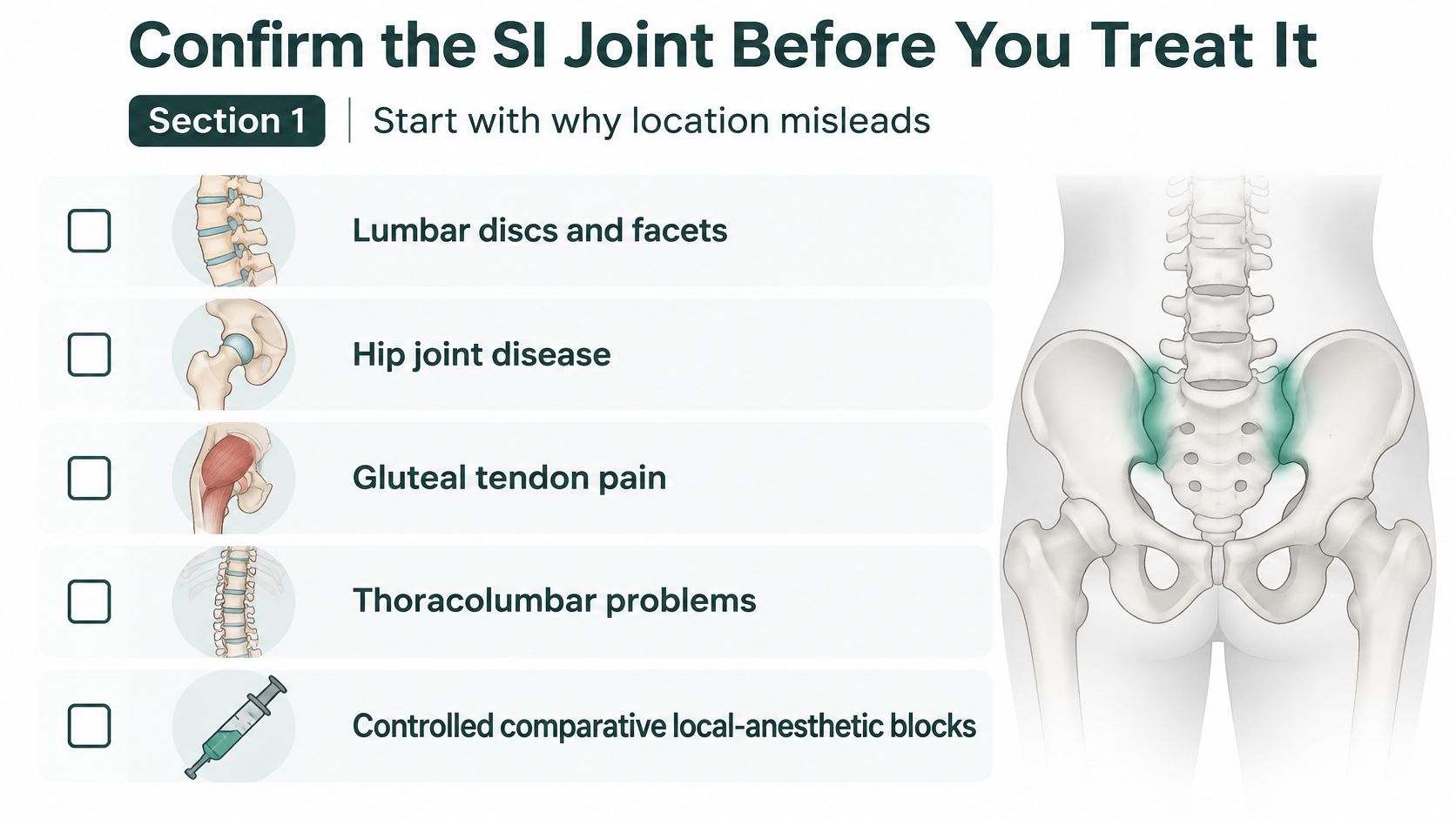
Pain location can mislead. SI-joint symptoms overlap with lumbar discs and facet joints, hip disease, gluteal tendon pain, and problems higher in the thoracolumbar spine. A tender spot below the beltline may be part of the picture, but it doesn't tell you which structure is responsible.
Why one test or injection isn't enough
A systematic review found that controlled comparative local-anesthetic blocks identified the SI joint as the pain source in approximately 10%–27% of people evaluated for chronic low-back pain. Estimates varied with the patient population and diagnostic criteria. The same review reported an approximately 20% false-positive rate for a single, uncontrolled injection, so one injection alone shouldn't settle the diagnosis. The systematic review of SI-joint diagnosis rated the evidence for physical provocation tests as limited and the evidence for controlled diagnostic blocks as moderate.
For a block to support the diagnosis, the anesthetic should substantially reduce the familiar pain temporarily while you repeat activities that usually hurt. One clinical threshold is at least 75% pain reduction. That's a short-term diagnostic response, not proof that an injection will provide lasting relief.
Even a well-performed block has limits. An injection inside the joint may not identify pain arising from posterior ligaments or the sacral lateral branches, and diagnostic blocks can be falsely positive or negative. If lumbar-disc symptoms are a concern, a clinician may also assess the spine; this overview of a bulging disc describes one common competing source of low-back symptoms.
Take extra care with overlapping conditions
A 2025 review of 43 randomized trials found that 32 studies (74.4%) did not screen the thoracolumbar spine before diagnosing SI-joint pain, while only two (4.7%) used a reasonable screening process. The review in the NCBI Bookshelf also notes that examination-test clusters have reasonable sensitivity but lower specificity, so negative findings can be more informative than positive ones.
Pregnancy and postpartum changes can increase mechanical strain around the pelvis, but they don't rule out other causes. If the pain is unusually severe, inflammatory, or accompanied by systemic symptoms, a clinician may need to investigate further; when acute inflammatory sacroiliitis is suspected, clinical examination and MRI are useful diagnostic tools.
Use a simple self-check: one tender spot isn't a diagnosis. A clear hip and nerve screen, consistent findings across an examination, and a reasonable response to conservative care make it more appropriate to proceed with the home program.
Run the Four to Six Week Trial and Adjust for Load
A useful rehab trial changes the forces that provoke pain, then builds tolerance gradually. It isn't a contest to stretch farther or to keep training through sharp symptoms. Make one adjustment at a time, and use the task you care about, such as stairs, carrying a child, or standing to cook, to judge progress.
Set up the trial
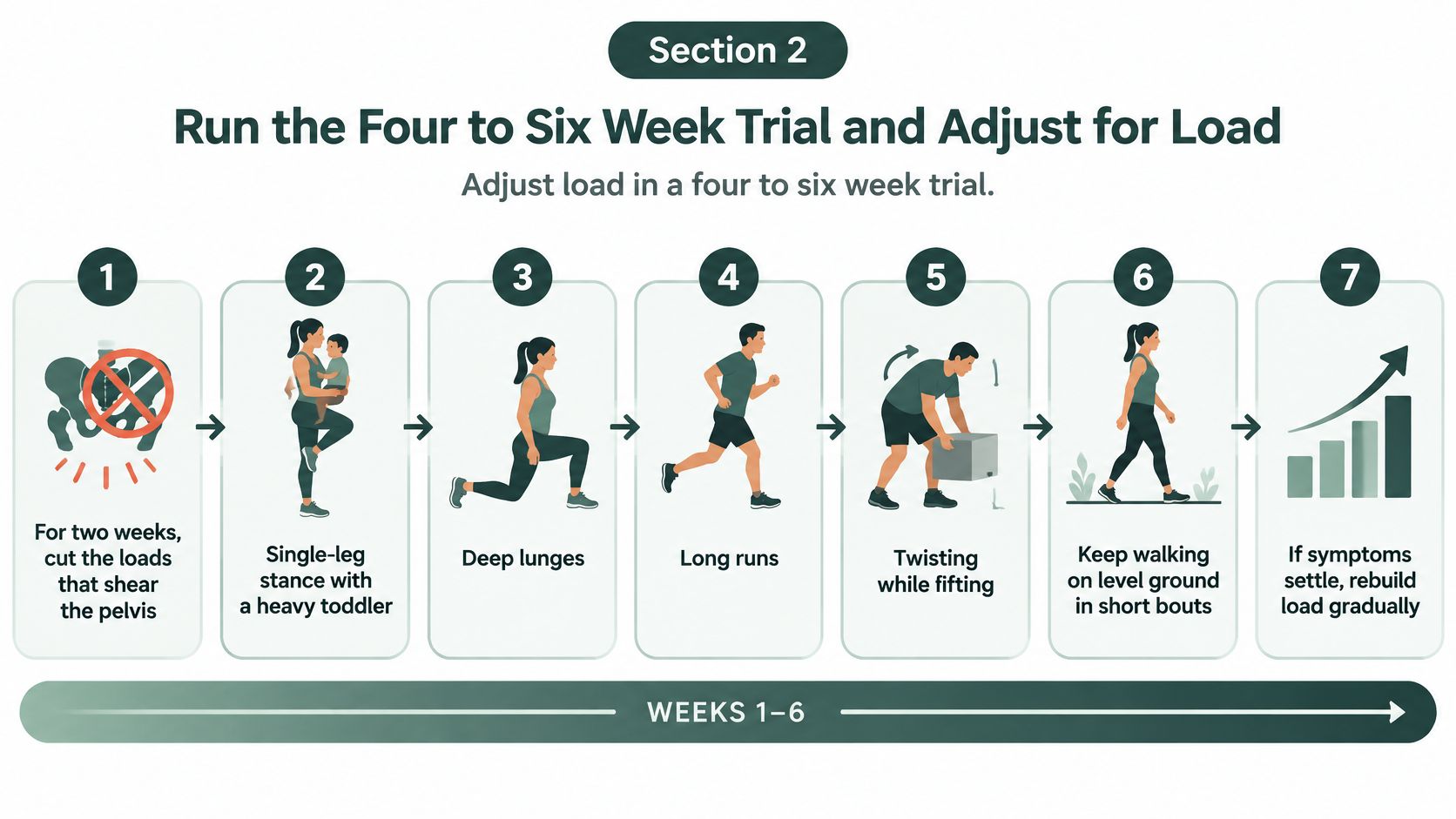
For two weeks, reduce activities that shear or asymmetrically load the pelvis. Scale back deep lunges, long runs, twisting while lifting, and standing on one leg with a heavy toddler on one hip. Keep level-ground walking in short bouts if it doesn't increase symptoms. Success sign: ordinary walking stays manageable. Common mistake: replacing every activity with bed rest, which makes it harder to see what you can tolerate.
Try a pelvic belt if the pelvis feels unstable. Wear it low across the bony pelvis during standing or walking tasks, and take it off for sleep. This can give temporary external support, especially during pregnancy or postpartum recovery; it doesn't diagnose the pain or replace strengthening. Success sign: standing tasks feel more controlled. Common mistake: wearing it tightly all day without checking whether it helps.
Use a short stability set rather than forcing end-range stretches. Try an abdominal brace while lying on your back for 8 to 10 breaths, side-lying clamshells for 2 sets of 8 per side, and bridges with both feet planted for 2 sets of 8. Add a tall kneel or hip hinge only within a comfortable range. Success sign: you finish without a sharp flare. Common mistake: pushing a figure-four stretch into sharp buttock pain because it feels like the sore spot needs a deeper stretch.
Let a clinician guide manual therapy as an adjunct. A hands-on session may help address mobility, but pair it with the movement work and reassess a specific painful task that week. Success sign: stairs or standing feel easier afterward and the improvement carries into daily activity. Common mistake: treating the session itself as the complete rehab plan.
Check medication safety before using an anti-inflammatory. Ask a clinician whether it's appropriate with pregnancy, stomach or kidney concerns, and other medicines you take. Success sign: the medication supports ordinary movement and exercise safely. Common mistake: assuming an over-the-counter medicine is suitable for everyone.
Review function at weeks four and six. If stairs, standing time, or night comfort are improving, progress the hip hinge and single-leg work gradually. If nothing has changed or you're clearly worse, stop escalating exercises and arrange reassessment; repeating the same program indefinitely isn't a useful test. Success sign: the activity that matters becomes easier. Common mistake: increasing the load on a calendar schedule even when symptoms are climbing.
A staged assessment matters during rehab too. A 2025 review found that SI-joint pain can be confused with lumbar, hip, or thoracolumbar disorders, and that examination findings shouldn't be reduced to a single provocative maneuver; the NCBI Bookshelf review describes the need for history, hip and neurologic assessment, and further evaluation when symptoms are atypical or persistent.
Adjust the plan to the day
A postpartum parent who can walk around the block but can't carry a car seat on one hip can reduce that one-sided load, hold the baby close while hinging, and exhale while lifting instead of twisting toward the seat. An athlete whose pain appears during running can keep cycling or pool exercise if those activities don't reproduce the symptoms.
After a flare from a long car ride, take short walks, use the belt during the next standing block if it helps, and return to the last easier exercise set for a short reset before progressing again. Don't turn a brief flare into an automatic test of every stretch.
Keep a one-week log with three entries for each meaningful attempt: the task that hurt, what you changed, and whether the next attempt was easier. If that record shows worsening or no useful change by the planned review, take it to a clinician rather than adding more aggressive stretches.
Compare Steroid and PRP When Rehab Stalls
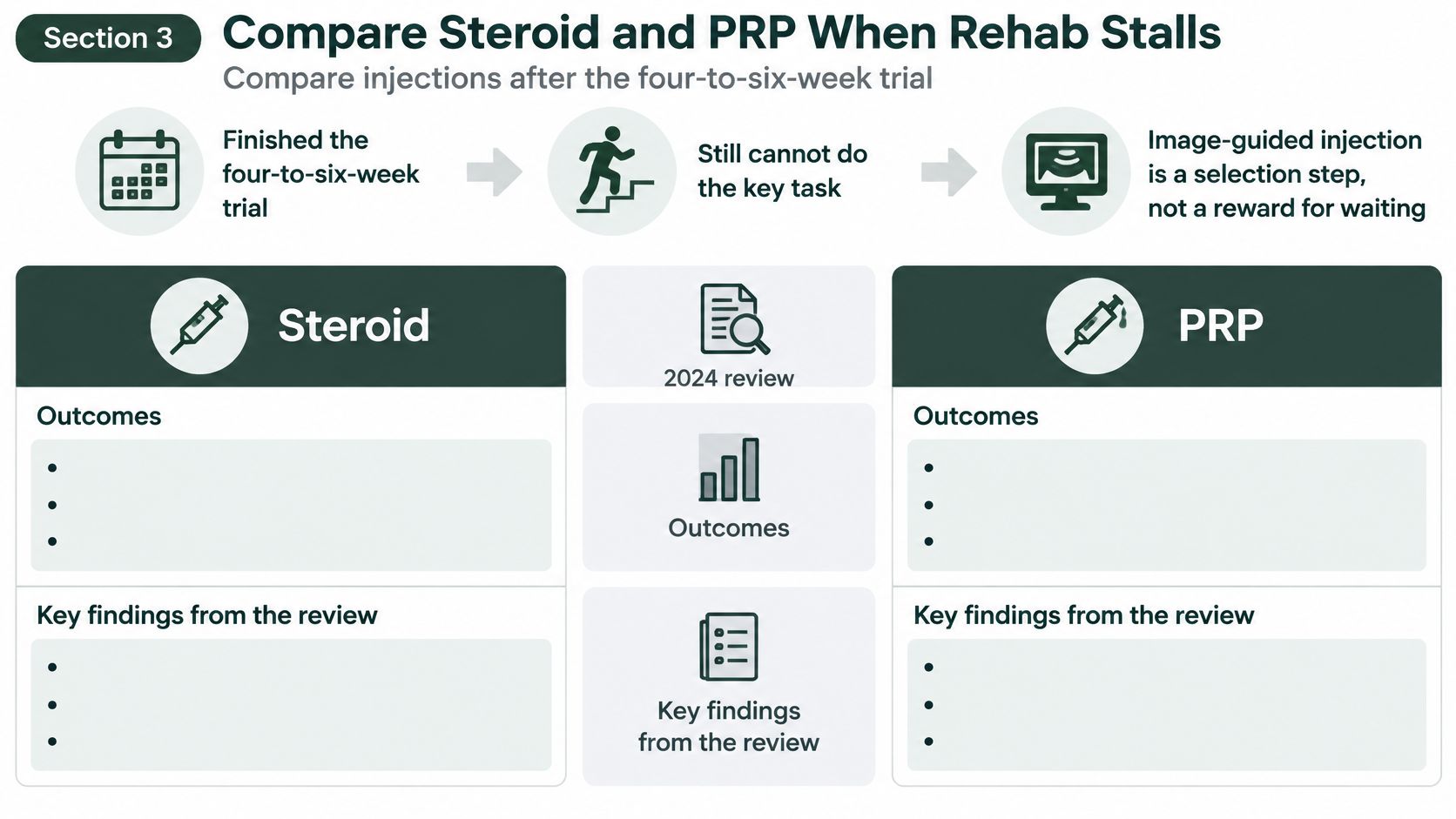
If you've completed the trial but still can't do the task that matters, an image-guided injection may be a selection step, not a reward for waiting. The choice should follow a credible diagnosis and a discussion of what each option can and can't do.
| Option | Share of studies | Pain change on a 10-point scale | Reported failure |
|---|---|---|---|
| Corticosteroid injection | 63% | 3.4 points mid-term and 3.0 points long-term | 26% |
| Platelet-rich plasma | 16% | 2.2 points mid-term and 2.3 points long-term | 14% |
| Other injective methods | 21%, mixed techniques | Not pooled as one result | Variable |
| Earlier injection and radiofrequency reviews | Limited evidence overall | Many studies reported over 40% pain improvement and over 20% functional improvement | Long-term certainty still limited |
The 2024 systematic review of SI-joint injection treatments reported these study shares, pain changes, and failure rates. PRP isn't automatically superior. The studies differed in design, patient selection, injection technique, follow-up, and comparisons, so the lower reported PRP failure rate doesn't prove it will work better for a particular person. If you're considering the treatment, learn what PRP injections involve and discuss whether the diagnosis and evidence fit your situation.
Match the option to the job it needs to do
A corticosteroid injection may make sense when a clinician is treating a confirmed joint source and a temporary reduction in pain could help you restart rehabilitation. The review found pain reduction at both mid-term and long-term follow-up, but an injection doesn't correct the movement or loading factors that contributed to the symptoms. An injection into the joint also doesn't automatically address pain arising from posterior ligaments.
PRP is another option to discuss when the pain source is confirmed and you're comfortable with uncertainty about how the treatment compares over time. Ask how the injection is targeted, what improvement would count as meaningful, and how the plan will support movement afterward. Don't choose it based on a headline comparison alone.
Earlier reviews described therapeutic SI-joint injections and radiofrequency procedures as options with limited evidence overall, even though many studies reported improvements in pain and function. That means treatment should be judged by your function and follow-up, not by a promise of a fixed outcome. If the next discussion is about a prognostic block, the question has shifted to whether lateral-branch treatment is suitable, not whether to repeat a blind steroid shot.
Use Prognostic Blocks Before Lateral-Branch Ablation
If chronic pain persists despite structured conservative care, radiofrequency ablation shouldn't be the automatic next step. A prognostic block helps determine whether numbing the relevant nerves temporarily improves the pain and function that ablation is intended to target.
Current consensus commonly uses at least 50% pain relief after a diagnostic or prognostic block, alongside documented functional improvement, to help select patients for radiofrequency treatment. Some protocols use two blocks, but requiring a higher relief threshold hasn't been shown to improve outcomes. The consensus guidance on SI-joint-complex pain describes this selection process and the limits of the evidence.
What the block can and can't tell you
A positive result means a properly selected nerve-targeting procedure is more reasonable to discuss. It isn't a guarantee that ablation will work, nor does it mean the block itself has treated the underlying cause. Record what you could do before and during the numbing period, such as standing, walking, or completing a usual lifting task, so the clinician can judge whether function changed as well as the pain score.
Anatomically valid sacral lateral-branch radiofrequency techniques have evidence for relief lasting at least six months in appropriately selected patients. By comparison, corticosteroid injections generally provide short-term relief of approximately four weeks or longer in selected cases. These time frames aren't promises. Techniques vary, trials are small, and long-term comparisons are limited; one randomized study found no significant advantage over exercise at either six or twelve months.
The handoff matters: a lateral-branch decision follows a positive prognostic block. It isn't a reason to proceed directly to denervation or to repeat an unguided injection.
Discuss what outcome you'll track and what you'll do if the block doesn't improve the activity you care about. That keeps the procedure decision tied to function rather than to a single pain score.
Book Hands-On Care Before You Consider Fusion
Arrange a clinician assessment promptly for red flags. Book a review if your staged plan hasn't restored the task that matters after six weeks, or if pregnancy or postpartum pain is limiting walking, lifting, or sleep. A confirmed diagnosis and a measured response to treatment should come before an irreversible surgical decision.
For persistent pain after conservative care, a clinician can decide whether a positive prognostic block supports lateral-branch radiofrequency. Fusion belongs at the end of the pathway, for carefully selected people with confirmed, refractory SI-joint pain after nonoperative and interventional care have failed. The evidence is mixed: a 2024 meta-analysis found a standardized pain-score reduction of 1.71 with minimally invasive fusion compared with nonoperative management, with a 95% confidence interval of 1.39 to 2.03 (meta-analysis findings). In a Swedish Spine Registry study, 59% of patients reached the predefined minimum clinically important improvement in low-back pain after surgery (registry study). At least one sham-controlled study was negative, so those results don't mean fusion is the right next move for everyone.
Start the appointment with function
Tell the clinician which activity the pain blocks, what you've already tried, and whether symptoms change with walking, stairs, lifting, or sleep. That helps keep the visit focused on diagnosis and realistic treatment options rather than starting with a request for a particular injection.
For readers in Aurora, Colorado, Restore Osteopathic Medicine offers gentle, hands-on Osteopathic Manipulative Medicine designed to improve mobility and support function. The clinic can evaluate whether regenerative injection therapy is appropriate for a particular patient; it isn't suitable for everyone. Learn about osteopathic manipulative treatment and movement as one hands-on care option to discuss during an evaluation.
Restore Osteopathic Medicine offers individualized, hands-on osteopathic care to support mobility and function, with an evaluation to determine whether regenerative injection therapy is appropriate for your situation. If SI-joint or pelvic pain is limiting daily activity, bring the task that hurts and the treatments you've tried when you visit Restore Osteopathic Medicine.