
If a clinic offers “ozone therapy,” do you know what treatment you're being offered? Applying an ozonated product to a wound, injecting a joint, and treating blood outside the body aren't interchangeable procedures, even when they appear under the same service name.
If you're nervous about booking, you don't need reassurance that skips the difficult questions. You need a clear explanation of the proposed method, what evidence supports it, and what could go wrong.
Table of Contents
- Why Ozone Therapy Near Me Searches Deserve a Careful Answer
- What Ozone Therapy Actually Is
- What the Evidence Says About Ozone Therapy
- Safety Risks and Who Should Avoid Ozone Therapy
- Comparing Ozone Delivery Methods and Their Risk Profiles
- How to Choose a Qualified Ozone Therapy Provider
- What to Expect at Your First Ozone Therapy Visit
- Your Next Step Toward Ozone Therapy in Aurora
Why Ozone Therapy Near Me Searches Deserve a Careful Answer
Searching for ozone therapy near me can put you in an uncomfortable position. You may find confident descriptions of benefits without enough detail to understand what would happen during an appointment.
The useful starting point isn't whether a clinic offers ozone. It's which route the clinician proposes for your particular diagnosis. A treatment name alone doesn't tell you whether the approach involves the skin, a needle, or blood handling.
A long history isn't proof of effectiveness
Ozone therapy has a history spanning more than 150 years, with medical applications documented in the nineteenth century and later use across disinfection, wound treatment, and integrative care. That varied development helps explain why the term covers so many techniques, but historical use doesn't establish modern effectiveness for every condition.
For a patient, the distinction matters. A long-established practice may still need better evidence for the specific use being offered today.
Rather than trying to decide whether ozone is universally good or bad, ask a narrower set of questions:
- The diagnosis: What condition are we treating, and how was it established?
- The procedure: Where will the ozone or ozonated material go?
- The comparison: What established treatment could I choose instead?
- The purpose: What outcome would make this worthwhile for me?
Practical rule: Evaluate a proposed procedure, not a broad promise attached to the word ozone.
You're allowed to slow the conversation down. A clinician should be able to describe the treatment in ordinary language without asking you to accept unexplained claims about healing, detoxification, or whole-body improvement.
A nearby location can make follow-up easier, but convenience shouldn't decide whether you proceed. The explanation you receive before treatment is more important than how reassuring the clinic's homepage sounds.
What Ozone Therapy Actually Is
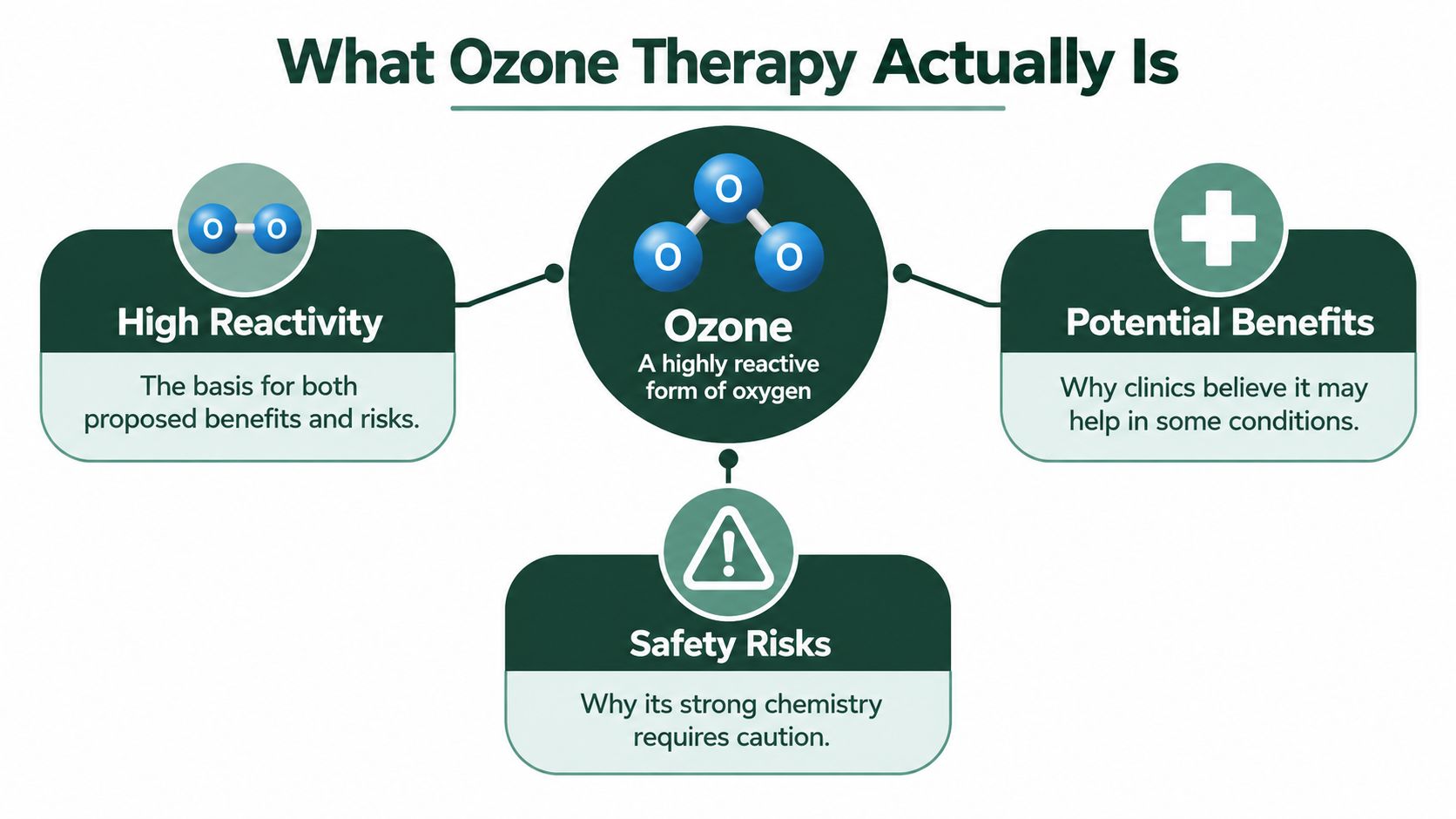
Ozone is a highly reactive form of oxygen. Its strong oxidative chemistry is central to both the effects researchers are investigating and the reasons medical use requires caution.
A helpful way to think about it is as a strong chemical agent, not a gentle nutrient. The fact that something involves oxygen doesn't make it equivalent to breathing oxygen or receiving ordinary oxygen support.
Understand the delivery vocabulary
Clinics may use a device to generate ozone for a particular procedure. What happens afterward determines the route of administration.
- Topical application: An ozonated product, such as an oil, is applied to a surface rather than injected.
- Ozonated water: Water containing ozone is used for a specified local application. Ask exactly where and how it will be used.
- Localized injection: A needle delivers the proposed treatment to a particular anatomical target, such as a joint.
- Blood-based treatment: In ozonated autohemotherapy, blood is handled outside the body, exposed to an ozone-containing mixture, and returned.
Those descriptions explain the categories, not whether any particular treatment is appropriate. Terms such as intra-articular mean within a joint, while intradiscal means within a spinal disc. Neither should be treated as a synonym for a superficial or topical procedure.
The protocol matters too
Even after you identify the route, you still need the actual protocol. Evidence reviews describe variation in concentration, exposure time, treatment frequency, and delivery devices, which complicates comparisons between clinics and studies, as discussed in the systematic review of ozone for chronic wounds.
Ask the clinician to write down the proposed method. A useful explanation should identify the device, the material being administered, the treatment site, and the intended exposure.
For example, if you're told that a clinic offers local ozone treatment, ask whether that means an external application or a needle-based procedure. Those words may sound similar in a sales conversation, but they describe very different experiences.
Don't feel embarrassed about unfamiliar terminology. Understanding what enters your body, or what is applied to it, is a basic part of informed consent.
What the Evidence Says About Ozone Therapy
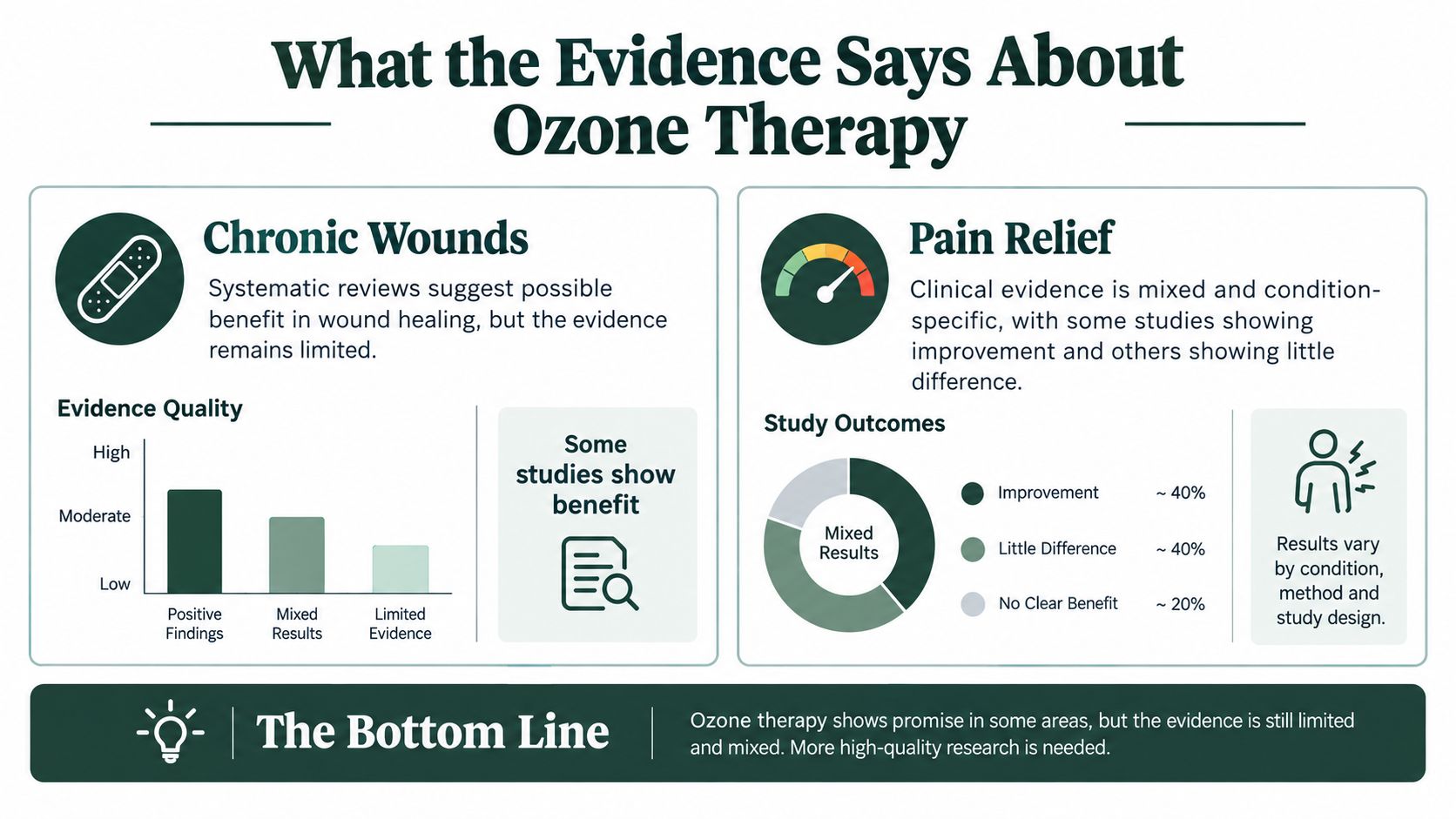
The evidence is mixed, condition-specific, and generally uncertain. A positive finding in a particular study isn't the same as proof that ozone should replace established treatment.
The most useful evidence discussion names the diagnosis, the delivery method, and the treatment used for comparison. Broad claims about ozone improving health leave those essential details unanswered.
Chronic wounds show promise, not a settled answer
A systematic review identified 9 eligible trials involving 453 participants. Although its meta-analysis found a statistically significant improvement in wound closure compared with controls, the authors didn't consider the evidence conclusive that ozone was superior to standard treatment, according to the chronic-wound evidence review.
That distinction is important. A statistical difference can justify further investigation without establishing that a treatment is the right choice for an individual patient.
For someone with a wound, the clinical conversation should remain focused on the complete care plan. Ask what established wound treatment will continue, what improvement will be measured, and what will happen if healing doesn't progress.
Dental findings illustrate why generalization fails
The periodontal review described in the evidence above included studies of ozone added to scaling and root planing. It found no statistically significant additional periodontal benefit and no significant microbiological advantage over scaling and root planing alone.
For a dental-specific resource to discuss with your clinician, Loul Dental Studio's ozone therapy research in dentistry provides a focused starting point. It shouldn't be used as evidence for unrelated procedures elsewhere in the body.
A promising result for one diagnosis doesn't establish a benefit for another diagnosis or delivery route.
Two terms also deserve clarification:
- Adjunctive use: The treatment is added to other care. This describes its role, not proof that it helps.
- Investigational use: Important questions about benefit, safety, or appropriate protocols remain unresolved.
For pain-related proposals, request evidence for your exact diagnosis and injection target rather than accepting a general pain-relief claim. Ask what outcome matters, such as a specific daily activity, and how the clinician will distinguish meaningful improvement from a temporary change in symptoms.
Safety Risks and Who Should Avoid Ozone Therapy
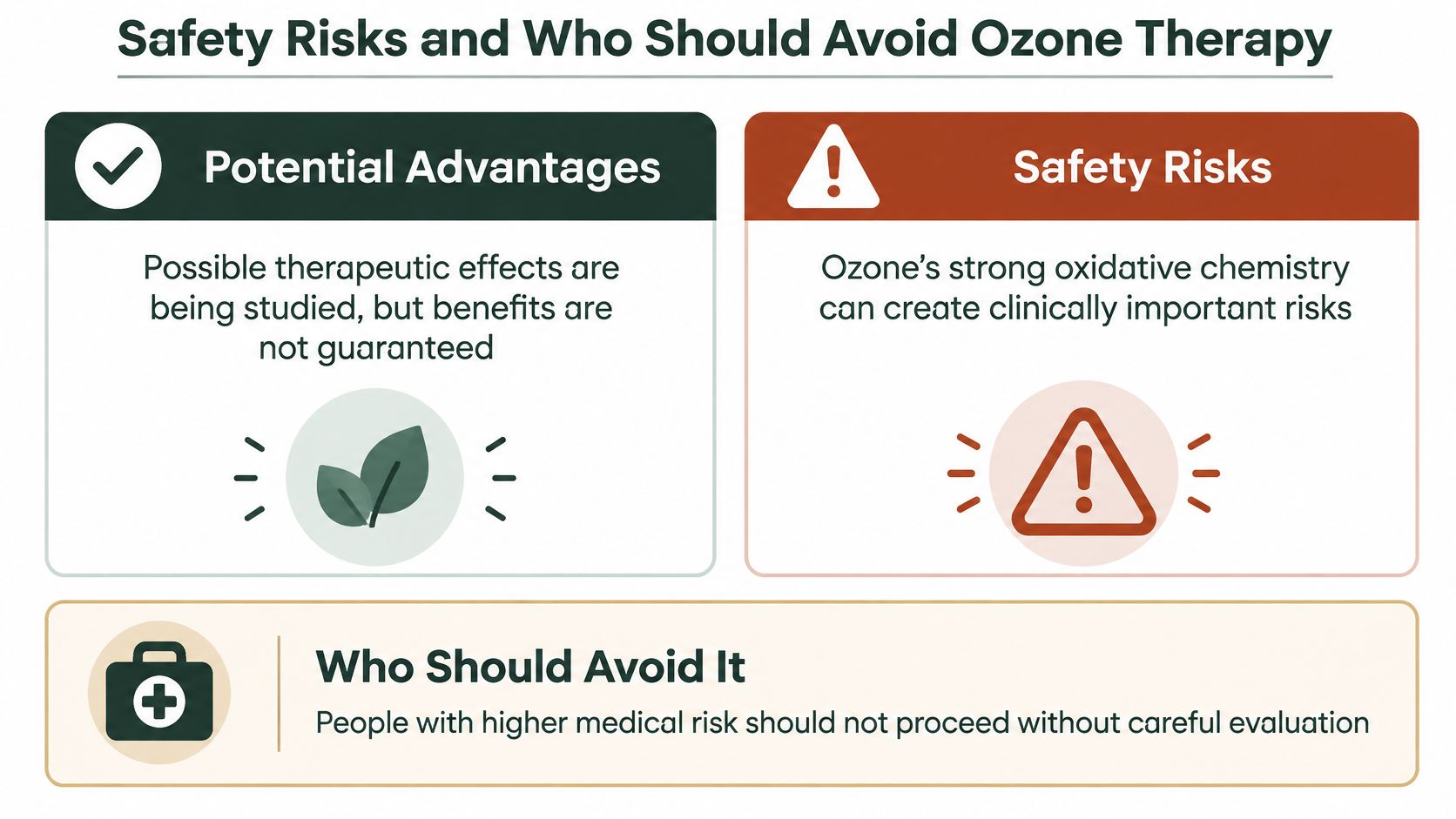
Avoid any procedure that intentionally exposes your lungs to ozone. Inhalation can irritate respiratory tissues and, at sufficiently high exposure, cause pulmonary edema, a serious buildup of fluid in the lungs.
U.S. federal regulation describes ozone as a toxic gas with no known useful medical application in specific, adjunctive, or preventive therapy. Under the cited device provisions, it specifies a 0.05 parts-per-million ceiling for accumulation in occupied indoor spaces and requires proof of safety and effectiveness for medical use, as stated in the federal ozone-device regulation.
Serious risks differ by route
A critical appraisal reported serious complications, including fatal gas embolism and bloodborne infection transmission, particularly in association with systemic ozonated autohemotherapy. Localized and topical applications didn't show comparable events in the reviewed literature, but inconsistent adverse-event reporting means the true complication rate remains uncertain, according to the modality-specific safety appraisal.
A gas embolism involves gas obstructing circulation. These reports are a reason to ask precise questions about the procedure, not to assume that every delivery method carries an identical risk.
The absence of comparable reported events for another route also doesn't establish that the route is risk-free. Incomplete safety reporting limits how confidently anyone can estimate risk.
Who needs medical review before proceeding
Don't book treatment without discussing your health history with a licensed physician, especially if any of the following apply:
- Pregnancy or possible pregnancy: Don't interpret a clinic's broader maternity services as evidence that ozone is appropriate during pregnancy.
- Respiratory disease: Describe your diagnosis and any current breathing symptoms.
- Cardiovascular conditions: Review your condition and relevant medical history.
- Anticoagulant use or bleeding concerns: Bring a complete medication list, including nonprescription products.
- Acute illness: Tell the clinician about current symptoms before attending a procedure.
These are reasons for individualized assessment, not a complete self-screening tool. Don't stop prescribed medication to qualify for treatment.
A clinician should be willing to say that treatment isn't appropriate. Likewise, you should receive clear instructions about whom to contact after a procedure and when to seek urgent medical attention. New severe breathing difficulty, chest pain, or sudden neurological symptoms warrant emergency assessment rather than reassurance that the treatment is working.
Comparing Ozone Delivery Methods and Their Risk Profiles
A useful comparison separates what the procedure involves from what benefit has been demonstrated. A technically detailed treatment description can still leave the evidence question unanswered.
The table below is a consultation aid, not a ranking of recommended treatments. The evidence and safety limitations discussed earlier remain relevant.
Ozone Delivery Routes Compared
| Route | What It Involves | Typical Use | Evidence Base | Notable Safety Concerns |
|---|---|---|---|---|
| Topical application and ozonated oils | Application to an external treatment area | Local surface or wound-related applications | Wound research offers limited, condition-specific findings | Exposure control and suitability for the particular tissue need review |
| Ozonated water | Water containing ozone applied to a specified site | Local applications, including dental contexts | Findings depend on the diagnosis and accompanying care | The intended site, preparation, and handling should be explained |
| Localized injection | Needle-based delivery to an identified anatomical target | Joint, soft-tissue, or disc-related proposals | Requires evidence matched to the exact target and condition | Procedure-specific risks, anatomical precision, and infection-control planning |
| Systemic blood-handling approaches | Blood is treated outside the body and returned | Proposed systemic applications | Local wound findings don't establish systemic benefit | Serious complications were reported in the safety appraisal discussed above |
Compare decisions, not treatment labels
Suppose one clinic proposes an external application and another recommends a blood-based procedure. Asking which clinic has the stronger ozone machine won't help you compare them. You first need to understand why either clinician thinks their proposed route fits your diagnosis.
For injection-based care, ask the clinician to name the anatomical target. A joint injection and an intradiscal procedure shouldn't be grouped together just because both use a needle.
Your comparison should also separate the treatment from the surrounding care:
- Diagnostic reasoning: Why is this procedure being considered for your symptoms?
- Alternatives: Could an established treatment address the same goal?
- Decision limits: What finding would make the clinician recommend against proceeding?
In Aurora, the publisher's physician-led practice offers ozone as adjunct support within individualized integrative care, alongside services such as osteopathic manipulative medicine, regenerative injections, IV infusion, and functional medicine. That setting doesn't remove the need to evaluate the specific ozone procedure on its own merits.
You shouldn't assume that every service available in an integrative clinic belongs in your treatment plan. The clinician should explain which options are relevant, which aren't, and why a less invasive or non-ozone approach might be preferable.
How to Choose a Qualified Ozone Therapy Provider
Treat the first conversation as an opportunity to assess the clinic, not an obligation to purchase treatment. You can ask for written answers and take time to review them before consenting.
A useful provider explains uncertainty directly. A medical license matters, but credentials alone don't prove that a particular procedure is effective or appropriate.
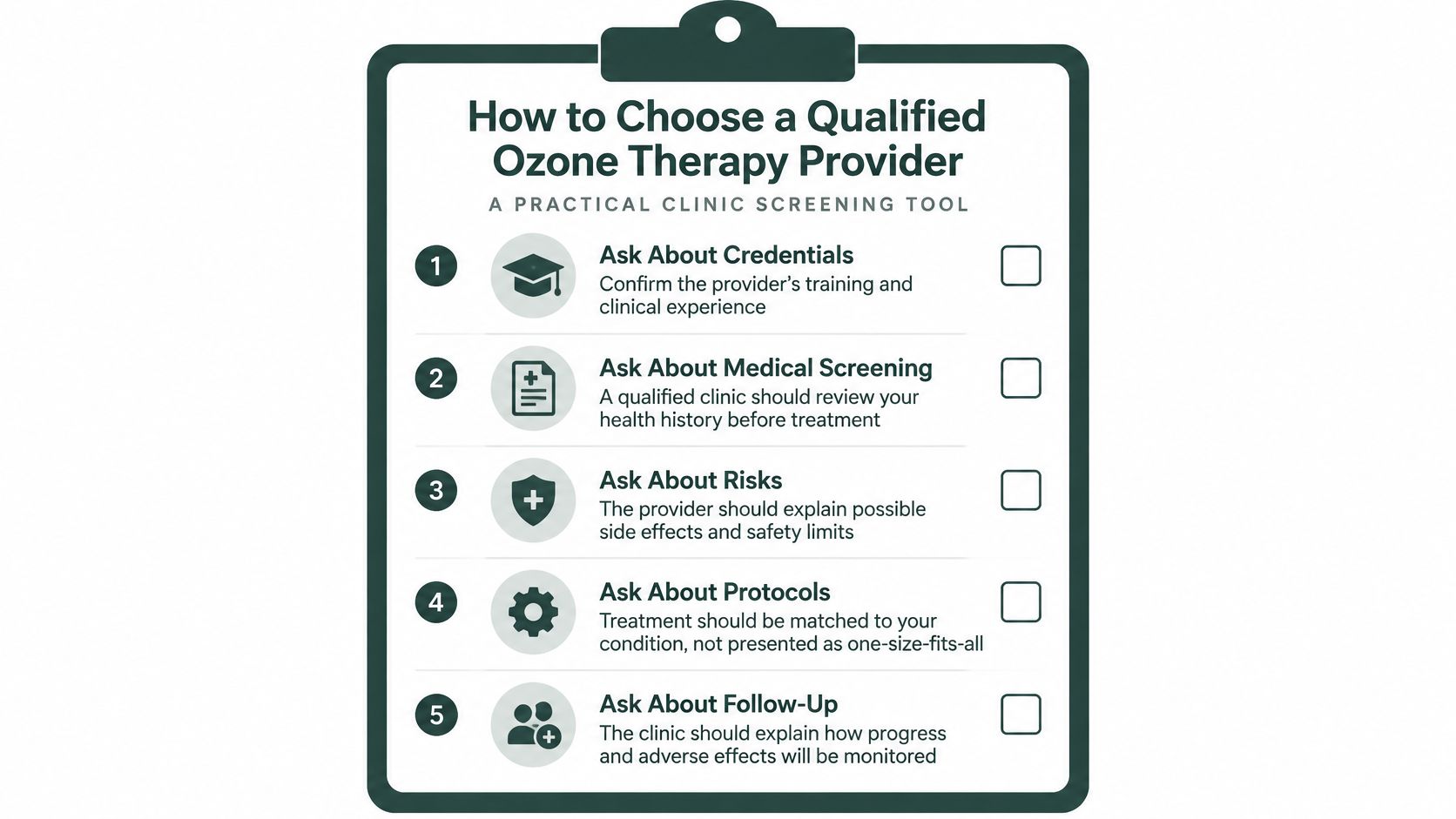
Bring this screening checklist
- Credentials and responsibility: Who evaluates me, who performs the procedure, and who handles complications? What license and procedure-specific training does each person hold?
- Diagnosis and evidence: What diagnosis are you treating? Can you show me evidence that matches the proposed route and my condition?
- Medical screening: Which parts of my history could make treatment inappropriate? Will you review my medications and coordinate with my existing clinicians when needed?
- Device and environment: What device is used? Is the procedure performed in a closed system, and how do you monitor room-air ozone?
- Blood handling and infection control: If blood is involved, how is equipment managed to prevent contamination or transmission between patients?
- Emergency readiness: What happens if I develop a serious reaction? Who is available, and what is the escalation plan?
- Follow-up and stopping rules: What will you measure, when will you reassess, and what would make you stop recommending treatment?
Don't accept “we've never had a problem” as a substitute for an emergency plan. Ask for an explanation of how the team identifies, documents, and responds to adverse events.
Notice how the clinic handles difficult questions
Be cautious if a provider promises a cure-all, refuses to name the delivery route, or dismisses concerns without explanation. Another warning sign is pressure to commit before your diagnosis and alternatives have been discussed.
Before you commit: Ask whether the clinician would still recommend the procedure if you chose not to purchase a treatment package.
A whole-person consultation can include nutrition, sleep, stress, and other contributors to symptoms. The clinic's functional medicine approach describes that broader context, but a broad evaluation shouldn't become an automatic recommendation for ozone.
For patients comparing options in the Denver–Aurora area, clarity is a useful decision criterion. You should leave knowing who is responsible for your care and what questions remain unanswered.
What to Expect at Your First Ozone Therapy Visit
A responsible first visit should begin with a conversation, not an assumption that you'll receive treatment. You should be able to attend an evaluation and decide afterward whether you want to proceed.
Bring your medication list, relevant records, and the screening questions above. Explain what bothers you most and what you hope to do more comfortably in daily life.
Evaluation and informed consent
The clinician should review your diagnosis, medical history, current symptoms, and the screening concerns discussed earlier. If the diagnosis remains unclear, ask whether further assessment should come before a procedural decision.
The consent conversation should cover the proposed benefit, the limits of the evidence, important risks, and reasonable alternatives. You should also understand the option of declining ozone while continuing appropriate medical care.
Before agreeing, clarify practical details:
- Appointment length: How much time should you allow for preparation, the procedure, and observation?
- Expected experience: What might you feel during this specific method, and what should you report immediately?
- Aftercare: Are there activity instructions, and whom should you contact with concerns?
There isn't a reliable universal duration or sensation to promise across all ozone procedures. Ask for an answer tied to your actual protocol rather than a generic description of a session.
Follow-up without automatic repetition
Before you leave, agree on how the clinician will assess your response. That might mean tracking the particular wound outcome, symptom, or functional goal relevant to your diagnosis.
Further sessions shouldn't be treated as inevitable. Ask what evidence of benefit, lack of progress, or adverse effects would change the plan.
You can review the practice's frequently asked questions before your appointment and bring anything that remains unclear. You don't need to resolve every decision on the day of your first visit.
Your Next Step Toward Ozone Therapy in Aurora
A useful local search should end with a better medical question, not just a booking. Ask whether the proposed procedure offers enough plausible benefit for your condition to justify its uncertainties and risks.
For Denver–Aurora patients, the publisher's clinic is led by Dr. Benjamin Keaton, DO, and is located at 10555 E Dartmouth Ave, Unit 200, Aurora, CO 80014. Its osteopathic and integrative services provide a setting for discussing ozone alongside other care options, rather than assuming ozone must be the answer.
Request an evaluation before choosing treatment
Use the clinic's contact page to request a consultation during published office hours. Explain your main concern and ask what records you should bring.
The purpose of that appointment is to determine whether ozone deserves consideration in your situation. Risks, alternatives, and reasons not to proceed should be part of the discussion before any treatment decision.
Bring the screening checklist, your medication list, and a concrete goal for care. If you leave with a clearer understanding of your options, including the option not to receive ozone, the consultation has served a useful purpose.
Restore Osteopathic Medicine offers physician-led osteopathic and integrative care, with ozone therapies used as adjunct support within individualized plans. Visit Restore Osteopathic Medicine to request a consultation and bring your screening checklist so you can discuss the proposed route, evidence, risks, and alternatives before deciding.