
What if the most enthusiastic ozone therapy reviews and the most cautious clinical conclusions are both describing real experiences, just not measuring the same thing? A patient can feel a procedure was easy, compatible with daily life, and worth trying while a trial still fails to show that the treatment healed tissue, reduced hospital care, or outperformed standard therapy. That gap is where most confusion starts.
Ozone isn't one intervention, one dose, or one risk profile. Reading reviews well means asking which condition was treated, which route was used, what outcome changed, and what might have happened with ordinary care instead. Those questions turn a collection of testimonials into something you can use.
Table of Contents
- What Ozone Therapy Reviews Actually Tell You
- Understanding Ozone Therapy and Its Delivery Methods
- What Clinical Research Shows About Effectiveness
- Patient Experiences and Satisfaction Survey Results
- Why One Review Does Not Apply to Another Treatment
- Safety Concerns and How to Evaluate a Provider
- Weighing the Evidence and Making an Informed Decision
What Ozone Therapy Reviews Actually Tell You
People searching for ozone therapy reviews aren't looking for a chemistry lesson. They're asking two practical questions before they spend time and money. Does this work for my problem, and is it safe for me?
A typical search produces confident patient stories sitting next to cautious medical summaries. That contrast doesn't automatically mean one side is dishonest. A person may report less pain, easier movement, or a good experience with the clinic, while researchers measuring the same broad treatment category find fragile methods and inconsistent results. Satisfaction, symptom change, and proven disease benefit are three different claims.
Three kinds of reviews get blurred together
Patient reviews usually describe convenience, staff communication, discomfort, cost, and whether symptoms seemed better afterward. Provider pages often add mechanism language about oxygen, inflammation, circulation, or immune effects. Clinical reviews ask a narrower question, whether a defined intervention improved a defined outcome compared with placebo, usual care, or another treatment.
Trouble starts when those categories are treated as interchangeable. A five star rating for a comfortable visit doesn't establish wound healing. A plausible biological mechanism doesn't prove durable pain relief. A positive result for one dental outcome doesn't support a claim about fatigue, infection, or joint disease.
Practical rule: Treat every review as incomplete until it names the condition, delivery route, comparator, outcome, and follow up period.
You're not being cynical when you ask for those details. You're matching the evidence to the decision in front of you. The strongest reading habit is also the simplest one. Separate what patients experienced from what researchers measured, then check whether either source studied a situation enough like yours to matter.
That approach respects patient experience without asking it to carry more weight than it can. It also respects clinical research without pretending that a pooled average predicts exactly what will happen to an individual who has a different diagnosis, route, dose, and set of coexisting conditions.
Understanding Ozone Therapy and Its Delivery Methods
Ozone therapy is best understood as a family of procedures that expose tissue or blood to a controlled oxygen and ozone mixture. The shared ingredient is only part of the story. Route, concentration, frequency, equipment, and the tissue being targeted can change both plausibility and risk.
Think of the difference between formulations of the same medication. A cream applied to skin, a tablet swallowed, and an injection into a joint shouldn't be judged as if they're identical because they contain a related active ingredient. Ozone raises the same issue, with even less standardization across studies and clinics.
Routes you'll see in reviews
- Ozonated autohemotherapy: Blood is removed, exposed to an oxygen and ozone mixture outside the body, and returned. Reviews using this route involve venous access and blood handling, so their safety questions differ from local treatments.
- Intra articular injection: The mixture is delivered into or around a joint for a musculoskeletal indication. Pain and function are the relevant outcomes, not systemic wellness claims.
- Topical or local application: Ozone or ozonated preparations are applied to skin, wounds, or dental tissues. Exposure is more localized, but wound type and concurrent standard care still shape the result.
- Rectal insufflation: Gas is introduced rectally with systemic intent. Comfort, dosing, and patient selection raise different questions from blood based or joint based methods.
None of those descriptions tells you whether treatment works. They tell you what kind of evidence you'd need before drawing a conclusion. A review that doesn't specify the route has omitted one of the main variables.
A long history isn't the same as settled evidence
Ozone has a long historical record, and a clinical review reports use as early as the 1800s, while Nikola Tesla patented an ozone generator in the United States in 1896 according to a clinical history of ozone therapy and its applications. Longevity explains familiarity, not effectiveness. Systematic evaluation came much later, and studies still vary in indication, protocol, comparator, and outcome definition.
One boundary should stay unambiguous. Breathing ozone isn't a controlled medical application, and inhalation exposure is harmful. Clinical use, when it's studied, depends on generated mixtures and specified delivery routes. Any review or sales pitch that blurs inhaled ozone with procedure based care is failing a basic safety test.
The lack of a single standardized treatment also complicates dose comparisons. Two clinics may use the same label while delivering different concentrations, session counts, and combinations with other therapies. If a testimonial doesn't identify those details, you can't tell whether you're comparing similar care or merely similar branding.
What Clinical Research Shows About Effectiveness
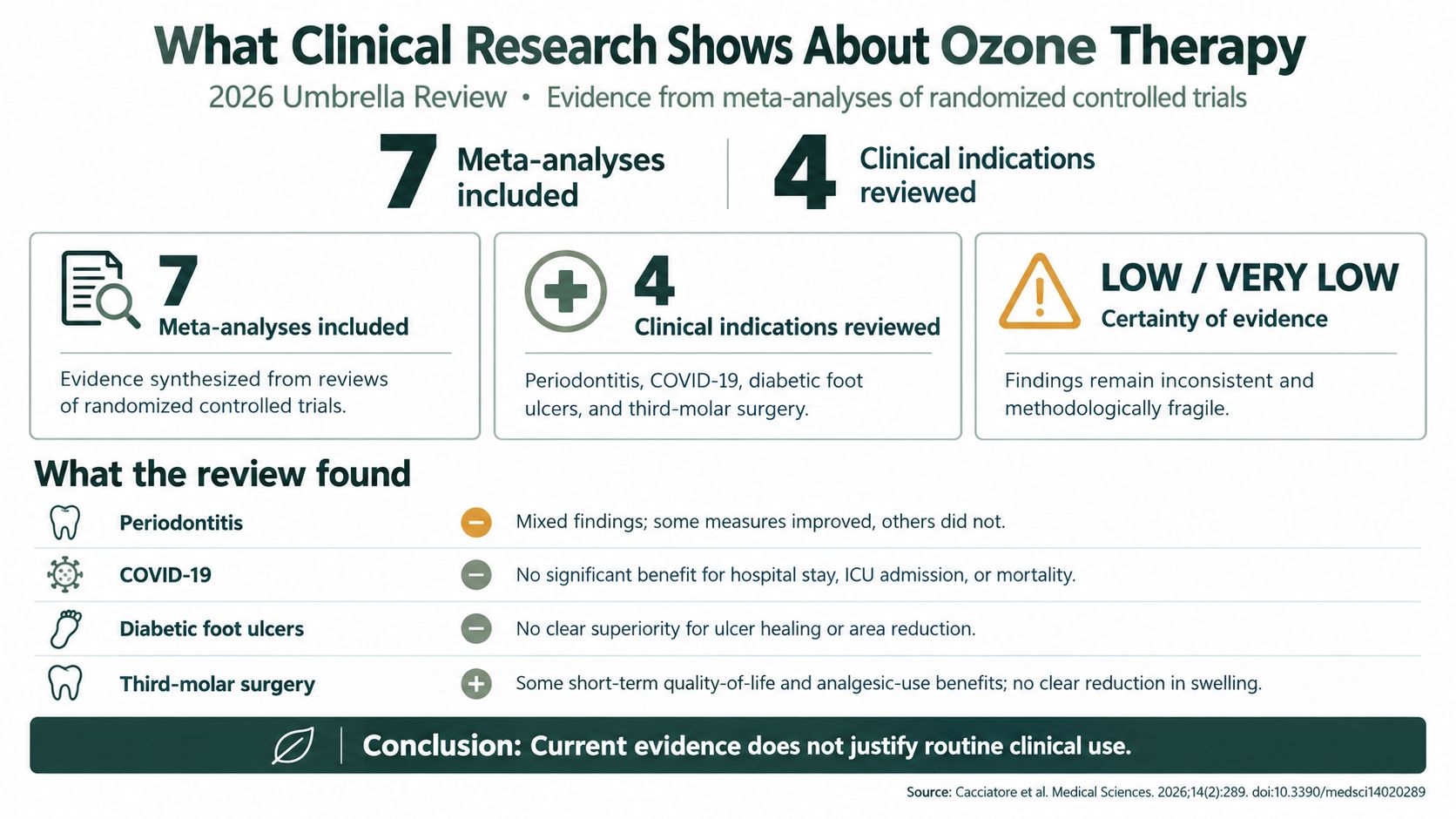
The most useful starting point is the highest level synthesis, not the newest isolated study. A 2026 umbrella review examined 1,243 records and included seven meta-analyses covering chronic periodontitis, COVID-19, diabetic foot ulcers, and impacted third molar surgery, as detailed in the 2026 umbrella review of ozone therapy meta-analyses. Its central finding wasn't a universal yes or no. Results were inconsistent, safety reporting was uneven, and certainty was predominantly low or very low.

COVID-19 and the problem of surrogate outcomes
For COVID-19, ozone reduced follow up PCR positivity with a risk ratio of 0.07 and a 95% confidence interval of 0.01 to 0.34 in the evidence summarized by the umbrella review authors' assessment of surrogate and clinical outcomes. That looks dramatic until you ask what it means for a patient. The authors judged PCR positivity clinically unimportant as a surrogate outcome and found no significant improvement in hospital stay, intensive care admission, or mortality.
That distinction matters well beyond infectious disease. A laboratory marker can move while the outcomes patients care about stay unchanged. Reviews that lead with a striking ratio but omit hospital care, function, symptoms, or survival are giving you statistical motion without clinical direction.
Diabetic foot ulcers and chronic wounds
For diabetic foot ulcers, ozone wasn't superior to control treatment for healing, with a risk ratio of 1.69 and a 95% confidence interval of 0.90 to 3.17, an interval wide enough to include no benefit. That's not proof ozone can never help any wound. It is a reason not to present it as an established replacement for debridement, infection control, offloading, glucose management, circulation assessment, and specialist follow up.
A separate systematic review of chronic wounds identified 9 studies involving 453 patients and reported pooled evidence favoring ozone for wound closure, while still not establishing superiority over standard care, according to the chronic wound systematic review and meta-analysis record. Those two conclusions can coexist because wound types, routes, comparators, and closure definitions differ. The defensible position is adjunctive and indication specific, not broadly curative.
Dental outcomes show partial signals
Dental results were also mixed. Chronic periodontitis findings included improved probing depth and gingival index, but not bleeding, plaque, or clinical attachment level. After third molar surgery, ozone didn't reduce swelling or improve mouth opening, although short term quality of life and lower analgesic use were reported.
Partial improvement can still matter to patients, especially when medication use or short term comfort changes. It shouldn't be repackaged as healing. Which endpoint improved is just as important as whether any endpoint improved.
A statistically significant result on a narrow or surrogate endpoint doesn't establish durable value for the condition as a whole.
The clinical literature therefore supports cautious, narrow questions. Does a specific route help a specific outcome, for how long, compared with what, and at what risk? Broad claims about detox, immunity, pain, circulation, and healing collapse several unanswered questions into one confident sentence. The evidence doesn't justify that shortcut.
Patient Experiences and Satisfaction Survey Results
Patient experience data answer a more immediate question. What was undergoing treatment like, and would patients describe themselves as satisfied afterward? Those answers matter for adherence, comfort, and shared decision making. They just don't substitute for controlled evidence of efficacy.
In one study of 81 patients receiving major ozone therapy, 85.1% rated the procedure very or extremely easy, 95% considered it very or extremely compatible with their lifestyle, 96.3% reported no discomfort, and 11.1% reported side effects, as reported in a patient experience study of major ozone therapy. Those figures suggest that, in that setting, the procedure was generally acceptable to people who received it. They don't tell you whether the underlying condition improved more than it would have otherwise.
What the larger survey adds
A larger retrospective survey gives a useful second angle. Among its respondents, most described themselves as satisfied or very satisfied, but adverse events still occurred and were often linked to venous access or procedural factors. That pattern is clinically plausible. When a therapy requires blood handling or repeated venous access, the delivery process itself becomes part of the risk and experience.
| Study | Patients | Satisfaction | Adverse Events |
|---|---|---|---|
| Major ozone therapy experience study | 81 patients in the cited patient experience report | 85.1% very or extremely easy, 95% very or extremely lifestyle compatible | 11.1% reported side effects, while 96.3% reported no discomfort |
| Retrospective patient survey | 240 patients in the same patient experience report | 51.7% very satisfied and 36.7% satisfied | 11.3% had adverse events, and 88.9% of those events were attributed to venous access or procedural factors |
Read those numbers as experience measures from particular settings, not market wide benchmarks. People who choose an elective therapy, complete it, and answer a survey may differ from people who decline treatment, stop early, or seek care elsewhere. Retrospective designs also depend on recall and don't include a randomized comparison group.
How to read online testimonials after seeing survey data
A patient who says a session was easy is reporting something concrete. A patient who says ozone cured a complex condition is making a causal claim that's much harder to verify from a testimonial. Concurrent medication, physical therapy, natural fluctuation, placebo effects, regression toward an average symptom level, and selective posting can all sit behind an improvement story.
Negative reviews need the same discipline. A bruise, difficult venous access, or disappointing result is important experience data, but one account can't estimate how often an event occurs. Look for patterns that identify route, timing, severity, follow up, and whether the clinic documented and managed the problem.
A credible clinic dashboard would keep these outcomes separate.
- Procedural experience: Ease, discomfort, completion, and lifestyle compatibility.
- Clinical response: Indication specific pain, function, medication use, healing, or another prespecified outcome.
- Safety: Adverse events recorded by route and severity, not folded into a general satisfaction score.
- Durability: Whether any change persists at standardized follow up instead of being measured only right after treatment.
That separation protects patients from a common rhetorical move. High satisfaction gets used as if it proves biological effectiveness. It doesn't. It proves that the care experience worked for many respondents, which is valuable but narrower.
Why One Review Does Not Apply to Another Treatment
The biggest analytical error in ozone therapy reviews is evidence transfer. A reader sees a favorable finding for one route or diagnosis and assumes it applies wherever ozone appears in the treatment name. The umbrella review shows why that assumption fails. Results differed across periodontitis, COVID-19, diabetic foot ulcers, and third molar surgery, even before you consider delivery method.
Route makes transfer still weaker. An intra articular injection concentrates exposure around a joint. A topical wound application acts at the surface and depends heavily on standard wound care. Rectal insufflation and autohemotherapy aim for systemic effects through entirely different pathways. Their plausible benefits, failure modes, and adverse events aren't interchangeable.
Build a route and indication match before you compare
Before applying any review to your situation, check five points in writing.
- Same condition: Is the diagnosis the same, or only in the same broad category such as pain or inflammation?
- Same route: Did the study use the delivery method being proposed to you?
- Same outcome: Did it measure pain, function, closure, medication use, a laboratory surrogate, or satisfaction?
- Same comparator: Was ozone tested against placebo, no added treatment, or an active standard therapy?
- Same time horizon: Was benefit immediate, short term, or maintained after treatment ended?
If several answers are no, the review may still be interesting background. It isn't a direct basis for consent. That same discipline applies when people compare ozone with unrelated integrative services such as bio-identical hormone optimization, because a treatment category or clinic setting never substitutes for evidence tied to the actual intervention and diagnosis.
Symptom relief isn't disease modification
A 2025 knee osteoarthritis systematic review described pain and mobility improvements while acknowledging treatment variability and limited long term follow up. Short term symptom relief can be meaningful, but it isn't proof that cartilage loss, disease progression, or future disability changed. Reviews should say adjunctive symptom relief when that's what was measured.
Biologic plausibility creates a similar trap. Researchers can propose oxidative or inflammatory mechanisms, and a study can detect short term change, yet patients may gain little durable benefit. Mechanism explains why an effect might occur. It doesn't establish how large the effect is, who receives it, or whether benefits outweigh burden and risk.
Don't ask whether ozone works in the abstract. Ask whether this route improves this outcome for this condition better than the available alternative.
That question also changes how you judge negative evidence. Failure to improve swelling after dental surgery doesn't settle joint pain. A favorable knee pain signal doesn't settle wound healing. Precision cuts both ways, and it's the only way to keep reviews clinically honest.
Safety Concerns and How to Evaluate a Provider
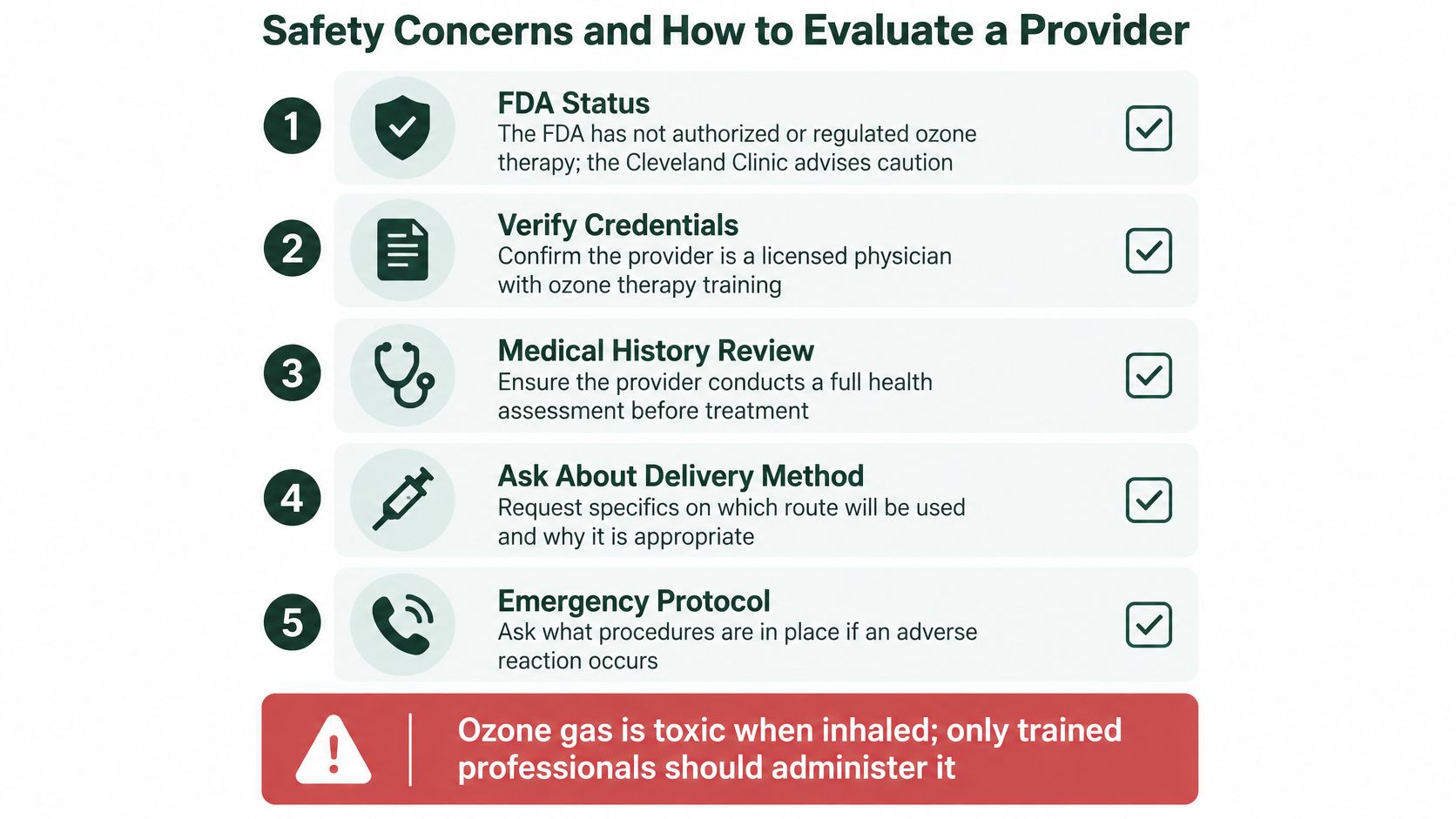
Safety is where incomplete evidence becomes practical. Cleveland Clinic notes that the FDA has not authorized or regulated ozone therapy and that evidence is insufficient to establish effectiveness or safety, as explained in Cleveland Clinic guidance on ozone therapy regulation and evidence. That statement doesn't mean every application has identical risk. It means you shouldn't rely on a general assurance that treatment is proven safe.
Recent synthesis has identified rare but severe risks, including gas embolism and bloodborne infection transmission, particularly in connection with systemic autohemotherapy. Rare doesn't mean imaginary, and absence of events in a small study doesn't prove a procedure is risk free. Incomplete adverse event reporting also limits how precisely anyone can estimate frequency.

Questions to ask before consent
- Exact intervention: Which route, concentration, session schedule, and equipment will be used, and why for your diagnosis?
- Evidence status: Is this use investigational, adjunctive, or supported by direct studies of the same condition and route?
- Personal risk review: Have pregnancy, cardiopulmonary disease, clotting problems, current medications, allergies, and infection risk been reviewed?
- Infection control: How are blood handling, sterile technique, single use components, and equipment maintenance managed when they apply?
- Emergency readiness: What monitoring is in place, who responds to a serious reaction, and how is urgent transfer handled?
- Stopping rules: Which symptoms, complications, costs, or lack of measured progress will trigger a change or stop treatment?
A small randomized study can report a mostly uneventful short term experience without settling general safety. In a 2025 randomized study of 62 patients receiving ozonated autohemotherapy for acute cerebral infarction, puncture site bruising occurred in 8 ozone group patients and resolved within a week. That's useful condition specific information. It can't clear every systemic use, patient group, or clinic protocol.
Provider quality shows up in how uncertainty is handled. A responsible clinician names alternatives, explains what outcome will be tracked, documents consent, and doesn't ask you to abandon urgent evidence based care. Vague promises about detox or total body reset, pressure to buy a long package before assessment, and refusal to specify route or emergency procedures are warning signs.
Inhalation deserves a final, unambiguous distinction. Controlled clinical applications are not a justification for breathing ozone from a generator or wellness device. If a provider treats that boundary casually, you've learned something important about their safety culture.
Weighing the Evidence and Making an Informed Decision
The balanced conclusion isn't that patient reports are worthless or that every ozone application is equally unsupported. It's that benefit, when present, appears specific, partial, and uncertain, while satisfaction and safety must be judged by route and setting. Positive findings shouldn't be generalized across indications or presented as proof of broad effectiveness.
Start with the outcome you'd consider worth the time, cost, and procedural burden. Then ask whether direct evidence exists for that outcome, how ozone compares with standard care, and how success or failure will be recognized. A broader evaluation through functional medicine can also help place any adjunct within diagnosis, lifestyle factors, medications, and conventional treatment rather than treating it as a standalone answer.
If you proceed, informed consent should cover uncertainty, alternatives, route specific risks, follow up, and stopping criteria. If the condition is urgent or progressive, ozone shouldn't delay care with stronger support. The most informed decision may be to try a narrowly defined adjunct, seek another opinion, or decline until better evidence exists.
If you're considering ozone as one part of an integrative plan, Restore Osteopathic Medicine in Aurora, Colorado offers physician led osteopathic, functional, regenerative, infusion, and ozone services with individualized evaluation and follow up. Visit Restore Osteopathic Medicine to discuss your diagnosis, alternatives, and whether a specific treatment route fits your goals before you commit.