
Your knee still hurts after physical therapy, anti-inflammatory medication, and perhaps an injection. You can walk around the house, but stairs or a longer outing bring the ache back. Now you're looking into ozone therapy and trying to work out whether it offers a useful next step or just another uncertain procedure.
That's a reasonable question. Ozone therapy for knee pain has some controlled clinical evidence, but the findings point mainly to possible short-term symptom relief, not a proven way to repair cartilage or stop osteoarthritis from progressing. Understanding that difference can help you decide what to ask a clinician before committing.
Table of Contents
- Why Patients Ask About Ozone for Knee Pain
- How Ozone Therapy Is Believed to Work in the Knee Joint
- What the Clinical Evidence Actually Shows
- How Ozone Compares to PRP Hyaluronic Acid and Corticosteroids
- What a Realistic Treatment Protocol Looks Like
- Does a Higher Ozone Dose Actually Work Better
- Making a Realistic Decision About Ozone Therapy
Why Patients Ask About Ozone for Knee Pain
Consider someone with knee osteoarthritis who has worked on strengthening, adjusted daily activities, and tried medication. Perhaps a corticosteroid injection helped for a while, or another injection didn't make enough difference. They're still looking for a way to move more comfortably, but they don't want a confident-sounding promise mistaken for proof.
Ozone enters the conversation because it's offered as a localized injection intended to address pain and inflammation. Supporters see it as a possible addition to an integrative care plan. Skeptics point to the limitations of the clinical research and question whether short-term changes translate into lasting benefit. Both reactions make more sense when you separate what patients hope the treatment will do from what studies have established.
The question behind the search
Often, the practical question isn't "Does it work?" It's "How much relief might I notice, how long could it last, and what happens if it doesn't?" Those questions matter because knee osteoarthritis is a chronic condition. A temporary improvement may be valuable if it helps someone take part in rehabilitation or manage everyday activities, but it's different from changing the disease itself.
That distinction also explains why ozone can attract enthusiasm and skepticism at the same time. A treatment may have a plausible rationale and encouraging results in some studies while still lacking strong evidence that it reliably outperforms established options or provides durable relief.
What the treatment refers to
In this discussion, ozone therapy means an intra-articular injection, where a medical-grade oxygen–ozone gas mixture is placed into the knee joint. It's not the same as inhaling ozone, and evidence about one delivery method shouldn't be taken as evidence for every other form of ozone treatment.
A useful starting point: Ask whether the proposed goal is temporary symptom management or a change to the underlying osteoarthritis. Current evidence supports discussing ozone as a possible adjunct for symptoms, not as established cartilage restoration.
A careful consultation should put the injection in context with your symptoms, examination, activity goals, and current care. The next step is understanding why researchers think ozone might affect pain, and where that explanation remains uncertain.
How Ozone Therapy Is Believed to Work in the Knee Joint
Ozone is a reactive form of oxygen. In a medical setting, it's generated from medical-grade oxygen and used in a controlled amount. The proposed explanation begins with a brief oxidative signal in local tissue, not with the idea that the gas supplies extra oxygen to the knee.
From a small stress signal to a possible response
The body constantly manages oxidative activity. In the proposed model, a carefully controlled oxidative stimulus may prompt protective responses, including activity in antioxidant systems and changes in inflammatory signaling. This is sometimes compared to exercise: a manageable challenge can trigger adaptation, although that analogy doesn't prove that an injection produces a useful or lasting clinical effect.
Researchers have also proposed that ozone may influence cytokines, which are signaling molecules involved in inflammation. These pathways offer a biological reason to study ozone for joint symptoms, but a plausible mechanism isn't the same as proof that a treatment reliably improves pain or function for a particular patient. Human studies still need to determine how these processes relate to meaningful outcomes.
The local setting matters, too. An injection into the knee is intended to act near the joint. It should not be confused with systemic ozone applications, which involve different delivery methods and risks. Ozone must not be inhaled because respiratory exposure is hazardous.
Why a mechanism doesn't settle the question
An anti-inflammatory effect, if present, may ease symptoms without rebuilding damaged cartilage. That's the key difference between symptom modulation and disease modification. The first concerns how you feel and function; the second would mean changing the course of the joint's degeneration.
If you're considering several ways to address pain or movement, it can help to understand how a whole-body movement approach differs from a joint injection. This overview of osteopathic manipulative treatment and movement describes a separate hands-on care approach, not evidence that ozone works.
The proposed biology gives researchers questions to test. It doesn't tell a patient how much benefit to expect, whether it will last, or whether ozone is a better choice than another injection. Those answers depend on the clinical evidence and its limitations.
What the Clinical Evidence Actually Shows
Say a patient has already tried a corticosteroid injection, finished a course of physical therapy, and still limps on stairs. The question they bring to an integrative clinic is simple: does the research show ozone helps, or does it only sound promising? The honest answer sits somewhere in between, and the details matter.
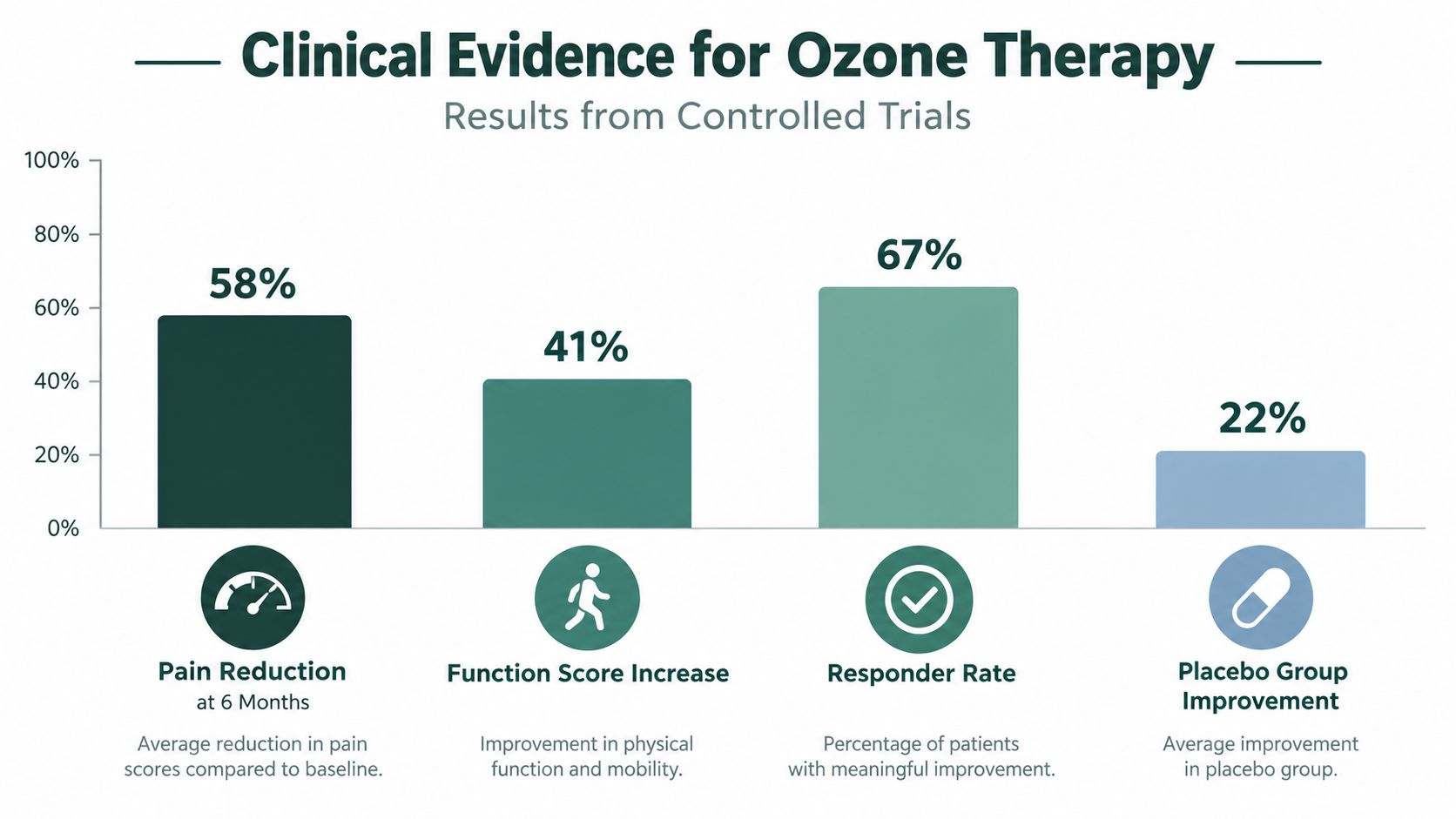
The evidence base has grown through controlled trials, but it remains thinner than what a dependable long-term treatment would require. A systematic review of studies published from 1998 through 2018 covered 11 trials and 858 patients, including 629 women and 229 men, with ozone compared against placebo, hyaluronic acid, platelet-rich plasma, corticosteroids, hypertonic dextrose, radiofrequency, and medication-based care (systematic review of intra-articular ozone trials). No major complications or serious adverse events were reported in the included studies, and pain and function improved over the short to medium term.
Two cautions temper that result. Many trials carried relevant risks of bias, and their methods differed enough that the pooled findings carry real uncertainty. Encouraging, yes. Conclusive, no.
What the time course suggests
A meta-analysis of randomized and controlled studies draws a more cautious picture. At one month, the pooled difference in visual-analog pain scores between ozone and comparator injections was -0.23 points, with P = 0.71, a gap that was not statistically significant. By three and six months, the pooled differences moved to 1.04 and 1.31 points in favor of the control treatments (meta-analysis comparing ozone with other injections).
WOMAC, the standard pain-and-function measure in osteoarthritis, traced the same arc. Ozone looked numerically better in the first month without reaching significance, and the later comparisons favored the control injections. Read plainly, the pooled results show an early effect that fades rather than durable superiority over other injections.
A separate randomized-trial meta-analysis did find a benefit over placebo or other noninvasive care, with the largest pain reduction around one month and a decline over the months that followed (randomized-trial meta-analysis of ozone for knee osteoarthritis). Patients sometimes find this confusing: how can one review favor ozone while another shows it losing ground? The analyses answer different questions. Beating no treatment or usual care is a lower bar than beating an active injection, and a therapy can clear the first bar without clearing the second.
That distinction frames ozone as a possible source of shorter-term relief rather than a demonstrated way to change the joint's course.
For people weighing broader joint-pain self-care alongside any injection decision, River of Life evidence-based recommendations offers another resource to raise with a clinician. Supplements and injections address different questions, and neither should replace an individualized osteoarthritis plan.
How Ozone Compares to PRP Hyaluronic Acid and Corticosteroids
There isn't one injection that's right for every knee or every treatment goal. The choice depends on what a patient and clinician are trying to address, what has already been tried, and how much uncertainty the patient is comfortable with. Ozone is best understood as an investigational or adjunctive option for possible short-term relief, not as a demonstrated route to cartilage repair.
| Injection Type | Primary Goal | Typical Onset | Typical Duration | Evidence Strength |
|---|---|---|---|---|
| Ozone | Possible short-term pain relief | Uncertain; early effects are reported | Benefit may fade over time | Limited and variable; consistent superiority hasn't been shown |
| PRP | Use a prepared concentration of a patient's platelets in an effort to support tissue response | Variable | Depends on the patient and protocol | Evidence and protocols vary |
| Hyaluronic acid | Symptom management and joint comfort | Variable | Variable | Studied as a comparator; ozone hasn't shown consistent superiority |
| Corticosteroid | Reduce inflammation and ease symptoms | Often sought for relatively quick relief | Generally considered short-term | Commonly used, but suitability depends on the patient and clinical plan |
| Prolotherapy | Stimulate a local tissue response | Variable | Variable | Protocols and supporting evidence vary |
How to read the comparison
The table describes broad treatment aims, not a guarantee of how any one person will respond. For ozone specifically, a meta-analysis comparing it with hyaluronic acid found no significant difference in pain reduction or functional improvement, with overall results favoring hyaluronic acid. That makes it especially important not to interpret a clinic's description of ozone as proof that it's more effective than a familiar injection.
PRP and prolotherapy are often discussed under the umbrella of regenerative injections, but their aims and protocols aren't interchangeable with ozone. If you're comparing these options, a guide to regenerative injection therapy can help clarify the categories to discuss with your clinician. Ask what evidence supports the specific procedure being proposed, what outcomes it targets, and how the plan fits with rehabilitation.
Corticosteroids, hyaluronic acid, PRP, and prolotherapy each come with their own uncertainties and patient-selection considerations. Rather than asking which injection wins in general, ask which option best matches your symptoms, goals, medical history, and willingness to accept temporary or uncertain benefit.
What a Realistic Treatment Protocol Looks Like
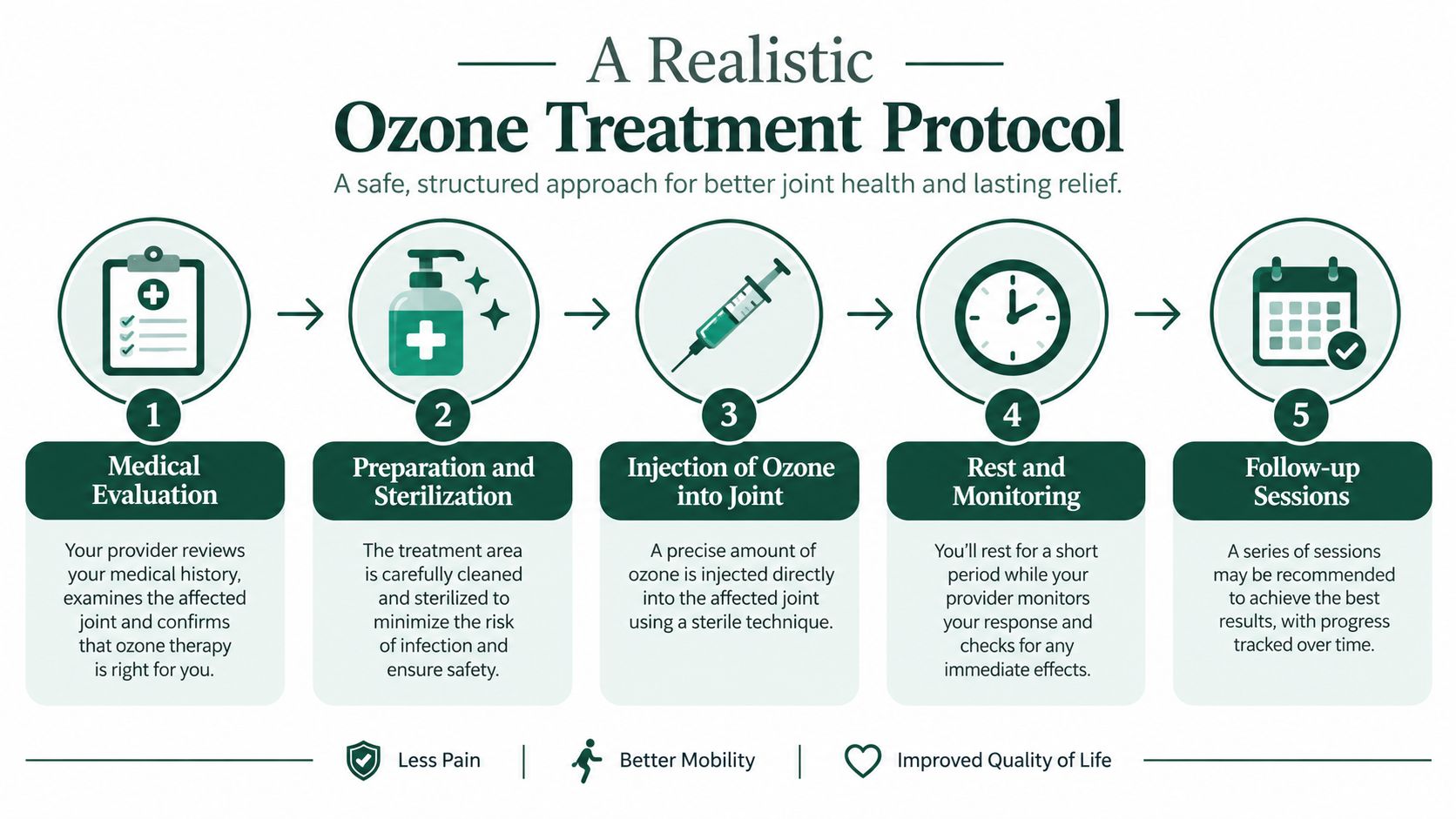
A responsible protocol starts with an assessment, not with a preset injection package. The clinician should review your symptoms, medical history, examination findings, and other possible causes of knee pain before deciding whether an intra-articular injection is appropriate.

What should be documented
Published protocols vary. An umbrella review of systematic reviews of randomized trials reported intra-articular volumes of approximately 5–20 mL and concentrations of 15–40 micrograms per milliliter (umbrella review of ozone protocols and safety). These are reported ranges, not a recommendation for an individual patient or evidence of one optimal dose.
A clinic should use a medical-grade oxygen–ozone generator, measure concentration accurately, follow sterile injection procedures, and confirm the intended anatomical target. The record should note the concentration, volume, delivery route, and interval. Without those details, it's difficult to compare protocols or interpret a patient's response.
Screening matters before any procedure. The clinician should consider inflammatory or infectious arthritis, significant effusion, bleeding risk or anticoagulant use, uncontrolled diabetes, and red flags such as fever, acute trauma, or rapidly increasing swelling. Tell the clinician about medications and relevant health conditions so they can judge whether an injection is appropriate.
After the injection
A patient may experience temporary discomfort after a joint injection. The clinician should explain what to expect, how to manage the immediate recovery period, and which symptoms warrant prompt medical attention. Ozone must not be injected intravenously or inhaled; respiratory exposure is hazardous, and evidence about knee injections cannot be generalized to other delivery methods.
There isn't one universally established session schedule. Ask the clinician to explain the proposed interval, why they chose it, and what finding would lead them to repeat, pause, or stop treatment. If activity support is part of the plan, practical aids such as sleeves or wraps for squats may be a separate topic to discuss, but they don't replace assessment or rehabilitation.
Does a Higher Ozone Dose Actually Work Better
It's tempting to assume that a higher concentration will produce a stronger result. The available dose-comparison evidence doesn't support that assumption. A double-blind randomized trial involving 59 patients with knee osteoarthritis compared intra-articular ozone at 20 and 40 micrograms per milliliter with an oxygen control. Both ozone groups improved on pain and functional measures, but there was no statistically significant difference between the two ozone concentrations (randomized trial comparing ozone concentrations).
That result doesn't prove that concentration never matters. It does mean that a clinic shouldn't present “higher dose” as automatically better based on this comparison. The dose is also more than a single number: the concentration, volume, route, and schedule together describe what treatment a patient is receiving.

Reassuring findings still have limits
Reviews have reported generally low rates of mostly minor adverse events, but protocols differ and long-term monitoring is limited. A lack of serious events in reviewed studies is reassuring for the treatments studied; it doesn't remove the risks of an injection or establish safety for every patient and delivery method.
Before proceeding, ask the clinician to state the exact concentration, volume, route, and treatment schedule, and to explain what evidence supports that protocol. Also ask what screening they perform, what symptoms should prompt urgent assessment, and what they'd do if your pain or function doesn't improve. A careful answer should make room for uncertainty rather than relying on dose-escalation claims.
Making a Realistic Decision About Ozone Therapy
Deciding whether to try ozone is less a yes-or-no question than a question about what role it can reasonably play. For a patient with symptomatic knee osteoarthritis who has already worked through conservative care, it may deserve a place in the conversation as an additional option. It has not been shown to reverse cartilage loss, so it should not crowd out strengthening, exercise, weight management where appropriate, or other guideline-based care.
Be honest with yourself about what you are hoping for. The evidence supports short-term symptom relief far more strongly than durable change in the joint itself, so a realistic goal looks like better pain and function over the coming months, not restored cartilage.
Decide how you will judge success before the first injection. A pain rating helps, and a validated score such as WOMAC captures stiffness and daily function that a single number misses. Follow-up around one to two months, and again at three to six months, lets you tell a short-lived response apart from one that holds. The randomized-trial meta-analysis cited earlier reports outcomes at these intervals, though those time points describe when researchers measured results rather than a prescribed monitoring schedule.
A practical decision rule: If there is little meaningful improvement at early follow-up, reassess the diagnosis, mechanical contributors, rehabilitation, and alternatives instead of assuming that repeating the injection is the answer.
Ask the clinician how they will measure improvement, what would lead them to change course, and how the proposed treatment fits your existing plan. If body weight is part of your broader osteoarthritis care, physician-guided weight management is one topic you can raise when building that plan. The aim is a strategy built around your health and function, with any injection serving that strategy rather than standing alone.
Restore Osteopathic Medicine offers physician-led integrative care, including ozone therapies used as adjunct support within personalized care plans. If you are weighing an injection for knee pain, visit Restore Osteopathic Medicine to discuss your goals, the proposed protocol, and how it may fit alongside your ongoing osteoarthritis care.