
Most pages sell ozone therapy as if it's a broad wellness upgrade. That's the wrong question. The right question is whether a specific patient, with a specific diagnosis, under a specific protocol, is likely to get a meaningful benefit without delaying better care.
Ozone is real, biologically active, and used in clinics. That still doesn't make it a universal solution. If you want an honest answer about ozone therapy benefits, start with eligibility and safety, then look at the evidence condition by condition.
Table of Contents
- Why Ozone Therapy Is Not the Universal Cure Some Pages Claim
- How Ozone Interacts with the Body at the Cellular Level
- Who Should Avoid Ozone Therapy and Why Eligibility Comes First
- The Best-Evidenced Ozone Therapy Benefits for Pain Conditions
- How Ozone Is Delivered and What Realistic Sessions Look Like
- Where the Evidence Is Thinnest in Wound Healing, Vascular Disease and Skin
- A Practical Framework for Deciding Whether Ozone Is Worth Trying
- Frequently Asked Questions About Ozone Therapy
Why Ozone Therapy Is Not the Universal Cure Some Pages Claim
Ozone therapy gets described like it's one intervention with one outcome. That's not how the evidence works. The picture is narrower, and more useful: ozone may have a role in selected settings, but the benefit depends on the indication, the route, the dose, the comparator, and the follow-up window.
The clearest way to think about it is this, ozone is a biologically active oxidant that can be used in medical contexts, but it is not a proven replacement for standard care. The U.S. Food and Drug Administration has classified ozone as a toxic gas and stated that it has no proven medical utility for specific, adjunctive, or preventive therapy, which is the right level of caution for patients to hear early (FDA safety concerns summarized here).
Practical rule: if a clinic presents ozone as a cure-all, the pitch is ahead of the evidence.
That doesn't mean nobody should ever consider it. It means the conversation should start with the problem you're trying to solve, not with a blanket promise. Pain, wounds, vascular issues, skin complaints, and infection-related claims do not all sit on the same evidence footing, and you should not expect them to.
A better approach is to ask a simple question before signing up: what condition is being treated, what outcome is being measured, and what standard treatment is still in place? If the answer is vague, the plan is vague too. And vague medicine usually costs patients time.
How Ozone Interacts with the Body at the Cellular Level
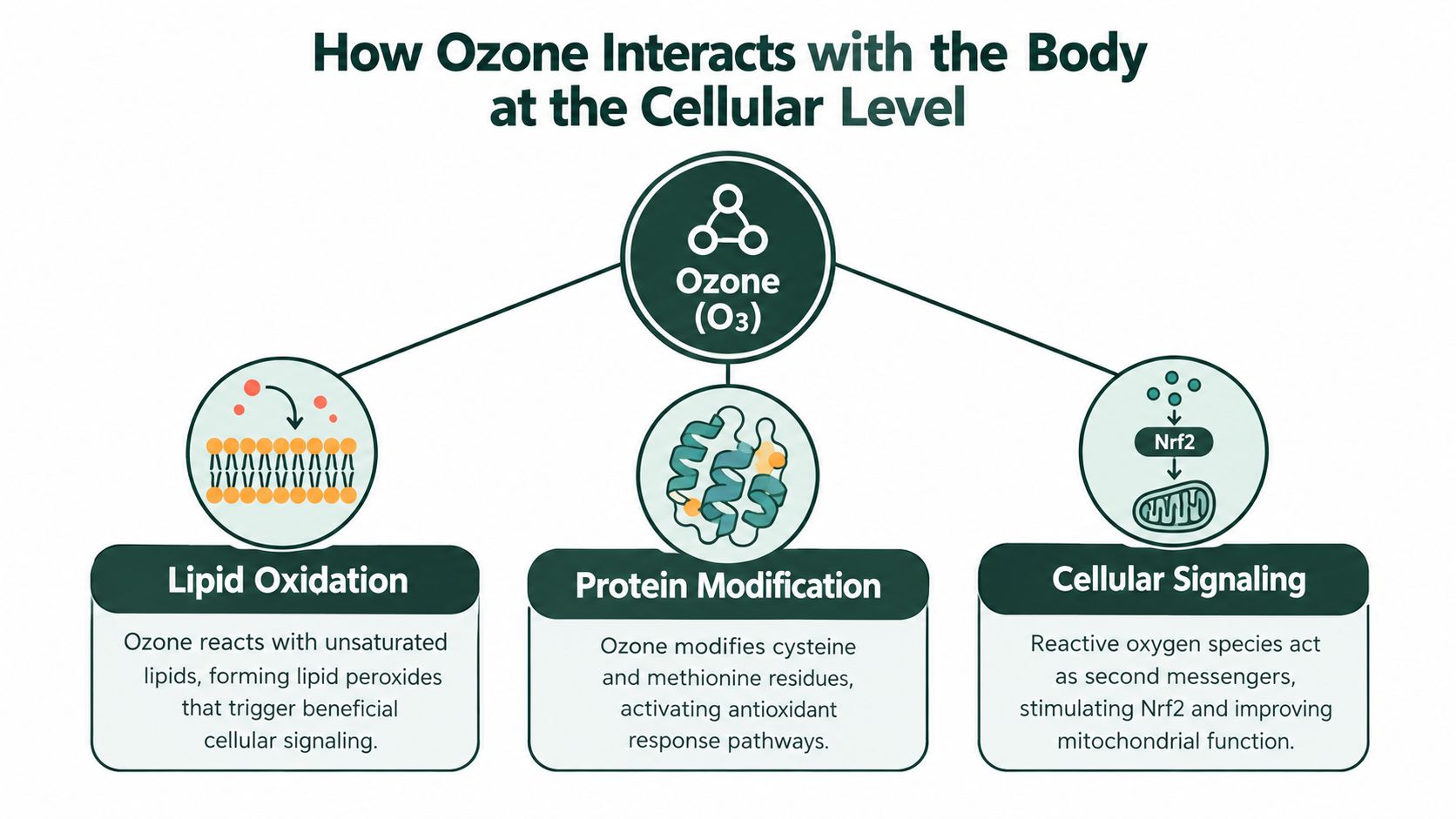
Ozone is a strong oxidizing agent. When it meets blood, tissue, or fluid interfaces, it reacts quickly with lipids and proteins and generates short-lived reactive oxygen species and lipid-oxidation products. Those signals can briefly influence redox-sensitive pathways, inflammatory mediators, microcirculation, and tissue repair, which is the biological rationale behind proposed ozone therapy benefits (mechanistic review).
Why that same chemistry can help and harm
The upside is transient signaling. The downside is that the same oxidative chemistry can damage cell membranes, proteins, and lipids when dose, route, or exposure is wrong. That's why mechanism alone is never enough to justify treatment. Plenty of substances do something biologically and still don't translate into predictable clinical benefit.
A responsible way to interpret ozone is to see it as a protocol-dependent signal, not a universal healer. Some clinicians use it to try to alter local inflammation or tissue environment. That's plausible. It's also why the details matter so much. A small change in technique can turn a theoretical benefit into an avoidable adverse event.
What the biology does and doesn't prove
The cellular model can explain why ozone is discussed in pain care, wound care, and circulation-oriented settings. It does not prove disease modification, tissue regeneration, or broad systemic wellness effects. If a claim jumps from “oxidative signaling is possible” to “therefore it treats everything,” the logic breaks.
Ozone's mechanism gives it a plausible role in selected protocols. It does not make it gentle by default, nor effective by default.
That is the balance patients should keep in mind. Biology can justify study. It cannot substitute for outcome data, safety monitoring, and honest limits.
Who Should Avoid Ozone Therapy and Why Eligibility Comes First
Before anyone talks about ozone therapy benefits, they should screen for patients who should not receive it. The main issue is oxidative stress. In G6PD deficiency, that stress can trigger hemolysis, so this is the clearest contraindication and the one that should stop treatment (contraindication review).
The groups that need caution or avoidance
Pregnancy should be avoided because safety data are too limited to justify routine use. Postpartum and breastfeeding patients also need direct counseling, since “natural” does not mean safe. Severe cardiovascular disease and heart failure deserve caution or avoidance because the risk-benefit balance can shift quickly, and uncontrolled hyperthyroidism raises the same concern.
Some patients carry higher practical risk because the route itself can irritate tissue or trigger technique-related complications. Mild local burning, headache, fatigue, dizziness, nausea, nerve injury, and tissue damage have all been described, and serious rare events have also been reported (safety synthesis).
A pre-treatment checklist worth using
- Pregnancy status: confirm whether the patient is pregnant, trying to conceive, or postpartum.
- Breastfeeding status: discuss safety uncertainty directly instead of assuming it is acceptable.
- G6PD history or testing: ask before any oxidant-based intervention.
- Heart and lung history: review cardiovascular disease, heart failure, and respiratory tolerance.
- Thyroid status: check for uncontrolled hyperthyroidism.
- Current medications and alternatives: document what is already being used so ozone does not crowd out better care.
If a clinic skips these questions, that is a bad sign. Eligibility comes first because it protects patients from optimism that ignores basic physiology. In integrative medicine, the honest answer is sometimes no.
The Best-Evidenced Ozone Therapy Benefits for Pain Conditions
Pain is the clearest place to judge ozone therapy, and even here the case is narrow. The better studies do not support selling it as a cure-all. A 2019 systematic review and meta-analysis of randomized trials found no statistically significant difference at 3 months, with 366 participants, RR 1.98, 95% CI 0.46–8.42, and p = 0.36 (pain meta-analysis).
The longer follow-up looked more favorable. At 6 months, the same analysis reported greater effectiveness than steroid or placebo comparators, with 717 participants, RR 2.20, 95% CI 1.87–2.60, and p < 0.00001. That split is the point. Ozone may help in selected pain settings, but the size and durability of benefit depend on the condition, the comparator, and how the protocol is used.
Treat the claim carefully. A short follow-up can miss a later effect. A later effect can still reflect patient selection, protocol differences, or the treatment being used alongside other care. The honest conclusion is limited but useful: ozone may have a role for some patients with pain, yet it should stay an adjunct, not a substitute for diagnosis, rehab, or standard treatment.
Knee osteoarthritis is the best-supported example. A review of 11 randomized controlled trials involving 858 patients found intra-articular ozone to be better than placebo and broadly similar to comparator injections, with no severe adverse reactions identified in the reviewed trials (knee osteoarthritis review). That is a reasonable signal, not proof of cartilage repair or disease reversal.
Keep the plan grounded. Ask whether the goal is pain relief, improved function, or both, then judge the result against that goal. For a clearer comparison point on how pain procedures should be framed, the guide to clinical laser therapy is useful because it shows the same standard patients should demand from any pain intervention.
Some osteopathic clinics, including Restore Osteopathic Medicine, describe ozone as part of adjunctive care. That is the right frame. Use it only when the rest of the pain plan remains intact, and stop if the response is not meaningful.
How Ozone Is Delivered and What Realistic Sessions Look Like
The route matters because it changes the goal and the risk. In practice, ozone may be given through major autohemotherapy, minor autohemotherapy, intra-articular or intramuscular injection, rectal insufflation, topical ozonated oils, or limb bagging. These are not interchangeable. Each route is chosen for a different local or systemic target.

A competent provider should tell you the route, the exact concentration, the sterility process, the device calibration, and the plan for measuring response. If those details stay vague, do not consent. Ozone only belongs in a protocol-driven plan, not in promotional language.
Published protocols vary, but chronic pain regimens are usually set up as a finite trial, not open-ended visits. The session itself should feel deliberate, not rushed. You should know what sensations are expected, what side effects are possible, and when the plan will be reviewed.
One short trial is reasonable. Endless treatment without outcome tracking is not.
Questions to ask before you agree
- What route are you using, and why that route for my diagnosis?
- What concentration will you use, and how is it measured?
- How will you know if it is helping me?
- What adverse effects should make me stop and call the clinic?
- What standard treatments stay in place during the trial?
That is the standard I would want for my own family. It keeps the conversation clinical instead of promotional, which is where it belongs.
Where the Evidence Is Thinnest in Wound Healing, Vascular Disease and Skin
Outside pain, ozone is promoted more confidently than the evidence supports. The honest reading is uneven. A 2022 dermatology systematic review included 17 studies and 643 patients. It found ozone promising for some short-term outcomes such as ulcers and scarring, but the evidence was not enough to establish an evidence level for acne, dermatitis, psoriasis, herpes, systemic sclerosis, or skin aging (dermatology review).
Where claims outrun the data
Recent evidence syntheses describe possible modest benefits for chronic radicular low-back pain, diabetic wounds, and peripheral arterial disease, but certainty is often low or very low because studies are small, methods differ, and safety monitoring is limited (pain and vascular synthesis, broader synthesis). Clinicians should keep that limitation front and center in wound and circulation care.
For diabetic-foot-ulcer healing, one synthesis found ozone was not superior. The same broader evidence review also found no improvement in key COVID-19 outcomes, and the signal in periodontal disease remained inconsistent (broader synthesis). Those findings argue against treating ozone as a default answer for complex disease.
For patients weighing wound support alongside regenerative options, a practical hydrogel dressing guide from DME Superstore is more relevant to day-to-day care decisions than a vague promise of regeneration. For adjacent procedural options, regenerative injection therapy such as PRP or prolotherapy is worth discussing with a physician, but it should be evaluated on its own merits.
Safety keeps the ceiling low
Safety reporting is inconsistent, and long-term safety data are lacking. Rare serious events, including hemolysis, thrombosis, stroke, myocardial infarction, and a fatal gas embolism after ozonated autohemotherapy, have been reported in safety reviews and case literature. That does not mean these events are typical. It does mean the risk discussion has to be explicit and sober.
If a clinic presents ozone as a fix for wounds, circulation, skin, or infection, slow the conversation down. In these settings, the evidence is still investigative, not settled.
A Practical Framework for Deciding Whether Ozone Is Worth Trying
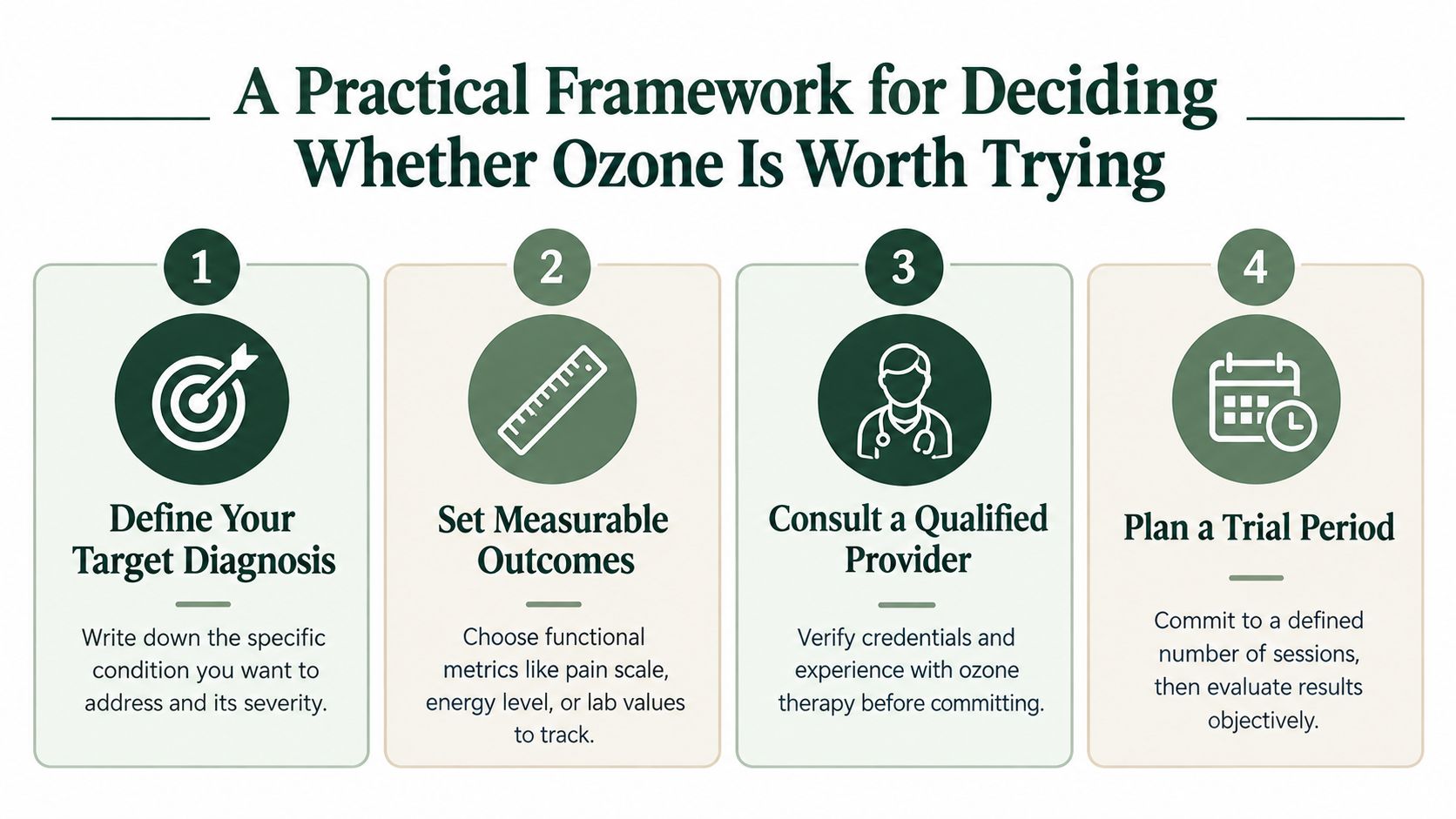
The decision should not begin with, “Do I want ozone?” It should begin with, “What am I trying to change?” If you can't define the target clearly, you can't know whether the treatment helped. That's why a measured trial beats a hopeful leap every time.
Set the target before the first session
Choose one diagnosis and one measurable outcome. For pain, that might be a pain score, walking tolerance, or a validated disability scale. For wound care, it might be visible progress in healing. For vascular complaints, it should be a functional marker, not just a feeling.
Document the exact route, concentration, and schedule. If you can't compare visit one with visit five, the treatment is hard to judge. A responsible clinician will welcome that structure because it protects both sides.
Reassess like a clinician, not a fan
After a defined trial period, decide whether the change is meaningful enough to continue. If the answer is unclear, stop and reassess the diagnosis instead of extending treatment indefinitely. Bruising, fatigue, headache, dizziness, nerve symptoms, or tissue irritation should be taken seriously, not waved away.
Bottom line: ozone belongs in an integrative plan only when it has a clear target, a clear monitoring plan, and a clear stop point.
If you want a broader organizing model for whole-person care, practical 2026 wellness tips can be helpful as a general framework, but they still need to be filtered through medical reality. Ozone never gets a pass on that.
Frequently Asked Questions About Ozone Therapy
Can ozone fit inside a larger osteopathic or functional medicine plan? Yes, as adjunct support only. It belongs alongside diagnosis, manual care, rehabilitation, nutrition, and any standard medical treatment you still need. If a clinic presents ozone as the main answer, that is the wrong framing.
How often should a responsible provider reassess? After a short trial with a defined outcome, not after months of vague follow-up. The provider should know what counts as meaningful change and when to stop if the response is weak.
What does a normal visit feel like in a Denver–Aurora clinic? Structured. You should get screening, a route-specific explanation, informed consent, and a clear plan for what happens after the session.
What if I've already started treatment elsewhere and want a second opinion? Bring the route, dose, frequency, and any side effects you've noticed. You can review those details through the clinic's patient questions and visit logistics and compare them with your diagnosis and goals.
Restore Osteopathic Medicine offers osteopathic and integrative care in Aurora, with ozone therapies used as adjunct support, not stand-alone cures. If you are weighing whether ozone fits your situation, the right next step is a careful evaluation that matches your diagnosis, goals, and safety profile. Visit Restore Osteopathic Medicine to discuss options with a physician-led team that respects both the promise and the limits of ozone therapy.