
You may be searching for weight loss peptides after months of doing “the right things” and still feeling that your appetite, blood sugar, or body composition won't cooperate. At the same time, you may be thinking about another pregnancy, recovering after delivery, breastfeeding, entering perimenopause, or managing symptoms that make weight the least simple part of the conversation. The medication question is important, but it's only one part of a safe women's-health plan.
Table of Contents
- Why Women Ask About Weight Loss Peptides
- How Weight Loss Peptides Work in Clinical Practice
- Semaglutide and Tirzepatide Evidence for Women
- Reproductive Planning and Peptide Safety
- Menopause, Hormone Therapy, and Peptide Outcomes
- Common Misconceptions About Peptide Weight Loss
- How to Evaluate Whether Peptide Therapy Is Right for You
Why Women Ask About Weight Loss Peptides
A patient may arrive at a women's health visit with a notebook full of questions: Can I use a peptide while breastfeeding? How long before trying to conceive should I stop? Will treatment work differently after menopause? Is the product offered online the same as a prescription medicine?
Those questions reflect a gap in much of the consumer conversation. Weight-loss content often presents peptides as universal appetite tools, while women frequently need decisions that account for fertility intentions, contraception, lactation, recovery, hormones, bone health, and muscle preservation. A treatment that might be reasonable in one life stage can be inappropriate in another.

The question behind the question
Consider a woman with persistent obesity who is also planning a pregnancy. Her decision isn't just whether appetite regulation could help. She needs to discuss when treatment would stop, what washout period applies, what contraception is appropriate during therapy, and how care will change if pregnancy occurs.
A postpartum patient has a different set of priorities. Breastfeeding, nutritional requirements, return of fertility, sleep deprivation, medication use, and recovery can all affect whether treatment should begin or wait. The FDA-approved Wegovy label states that semaglutide may cause fetal harm, that weight loss provides no benefit during pregnancy and may cause fetal harm, and that treatment should be discontinued when pregnancy is recognized (FDA-approved Wegovy safety information).
Clinical perspective: A peptide decision should begin with life stage and medical context, not with the promise of a particular result.
Women also don't form one uniform treatment population. U.S. estimates cited by the National Institute of Diabetes and Digestive and Kidney Diseases report obesity prevalence of 39.8% among non-Hispanic White women, 56.9% among non-Hispanic Black women, 17.2% among non-Hispanic Asian women, and 43.7% among Hispanic women (NIDDK obesity statistics). Those differences reinforce why a generic message about weight loss peptides for women can miss the social, medical, and reproductive realities shaping care.
How Weight Loss Peptides Work in Clinical Practice
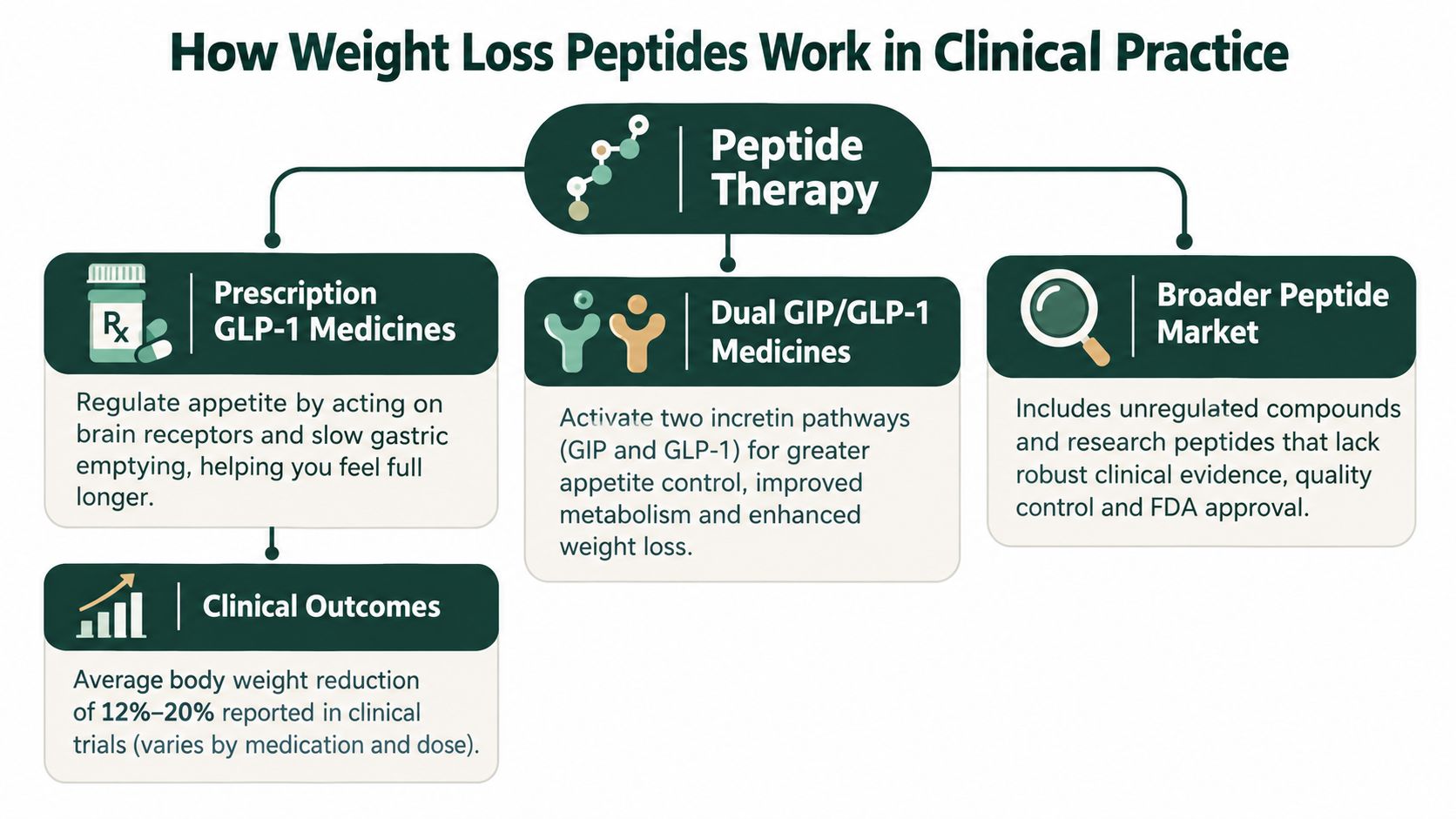
The word “peptide” covers more than one clinical category. In evidence-based weight management, the strongest foundation comes from prescription incretin medicines, including GLP-1 receptor agonists and dual GIP/GLP-1 receptor agonists. That category should be separated from research compounds and products sold without the same level of regulatory review or randomized-trial evidence.
What prescription pathways do
GLP-1 medicines act on a hormonal pathway involved in appetite and glucose regulation. In practical terms, they can help a patient feel satisfied with less food and may slow gastric emptying. That doesn't mean they “melt fat” independently of behavior. They change the physiological environment in which eating, hunger, and glycemic control occur.
Dual GIP/GLP-1 medicines work through two incretin pathways. Tirzepatide's combined activity can support appetite regulation, glycemic control, and insulin sensitivity, while dose escalation requires attention to gastrointestinal tolerance and hydration. Clinical use still depends on medical screening, gradual titration, medication review, and follow-up.
What the broader peptide market doesn't establish
Online sellers may use the same word, peptide, for compounds that lack comparable clinical evidence, standardized manufacturing, or clear dosing reliability. A product described as “research use” isn't interchangeable with a prescription medicine studied in a large randomized trial. Marketing language about fat burning, muscle preservation, or hormone optimization shouldn't substitute for evidence about safety and outcomes.
Patients also need practical storage information once a clinician has prescribed a legitimate product. A reconstituted peptide storage guide can help explain handling principles, but it can't replace the dispensing pharmacy's instructions or a clinician's advice for a specific medication.
The most useful clinical model is therefore simple: the medicine addresses selected biological pathways, while the care plan addresses the person. Nutrition, resistance training, sleep, mental health, reproductive planning, and monitoring remain part of treatment rather than optional extras. Patients interested in a medically supervised approach can review peptide therapy services as one example of how a clinic may integrate medication with broader evaluation.
Semaglutide and Tirzepatide Evidence for Women
The major trials provide a useful anchor, but they don't provide a personal guarantee. Trial participants met defined eligibility criteria, followed a structured dosing schedule, received lifestyle intervention, and were monitored under controlled conditions. A patient's response can differ because of health history, tolerability, adherence, concurrent medications, nutrition, activity, and treatment duration.
The STEP 1 trial randomized 1,961 adults with obesity or overweight plus a weight-related condition to once-weekly semaglutide 2.4 mg or placebo for 68 weeks, alongside lifestyle intervention. Mean body-weight reduction was 14.9% with semaglutide versus 2.4% with placebo, a difference of 12.5 percentage points (STEP 1 trial summary). At least 5% weight loss occurred in 86.4% of semaglutide participants and 31.5% of placebo participants.
What the women-specific analysis adds
Female participants in the STEP 1 post-hoc analysis lost an average of 18.4% of baseline weight with semaglutide versus 2.1% with placebo, while male participants lost 12.9% versus 3.5%, respectively (sex-specific STEP 1 findings). These are averages, not promises. They show that women can respond substantially, but they don't predict an individual patient's result.
Tirzepatide produced dose-dependent results in SURMOUNT-1 over 72 weeks. Mean weight reduction was 15.0% with 5 mg, 19.5% with 10 mg, and 20.9% with 15 mg, compared with 3.1% with placebo (SURMOUNT-1 trial summary).
| Medicine | Dose | Mean weight loss | At least 5% loss |
|---|---|---|---|
| Semaglutide | 2.4 mg | 14.9% | 86.4% |
| Tirzepatide | 5 mg | 15.0% | 85.1% |
| Tirzepatide | 10 mg | 19.5% | 88.9% |
| Tirzepatide | 15 mg | 20.9% | 90.9% |
Tirzepatide's higher trial results don't automatically make it the right choice. More dose intensity can bring more gastrointestinal burden, and the practical choice may depend on glycemic needs, prior treatment, side effects, pregnancy plans, access, and the quality of follow-up. A useful evidence-based peptide review can provide additional background, but a prescribing decision still belongs in an individualized clinical assessment.
Reproductive Planning and Peptide Safety
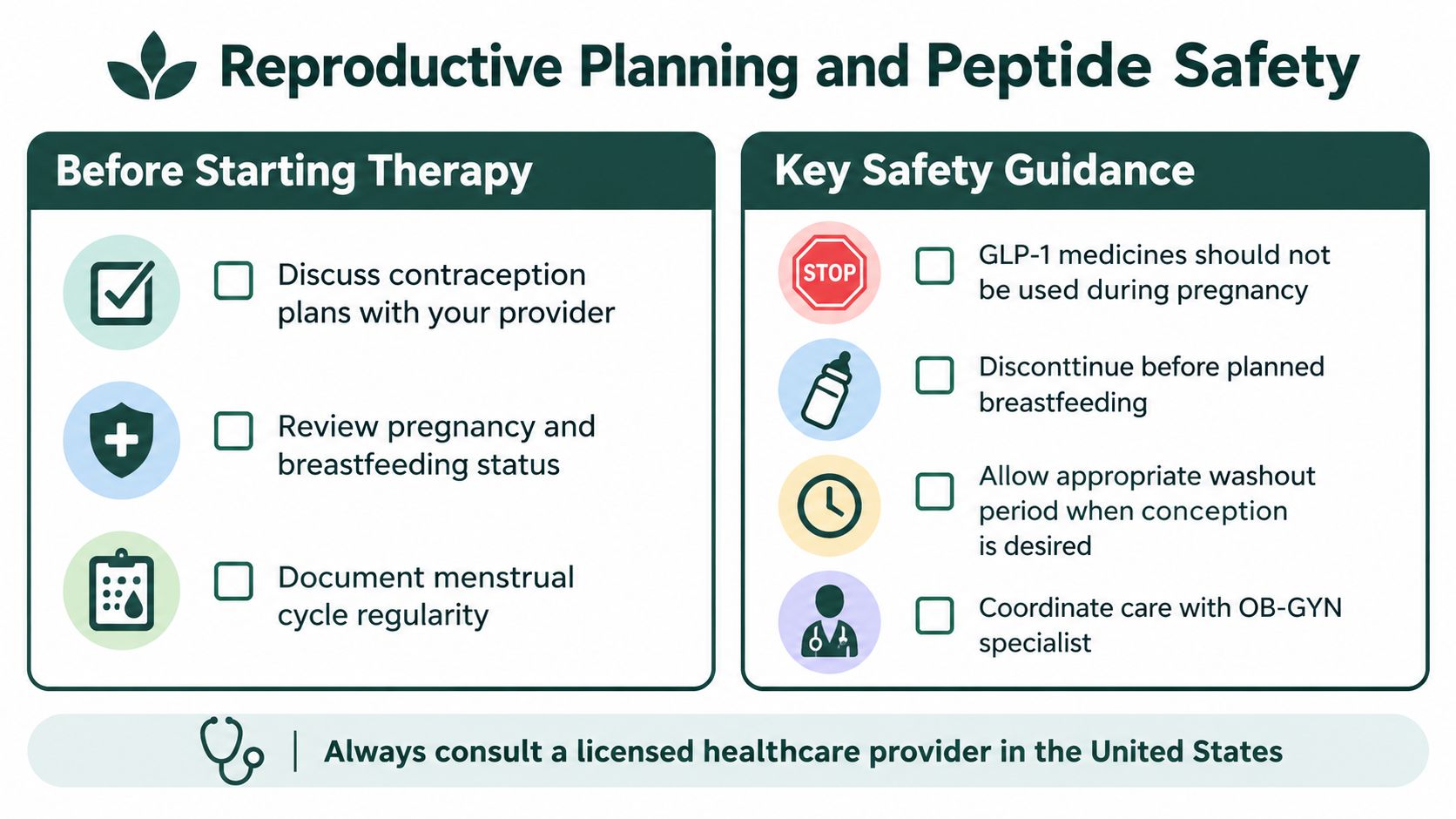
Reproductive planning belongs in the first visit, not after treatment begins. A clinician should ask whether pregnancy is possible, desired, or being actively planned, and should document breastfeeding status and contraception goals. These questions aren't administrative. They determine whether therapy is appropriate and how long it should continue.
Before starting treatment
A practical conversation should include:
- Pregnancy status: Confirm whether the patient is pregnant or could be pregnant before therapy begins.
- Contraception plans: Review the current method, future fertility intentions, and whether treatment changes could affect contraceptive reliability.
- Breastfeeding: Discuss whether the patient is lactating and whether treatment should wait.
- Medication interactions: Tirzepatide can reduce exposure to oral hormonal contraceptives during dose escalation because delayed gastric emptying may affect absorption. Clinicians commonly recommend a nonoral method or added barrier contraception during escalation and for the label-specified interval.
- Care coordination: Include an obstetrician-gynecologist or other appropriate reproductive-health clinician when pregnancy is being considered.
The FDA-approved Wegovy label reports that available human pregnancy data are insufficient to establish the risk of major birth defects or miscarriage, while also warning about potential fetal harm (Wegovy pregnancy safety information). That combination matters. “Insufficient human data” doesn't mean “known to be safe.”
Conception, accidental exposure, and breastfeeding
UK regulatory guidance issued in June 2025 advises effective contraception during treatment, notes that some medicines require up to two months between stopping treatment and attempting pregnancy, and states that these medicines shouldn't be used during breastfeeding (UK reproductive-safety guidance). Washout timing differs by medication, so patients shouldn't rely on a general internet rule.
If pregnancy occurs while using a peptide, the appropriate response is to stop and contact the prescribing clinician and prenatal-care team promptly. That situation requires coordinated review, not panic or self-directed substitution. For postpartum women, the plan should account for lactation, nutritional intake, recovery, medications, contraception, and the possibility that fertility may return before weight goals feel complete.
Menopause, Hormone Therapy, and Peptide Outcomes
Menopause changes the clinical conversation because body composition, sleep, appetite, insulin sensitivity, cardiovascular risk, and symptoms can shift together. Weight is one health marker, but it shouldn't become the sole measure of a woman's health or the only reason to prescribe hormone therapy.
Established trial evidence indicates that tirzepatide can produce substantial weight reduction across reproductive stages. A post-hoc analysis of 2,542 women from three tirzepatide trials found approximately 20% weight reduction regardless of whether participants were premenopausal, perimenopausal, or postmenopausal (menopause-stage tirzepatide analysis). That finding supports individualized treatment rather than the assumption that menopause makes peptide therapy ineffective.
What hormone therapy evidence can and cannot say
A 2025 report involving 120 postmenopausal women receiving tirzepatide found approximately 17% weight loss among hormone-therapy users versus 14% among nonusers after a median 18 months. Forty-five percent of hormone-therapy users reached at least 20% weight loss compared with 18% of nonusers (reported hormone-therapy findings). The investigators emphasized that larger studies are needed, and later coverage characterized the findings as an association rather than proof of causation.
Hormone therapy may be appropriate for menopausal indications. It shouldn't be presented as a weight-loss treatment or added solely to improve a peptide result.
That distinction protects patients from a common overinterpretation. Menopause care should also address resistance training, protein intake, muscle function, bone health, sleep, symptoms, and cardiovascular risk. A clinic offering bio-identical hormone optimization should still evaluate whether hormone treatment has a recognized indication for that individual, rather than using weight response as the deciding criterion.
Common Misconceptions About Peptide Weight Loss
The first misconception is that a peptide replaces lifestyle care. It doesn't. Appetite regulation may make nutrition changes more achievable, but muscle preservation still requires adequate protein and resistance training, and gastrointestinal side effects can make hydration and food quality more difficult.
The second is that a compounded or online product is automatically equivalent to a prescription medicine. It isn't. The evidence described in major trials concerns prescription semaglutide or tirzepatide studied under defined conditions, not every compounded, relabeled, or commercially marketed peptide product.
Claims that deserve a closer look
- “The trial average is my expected result.” Trial averages help establish efficacy, but individual outcomes vary. A clinician should discuss response, tolerability, and whether the plan needs modification.
- “Faster loss is always better.” Rapid changes can create practical problems with nausea, constipation, hydration, protein intake, and strength. The appropriate pace depends on the patient's response and medical context.
- “More medication means better care.” Dose escalation should follow a structured plan. Increasing intensity despite persistent gastrointestinal symptoms can undermine nutrition and adherence.
- “Menopause means peptides won't work.” Women in different reproductive stages can respond, but treatment still needs to account for muscle, bone, symptoms, and cardiovascular health.
- “Hormone therapy improves weight loss, so I should start it.” Exploratory findings show association, not causation. Hormone therapy decisions should rest on menopausal indications and individual risk assessment.
A responsible program measures more than the scale. It monitors symptoms, gastrointestinal tolerance, hydration, nutrition, strength, relevant metabolic markers, and reproductive status. Marketing rewards certainty. Clinical care has to respect uncertainty.
How to Evaluate Whether Peptide Therapy Is Right for You
A thorough evaluation should answer practical questions before a prescription is considered:
- What is the treatment goal? Address obesity or a weight-related metabolic concern, rather than pursuing an arbitrary number.
- What is your reproductive plan? Include pregnancy possibility, contraception, breastfeeding, and timing for conception.
- What else affects safety? Review medical history, medications, gastrointestinal symptoms, nutrition, sleep, mental health, and cardiovascular risk.
- What will follow-up measure? Establish how the clinician will assess response, side effects, hydration, protein intake, strength, and dose tolerance.
- What happens if circumstances change? Agree on what to do if pregnancy occurs, breastfeeding begins, side effects persist, or treatment must be paused.
Peptide therapy can be useful, but it works best as one component of individualized metabolic care. Restore Osteopathic Medicine describes integrative weight-loss care that places medication options alongside nutrition, lifestyle, and whole-person evaluation. Whatever practice you choose, seek a clinician who will explain the evidence, distinguish approved treatment from unproven products, and coordinate reproductive or menopausal care when needed.
Restore Osteopathic Medicine provides physician-led evaluation for weight management and peptide therapy, with attention to pregnancy, postpartum recovery, and later-life metabolic concerns. Visit Restore Osteopathic Medicine to discuss whether a personalized, medically supervised plan fits your health goals and reproductive stage.